
Startup Funding Options 2026: The Insider’s Guide to Private Market Momentum
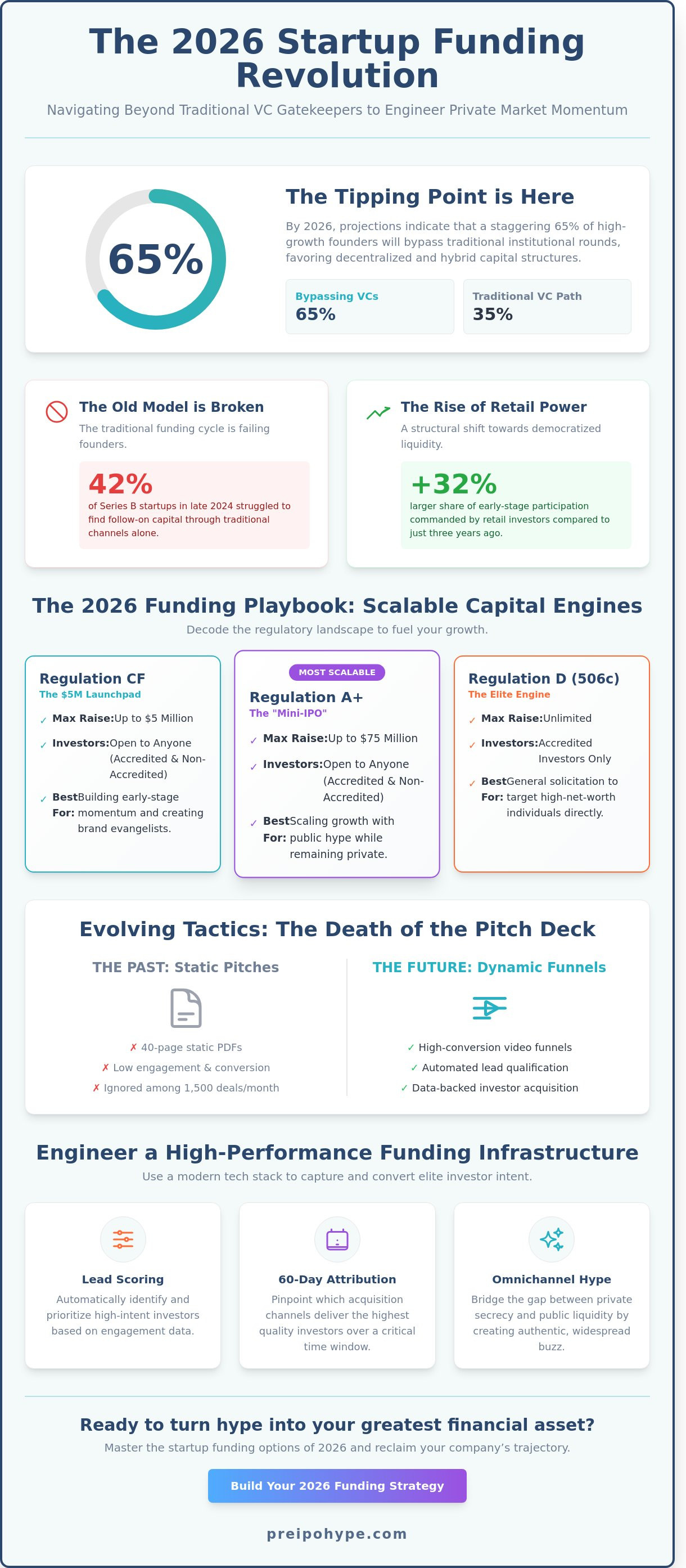
What if the venture capital gatekeepers you’ve been courting are actually the ones throttling your valuation? By the start of 2026, projections indicate that 65% of high-growth founders will bypass traditional institutional rounds to favor decentralized capital structures. You already know the old model is broken. You’ve felt the friction of a fragmented investor landscape and seen the predatory term sheets that prioritize liquidation preferences over your vision. It’s a cycle that left 42% of Series B startups in late 2024 struggling to find follow-on capital through traditional channels alone.
We’re here to change that narrative. This guide reveals the most viable startup funding options 2026 offers, moving beyond the velvet rope to help you engineer genuine private market momentum. You’ll discover how to build a diversified cap table and implement a predictable investor acquisition system that creates secondary liquidity long before an IPO. We are breaking down the technical infrastructure required to manage a large-scale raise and reclaim your company’s trajectory from the hands of the elite few. It is time to turn the hype cycle into your greatest financial asset.
Key Takeaways
- Pivot from traditional VC dependency to a hybrid model that harnesses the new institutional power of retail investors.
- Decode the 2026 regulatory playbook to determine whether Reg CF or Reg A+ offers the most scalable capital engine for your growth stage.
- Audit the most viable startup funding options 2026 has to offer by comparing equity costs against the speed and scalability of private market vehicles.
- Build a high-performance funding infrastructure using lead scoring and 60-day attribution to capture and convert elite investor intent.
- Master the "Omnichannel" approach to investor acquisition, creating the necessary hype to bridge the gap between private secrecy and public liquidity.
Navigating the 2026 Startup Funding Landscape: Beyond Traditional VC Gatekeepers
The era of the venture capital gatekeeper has officially closed. By the start of 2026, the landscape for a startup company has evolved into a high-velocity hybrid ecosystem. Traditional institutional money now competes with a decentralized wave of retail capital that moves with the speed of a viral trend. Founders no longer wait for a single "yes" from a Sand Hill Road partner. They build momentum through diversified startup funding options 2026 that leverage both private placements and public-facing hype. This is the new architecture of the private market, where exclusivity meets accessibility.
Democratization isn't a buzzword anymore; it's a structural shift in how liquidity moves. Retail investors command a 32% larger share of early-stage participation than they did just three years ago. This influx of capital has transformed the Hype Cycle into a legitimate financial indicator. Momentum is now a measurable asset that sophisticated investors track with the same rigor as EBITDA. If you can't quantify the buzz around your brand, you aren't ready for the 2026 market.
To better understand how the capital raise landscape has shifted, watch this breakdown of modern funding strategies:
The Death of the Traditional Pitch Deck
Sophisticated 2026 investors have zero patience for 40-page static PDFs. These relics are being replaced by high-conversion video funnels that qualify leads before a human ever enters the room. Successful founders are ditching the "pitch" for story-driven frameworks that scale across digital platforms. It's about data-backed acquisition. If your narrative doesn't trigger an immediate emotional and analytical response, you'll be buried by the 1,500 other deals hitting an investor's feed every month.
Private Markets as the Final Frontier
The real wealth is staying behind closed doors. Late-stage growth companies are remaining private 4.5 years longer than the 2010 average, creating a massive demand for secondary liquidity. Accessing these "insider" circles requires positioning your startup as a high-velocity vehicle for growth. You don't just want capital; you want the elite status that comes with being a private market unicorn. Master the startup funding options 2026 by creating a sense of scarcity. When the ground floor is crowded, the only way to stand out is to become the signal in the noise. This is where the informed insider thrives, bridging the gap between private secrecy and public opportunity.
The Rise of Equity Crowdfunding: Reg CF and Reg A+ as Scalable Capital Engines
The 2026 capital markets operate on a different frequency than the closed-door eras of the past. Founders are no longer begging for a seat at the venture capital table; they are building their own tables through democratized SEC regulations. These startup funding options 2026 have shifted from niche experiments to the primary engine for high-growth ventures. By leveraging Regulation Crowdfunding (Reg CF) and Regulation A+, companies are turning their cap tables into strategic weapons.
The real power lies in the 506(c) offering. Unlike traditional private placements, 506(c) allows for general solicitation. This means you can publicly broadcast your raise to accredited investors across social media and digital channels. It’s the final frontier of elite fundraising, allowing you to reach the top 1 percent of wealth holders without the friction of a middleman. This transparency creates a competitive environment where investors compete to join your round, rather than you competing for their attention.
Reg CF: The $5M Launchpad
Regulation Crowdfunding has evolved into a $5 million powerhouse for early-stage momentum. Success in 2026 requires more than a pitch deck; it demands a rigorous technical setup involving Form C filings and tiered financial reviews. Most founders fail here because they treat Reg CF like a "GoFundMe" for charity. It is a regulated securities offering. To cut through the noise, you must deploy sophisticated Reg CF marketing services that engineer a sense of scarcity and momentum. If you don't treat your launch like a blockbuster movie premiere, your offering will get lost in the digital noise.
Reg A+: The Mini-IPO for Mid-Stage Scale
Reg A+ serves as the bridge for companies ready to raise up to $75 million from both accredited and non-accredited individuals. It functions as a "mini-IPO," providing a path to secondary liquidity without the soul-crushing costs of a full Nasdaq listing. While many founders start by exploring SBA funding programs for foundational debt, Reg A+ is where equity scaling truly happens. The "Testing the Waters" provision is your greatest asset; it allows you to gauge investor appetite before spending a dollar on legal audits. This data-driven approach ensures you only pull the trigger when the hype is guaranteed.
Managing a crowd of 10,000+ brand ambassadors creates a permanent marketing moat. These aren't just investors; they are customers who own a piece of the mission. They will defend your brand on social media, buy every product launch, and evangelize your vision to the masses. If you're ready to see how these startup funding options 2026 fit your specific roadmap, you can connect with our team to discuss your trajectory.
Comparing Funding Vehicles: Grants, Venture Capital, and Private Equity Crowdfunding
Choosing the right fuel for your growth engine isn't just about the check size. By 2026, the landscape of startup funding options 2026 has fractured into distinct lanes, each with its own speed limit and tax on your future equity. Understanding the trade-offs between speed, cost, and control is the difference between a clean exit and a cap table catastrophe.
- Grants: Slow speed to receive. Zero equity cost. Very low scalability due to rigid use-of-funds rules.
- Venture Capital: Medium speed. High equity cost. Infinite scalability for the top 1% of performers.
- Equity Crowdfunding: High speed. Low to medium equity cost. High scalability through massive community leverage.
Founders often chase federal grants thinking they've found "free money." It's a mirage. Data from 2025 grant cycles indicates that the average SBIR or STTR application requires 180 to 220 hours of administrative labor. Between strict reporting requirements and the inability to pivot your product without government oversight, the hidden cost of "free" capital is your company's agility. In a market that moves at the speed of AI, waiting nine months for a government check can be a death sentence.
Venture Capital has evolved into a specialized surgical tool rather than a default choice. If your business doesn't fit the 100x return profile, taking VC money is a trap. The most sophisticated founders are now leaning into the "Hybrid Raise." They secure a lead VC to anchor the round with institutional credibility, then use investor acquisition platforms to fill the remaining 40% of the round with high-volume retail and accredited investors. This creates a groundswell of brand advocates that a single board member simply cannot provide.
Federal Grants vs. Market-Driven Capital
Use SBA or EDA grants as non-dilutive padding, not the foundation. Grants don't validate your market; they validate your ability to follow bureaucratic rules. Private capital is the only true signal of product-market fit. Chasing grants for more than 20% of your total capital stack risks distracting your engineering team from what the customer actually wants. Market-driven capital forces you to stay lean and responsive.
The VC Term Sheet vs. The Crowdfunding Cap Table
VC deals in 2026 often come with 1.5x or 2x liquidation preferences and aggressive board control clauses. You're trading autonomy for a seat at the elite table. Conversely, managing a large cap table of 1,000+ crowdfunding investors used to be a nightmare. Modern software and Special Purpose Vehicles (SPVs) have solved this. You retain more control, keep your board seats, and leverage a thousand mini-marketers instead of one demanding partner who might fire you from your own company.
Engineering the Raise: The Tech Stack and Infrastructure Required for 2026 Funding
By 2026, the era of "spray and pray" advertising is dead. Elite raises are won in the foundation layer, not the advertising layer. If your technical plumbing is weak, your capital raise will leak. Successful startup funding options 2026 rely on 60 day attribution models that track investor intent with surgical precision. You don't just want traffic; you want a data stream that identifies exactly when a "curious clicker" becomes a high-intent lead.
Lead scoring is the engine of this transformation. In the private markets, 82% of investors require at least seven touchpoints before committing capital. An omnichannel outreach system ensures you stay top of mind. By unifying SMS, email, and retargeting into a single ecosystem, you create a surround-sound effect. When an investor sees your brand on LinkedIn, receives a personalized SMS update, and then finds a deep-dive report in their inbox, the perception of momentum becomes reality. This is how you convert interest into committed capital.
The Custom Investor CRM: Your Most Valuable Asset
Generic CRMs fail because they treat investors like retail customers. To win, you must move toward a custom investor CRM designed for the unique cadence of private placements. This system tracks the journey from the first pixel fire to the signed subscription agreement. It allows you to automate repetitive follow-ups without losing the high-stakes personal touch required for six-figure checks. Precision tracking ensures no lead goes cold during the critical 48 hour window after they download your deck.
Foundation Infrastructure: The Technical Bedrock
Technical debt is the silent killer of momentum. Industry data shows that 38% of equity crowdfunding campaigns fail to reach their minimum target due to broken tracking or poor user experience. You must establish your foundation infrastructure before spending a single dollar on paid media. This involves perfect pixel placement, advanced tracking parameters, and the creation of an "Investor Data Lake." This centralized repository aggregates data from every channel, allowing you to optimize your startup funding options 2026 based on actual conversion behavior rather than vanity metrics like likes or shares.
Ready to see the machinery behind a 10x oversubscribed raise? Watch our infrastructure breakdown and claim your edge.
Executing Your 2026 Funding Strategy with Pre-IPO Hype
Winning the capital race in 2026 requires more than a polished deck. It requires a movement. Pre-IPO Hype bridges the gap between private secrecy and public opportunity by turning your raise into a high-demand event. We don't just find investors. We engineer a narrative that forces them to pay attention. Our Omnichannel Mastery approach ensures your brand dominates the digital spaces where high-net-worth individuals and institutional players live. This isn't passive fundraising. It's active market domination.
We've proven this model works through rigorous execution. To date, we helped facilitate over $100M in funding for more than 230 companies. These aren't just statistics. They represent founders who stopped begging for meetings and started selecting their partners. If you're weighing your startup funding options 2026, this is how you separate yourself from the thousands of companies stuck in the traditional VC echo chamber. We provide the insider keys to a gated financial world.
From Discovery to Liquidity
The roadmap to 2026 success follows a precise three-phase trajectory: Setup, Momentum, and Scale. During Setup, we build the infrastructure. In the Momentum phase, we deploy digital marketing and advertising that is strictly investor-centric. This tactical roadmap is essential when evaluating startup funding options 2026 because it shifts the power balance back to the founder. Finally, Scale prepares you for the exit. We position your company for secondary market liquidity or a full IPO by building the retail and institutional demand necessary for a massive valuation.
Join the Elite Private Market Movement
Stop pitching and start engineering your capital. The days of the 100-slide deck are over. In 2026, investors want to join a winner, not save a struggling startup. You have the opportunity to join the elite private market movement and take control of your destiny. Our process is designed for those who want to hunt unicorns rather than wait for a handout.
- Phase 1: Audit your current narrative and investor funnel.
- Phase 2: Launch targeted "Hype" campaigns to build institutional FOMO.
- Phase 3: Secure late-stage growth capital and prepare for secondary liquidity.
Ready to see the blueprint? You can Ask the CEO directly or Book a Strategy Session to map out your specific 2026 trajectory. The private market is the final frontier of wealth creation. Don't watch from the sidelines while others claim their territory. Act decisively and secure the capital your vision deserves.
Own the Private Market Momentum
The era of relying on a handful of venture capital gatekeepers is over. As we look toward the shifting landscape, the most successful founders will be those who leverage Reg CF and Reg A+ as scalable capital engines rather than just alternatives. You now understand that a robust tech stack and a proprietary Investor CRM are the infrastructure required to turn a vision into a liquid reality. Navigating startup funding options 2026 isn't about following the crowd; it's about leading the hype cycle with precision and authority. Success in this new frontier requires moving beyond traditional pitch decks to embrace a strategy that democratizes access while maintaining elite valuation benchmarks.
Pre-IPO Hype has already scaled 230+ companies and facilitated over $100M in capital raises for ambitious founders. We provide the insider access and institutional-grade tools necessary to bridge the gap between private secrecy and public opportunity. The window for ground floor entry is open for those who recognize that momentum is a financial indicator, not a coincidence. Don't leave your next round to chance when you can engineer a movement.
Secure your capital roadmap; Schedule a 30-minute consultation today
The future of wealth creation is happening in the private markets right now, and your seat at the table is ready.
Frequently Asked Questions
What are the best startup funding options for 2026?
The most dominant startup funding options 2026 include Regulation Crowdfunding (Reg CF), Regulation A+, and strategic venture debt. These pathways allow founders to bypass traditional gatekeepers and tap into secondary liquidity markets early. By utilizing Reg A+, companies can raise up to $75 million annually from both accredited and non-accredited investors. This creates a ground floor opportunity for a diverse cap table while maintaining institutional momentum.
Is equity crowdfunding better than venture capital for tech startups?
Equity crowdfunding is better for founders who want to retain control and build a loyal army of brand advocates. Venture capital typically demands 20% to 30% equity and a board seat, which can dilute your vision. Crowdfunding via Reg CF allows you to raise up to $5 million without giving up a single board seat. It's the ultimate insider move to build hype and validate your product market fit simultaneously.
How much does it cost to run a Reg CF marketing campaign in 2026?
A professional Reg CF marketing campaign in 2026 typically requires a budget of 10% to 20% of the total raise goal. This capital covers high-production video content, targeted social ads, and investor relations outreach. Data from the 2024 State of Regulation Crowdfunding report shows that top-tier campaigns spend at least $50,000 to hit their minimum funding targets. You're buying momentum, not just clicks.
Can I use federal grants and equity crowdfunding at the same time?
You can absolutely combine federal grants like SBIR or STTR with equity crowdfunding to create a powerful, non-dilutive capital stack. This strategy allows you to leverage government-backed validation to attract private market investors. The Small Business Administration distributed over $4 billion in grant funding in 2023 alone. Pairing these funds with a Reg CF raise signals to the market that your tech is both scientifically sound and commercially viable.
What is an investor CRM and why do I need one for my raise?
An investor CRM is a specialized database designed to track communications, commitments, and compliance for your capital raise. You need one to manage the hundreds of leads generated during a high-hype Reg A+ or Reg CF campaign. Automated tracking reduces the time to close by 40% according to recent fintech benchmarks. It's the difference between a disorganized scramble and an elite, data-driven execution that impresses high-net-worth individuals.
How long does it typically take to close a Reg A+ round?
Closing a Reg A+ round typically takes 6 to 9 months from the initial SEC filing to the final disbursement of funds. The SEC review process accounts for 60 to 90 days of this timeline before you can even begin testing the waters. Successful founders use this period to build an insider waitlist. Once qualified, the actual funding window stays open for up to 12 months, allowing for continuous capital inflow.
What are the SEC requirements for startup fundraising in 2026?
SEC requirements for 2026 focus on rigorous financial disclosures, including two years of GAAP-compliant audits for Reg A+ Tier 2 offerings. If you're raising via Reg CF and seeking more than $1.235 million, you'll also need audited financials. These regulations ensure transparency in the private market. Staying compliant is the only way to protect your unicorn trajectory and ensure future secondary liquidity for your early investors.
Disclaimer
Educational only. Not investment, tax, or legal advice. Pre-IPO Hype is investor relations infrastructure for Regulation CF and Regulation A+ raises. We are not a broker-dealer, funding portal, or investment adviser, and we do not offer or sell securities or make investment recommendations. Any securities offering is made only by the issuer, through its own offering documents and, where required, a registered intermediary.


