
Startup Fundraising Checklist 2026: The Data-Driven Roadmap to Capital
Why are some founders closing $5 million Reg CF rounds in record time while others get buried under AI-powered due diligence? In 2026, fundraising isn't a networking game; it's a high-performance digital acquisition campaign where infrastructure dictates your valuation. You've likely felt the weight of market volatility or the exhaustion of outreach that yields zero conversion. It's frustrating to pitch a bold vision when investors now demand $300,000 in ARR just to consider a seed stage entry. This startup fundraising checklist 2026 provides the surgical roadmap you need to turn investor curiosity into committed capital by professionalizing your entire operation.
We'll show you how to master the new landscape of Deal Operating Systems and omnichannel investor acquisition. You'll learn how to leverage social proof to drive higher valuations and gain access to the gated circles that control the capital flow. From navigating Reg A+ limits to meeting the rigorous data demands of modern VDRs, this guide ensures your fundraising engine is built for speed and certainty. It's time to stop chasing checks and start engineering momentum that investors can't ignore.
Key Takeaways
- Master the "Precision Funding" shift by prioritizing capital efficiency and surgical lead targeting over outdated "spray and pray" tactics.
- Build a high-velocity fundraising engine by deploying foundation infrastructure and a custom investor CRM to eliminate friction in your outreach.
- Future-proof your data room against AI-driven due diligence, ensuring your pitch stack communicates institutional-grade readiness to modern VCs.
- Utilize this startup fundraising checklist 2026 to launch an omnichannel acquisition engine that synchronizes digital marketing and newsletter exposure for maximum investor conversion.
- Capitalize on updated Reg CF and Reg A+ limits to democratize your cap table while maintaining the exclusivity required to attract elite investment circles.
The 2026 Paradigm Shift: From Pitching to Precision
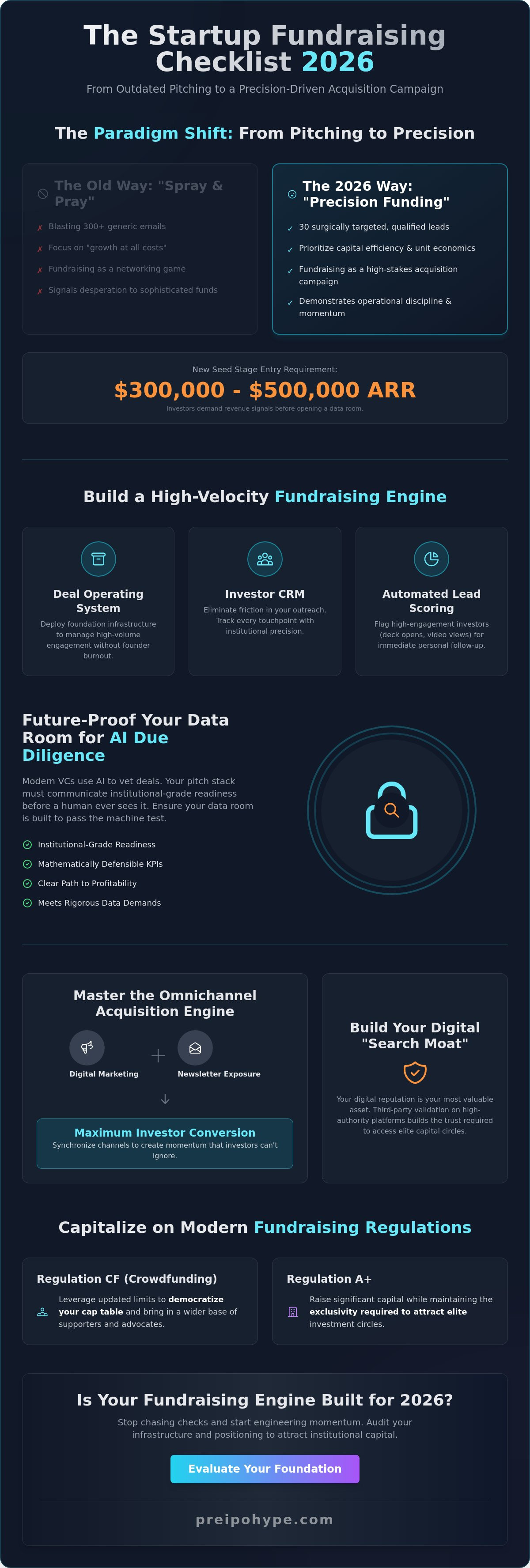
The era of burning capital for growth is over. Investors in 2026 have shifted to "Precision Funding," a strategy where every cent is tied to measurable efficiency. It's no longer about who has the loudest pitch; it's about who has the tightest unit economics. This strategic pivot is the foundational entry on your startup fundraising checklist 2026. If your roadmap doesn't prioritize capital efficiency over raw scale, you're already behind the market curve; engaging with a firm like 41 Legacy can help you better understand and protect the enterprise value of your company as you navigate this shift.
The "spray and pray" method of blasting 300 generic emails is dead. It signals desperation to sophisticated funds. Today, 30 highly targeted, surgically qualified leads yield higher conversion than a database of thousands. Modern venture capital financing requires a data-driven approach that mirrors a high-end sales funnel. Founders who treat their raise like a high-stakes acquisition campaign are the ones winning the term sheets.
To better understand the rigor required for this process, watch this helpful video:
The Shift Toward Disciplined Capital
The "higher for longer" interest rate environment has fundamentally reshaped the 2026 venture market. Capital isn't cheap, and the hurdle for entry has risen. In 2026, every dollar of startup capital is expected to work twice as hard as in the previous decade. Seed stage investors now expect to see revenue signals between $300,000 and $500,000 in ARR before they even open a data room. Your KPIs must be mathematically defensible. We're seeing a return to fundamentals where unit economics and clear paths to profitability aren't just slides in a deck; they're the primary drivers of valuation.
Similarly, founders in the medical sector must account for industry-specific multiples; resources like healthcarebizbrokers.com offer specialized valuation and brokerage services to ensure your health-tech startup is priced correctly for the 2026 market.
Building a 'Search Moat' for Investors
Creating momentum in a disciplined market requires a sense of exclusivity. This isn't about manufactured hype; it's about demonstrating that your round is a fast-moving vehicle. When you combine surgical targeting with a robust digital presence, you stop chasing capital and start managing it. If you're ready to audit your current positioning, you can connect with our team to evaluate your foundation infrastructure and ensure you're ready for the 2026 landscape.
Foundation Infrastructure: The Technical Bedrock of Your Raise
Infrastructure isn't just a back-office concern; it's the engine that drives your close rate. In 2026, the difference between a stalled round and a fully committed cap table lies in the technical plumbing of your outreach. Most founders focus on the pitch. They ignore the systems required to manage the hundreds of touchpoints necessary to secure elite capital. This section of your startup fundraising checklist 2026 focuses on building a "Foundation" that ensures no lead is lost and every investor interaction is tracked with institutional precision. Data is the new social proof. Without it, you're just guessing.
Technical Setup Checklist
Deploying foundation infrastructure is the first step toward managing high-volume engagement without founder burnout. You need a system that does more than store contacts. It must configure lead scoring for potential investors based on their engagement depth. If an LP opens your deck three times and watches your video update, your system should flag them for an immediate personal follow-up. While you must remain compliant with SEC regulations for startups, you can still automate the "nurture" phase using custom marketing systems. This automation keeps your brand top-of-mind while you focus on high-level strategy and closing calls. Efficiency dictates your speed to close.
The Custom Investor CRM
A standard sales CRM is built for transactions, not relationships. It fails the fundraising test because it lacks the nuance of capital formation. Engineering momentum requires the custom investor CRM designed to integrate omnichannel data into a single source of truth. Whether an investor interacts via a specialized newsletter or a retargeting ad, those data points must converge. This visibility allows you to implement 60-day attribution tracking, giving you a clear view of which channels are actually driving capital. It's a critical component of any modern startup fundraising checklist 2026.
To scale your most limited resource, you need a sophisticated video funnel. This allows you to deliver your core message perfectly every time, qualifying investors before they ever reach your calendar. It's about creating an elite experience that feels personal but operates at scale. By the time you get on a call, the investor should already be 80% convinced. This technical bedrock transforms your raise from a frantic chase into a rhythmic, data-driven engine. If you're unsure if your current stack is up to the task, you can book a strategy session to audit your infrastructure and ensure your foundation is solid.
The Investor-Ready Stack: Data Rooms in the Age of AI
The virtual data room (VDR) has evolved from a static storage unit into a dynamic Deal Operating System. By 2025, the global VDR market reached approximately $3.4 billion, reflecting a massive shift toward intelligent workflow automation. If you're following a startup fundraising checklist 2026, your data room must be more than a folder of PDFs. It's now the primary training ground for the AI-driven due diligence tools used by modern VCs. Investors don't just read your files anymore; they deploy LLMs to stress-test your cap table and audit your financials in seconds.
AI-Optimized Due Diligence
VCs are looking for clean, structured data that machines can digest. If your data room isn't structured for AI analysis, you're invisible to the most efficient capital of 2026. This means using standardized naming conventions and machine-readable formats that allow predictive analytics to correctly interpret your growth trajectory. Beyond the documents, be prepared for communication pattern analysis. Advanced platforms now track the velocity of your responses and the consistency of your narrative across every touchpoint. This level of scrutiny requires a proactive approach to an investor outreach checklist, ensuring every digital interaction reinforces your core thesis.
The Modern Pitch Stack
The traditional PowerPoint deck is now just one component of a broader multi-media experience. To capture attention in a fast-paced market, you need a 2-minute "Hook" video. This asset is critical for social media and newsletter exposure, acting as the high-impact entry point for your funnel. Once you've qualified an investor, you move to the "Master Deck" for deep-dive meetings. This stack must be supported by scenario-based financial projections. Static spreadsheets are out. Investors expect dynamic models that allow them to toggle variables like CAC and churn rates in real-time to see how they impact your path to profitability.
Don't forget the "Proof of Traction" folder. This is where you centralize customer testimonials, LOIs, and growth metrics that prove your product-market fit. Pair this with a "Transparency Folder" for proactive disclosure. By surfacing potential risks and legal structures early, you accelerate trust and reduce the friction that often kills deals in the final stages. Engineering this level of professional transparency signals that you're organized and serious about protecting investor interests. If you're ready to scale your narrative through high-impact media, our video funnel strategy can help you deliver a perfect pitch to every potential lead on autopilot.
Mastering the Omnichannel Acquisition Engine
The Omnichannel Playbook
The core of this engine is integrating digital marketing and advertising directly into your fundraising cycle. You aren't just sending emails; you're coordinating email, SMS, and social outreach to stay top-of-mind. Use the "Invisible Follow-up" by deploying retargeting ads to potential investors who have viewed your data room or visited your site. This keeps the momentum alive without requiring a manual ping from the founder. With 95.4% of marketers now utilizing AI in their omnichannel strategies, you can use data-driven systems to qualify leads based on their digital behavior before you ever pick up the phone.
Scaling Curiosity into Capital
Turning cold curiosity into committed capital requires a video funnel strategy that operates 24/7. This system allows you to deliver a high-impact message that resonates with both institutional and retail capital. A/B testing your messaging is vital here. What hooks an institutional VC might not move the needle for a high-net-worth individual. By leveraging established investor audiences through newsletter exposure, such as Invst Guru, you gain immediate access to trusted circles. This isn't just about traffic; it's about shifting the narrative from a transaction to a movement.
Precision matters. You must track engagement decay to know exactly when a lead is fading and when to re-engage with a fresh angle. This level of analytics and performance tracking ensures your outreach remains efficient and your conversion stays high. If you're ready to stop chasing leads and start engineering a predictable flow of capital, you can connect with us for a custom acquisition campaign to dominate your market. Each touchpoint should reinforce your "search moat," proving that your startup is the primary vehicle for wealth creation in your sector.
Navigating Reg CF and Reg A+ in 2026
Choosing between Reg CF and Regulation A+ depends entirely on your capital goals and stage of growth. While Reg CF is perfect for agile raises up to $5 million, Reg A+ Tier 2 offers a massive ceiling of $75 million in a 12-month period. Many elite founders are now opting for a "hybrid raise." They secure a lead institutional VC to set the terms and then open a portion of the round to the crowd. This creates a powerful synergy of sophisticated oversight and grassroots momentum. It's a calculated move that democratizes access to rare opportunities while maintaining the exclusivity that attracts top-tier investment circles.
The Reg CF Advantage
The real magic of a crowd round lies in the "Hype Cycle." By leveraging specialized Reg CF marketing services, you can transform a standard raise into a viral movement. You're building a loyal army of ambassadors who provide social proof that institutional investors can't ignore. Managing a high-volume cap table used to be an administrative nightmare, but modern infrastructure handles the complexity for you. You can engage the "Crowd" effectively without losing your appeal to elite funds. In fact, seeing a passionate, invested user base often de-risks the deal for VCs, proving that your product has real-world traction and a mathematically defensible path to scale.
Strategic Next Steps
Don't guess your strategy when the stakes are this high. If you want a direct perspective on how to position your raise for maximum conversion, you should ask our CEO for an insider's view. We've moved beyond the era of static pitches. Your startup fundraising checklist 2026 is only complete when your technical infrastructure, omnichannel outreach, and regulatory strategy are perfectly aligned. If you're ready to engineer your own hype cycle and close your round with precision, book a 30-minute strategy session with our team today. The opportunities in 2026 are rare, but they're within reach for those who act with decisive, data-driven ambition. Let's build your roadmap to capital.
Dominate the Future of Capital Formation
The landscape has fundamentally changed. Fundraising is no longer about who you know; it's about the technical precision of your acquisition engine. By mastering this startup fundraising checklist 2026, you've moved beyond the "spray and pray" tactics that fail in a disciplined market. You've learned how to leverage AI-optimized data rooms and omnichannel outreach to create a sense of inevitable momentum. Success in this new era requires a calculated blend of institutional authority and aggressive digital strategy. You don't just need a pitch; you need a repeatable system that converts.
Now it's time to execute. We've facilitated over $100M in funding and achieved omnichannel mastery across 230+ successful campaigns. Our approach utilizes a custom investor CRM with 60-day attribution tracking to turn curiosity into committed capital with mathematical certainty. Don't leave your valuation to chance. Scale your capital raise with the 2026 Investor Acquisition Platform and secure your place in the market's elite circles. The capital is out there. It's waiting for the founders who are prepared to lead with precision. Let's make your vision the next realization event.
Frequently Asked Questions
What is the most important document in a 2026 startup fundraising checklist?
The dynamic, scenario-based financial model is the most critical asset on any startup fundraising checklist 2026. Unlike static spreadsheets of the past, modern investors expect models that allow for real-time stress testing of unit economics and customer acquisition costs. This document proves you have a mathematically defensible path to profit, which is the primary driver of valuation in today's disciplined market.
How much should a startup spend on marketing their capital raise in 2026?
Can I raise capital under Reg CF while also talking to traditional VCs?
How long does it typically take to prepare a startup for a 2026 funding round?
What are the common mistakes founders make when setting up their data room?
Is an investor CRM really necessary for a Seed or Series A round?
An investor CRM is essential for managing the high-volume engagement required to close a competitive round. Relying on manual spreadsheets leads to engagement decay and missed follow-ups. A specialized system allows you to track 60-day attribution and qualify leads based on their digital behavior. This technical bedrock ensures your startup fundraising checklist 2026 is built for speed and precision.
How has AI changed the way investors perform due diligence in 2026?
What is the difference between Reg CF and Reg A+ for a growing company?
The primary difference lies in the offering limits and the level of regulatory reporting required. Reg CF allows you to raise up to $5 million in a rolling 12-month period with relatively streamlined compliance requirements. Reg A+ Tier 2 allows for much larger raises, up to $75 million, but involves more intensive SEC review and ongoing disclosure obligations. Choosing the right vehicle depends on your specific capital goals and growth stage.
Disclaimer
Educational only. Not investment, tax, or legal advice. Pre-IPO Hype is investor relations infrastructure for Regulation CF and Regulation A+ raises. We are not a broker-dealer, funding portal, or investment adviser, and we do not offer or sell securities or make investment recommendations. Any securities offering is made only by the issuer, through its own offering documents and, where required, a registered intermediary.


