
Startup Valuation for Fundraising: Engineering Momentum in 2026
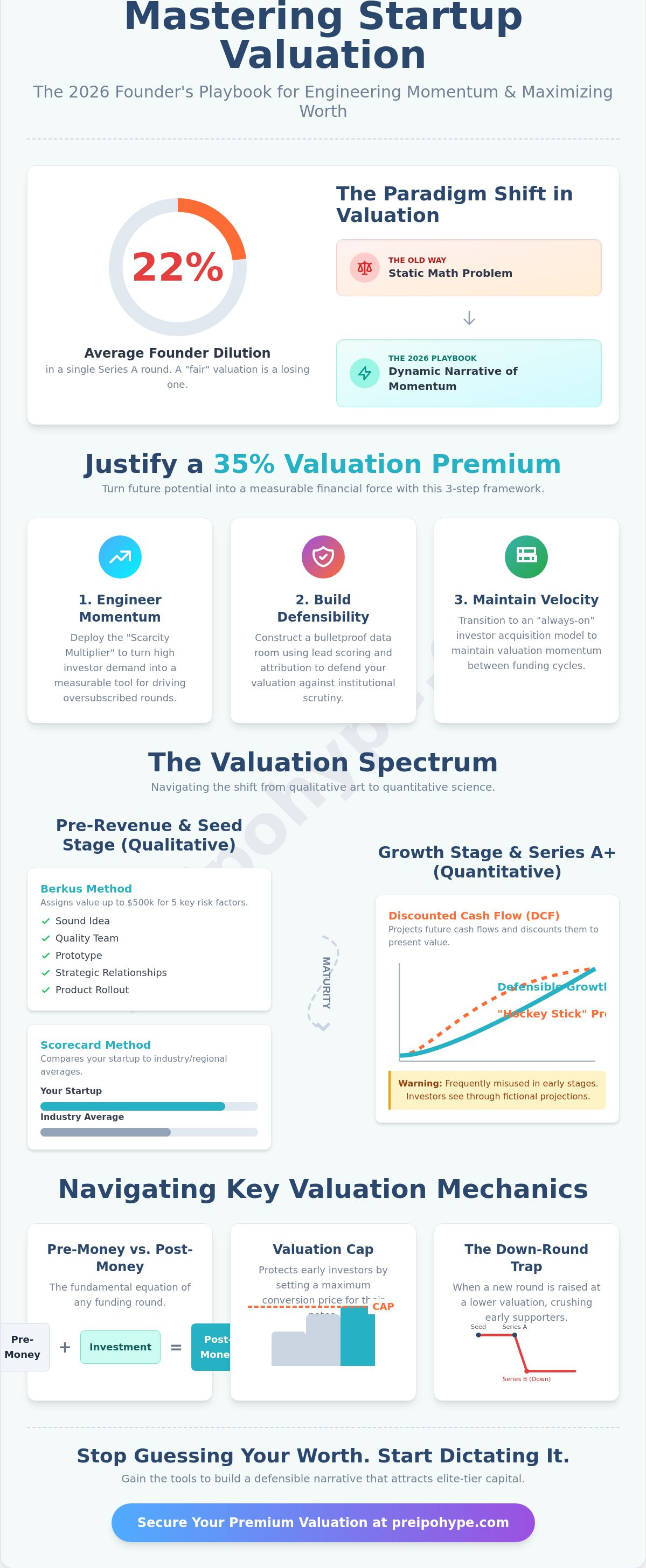
In the 2026 venture landscape, a fair valuation is effectively a losing one. Most founders watch their ownership erode by an average of 22% in a single Series A round because they treat their cap table like a static math problem rather than a dynamic narrative. You already know that the traditional spreadsheet approach fails to capture the true velocity of your brand in a crowded market. Mastering startup valuation for fundraising is no longer just about historical multiples; it is about engineering the institutional momentum that elite investors are desperate to chase. This is where the informed insider separates themselves from the crowd by turning future potential into a measurable financial force.
We'll show you how to justify a 35% premium on your pre-money valuation by quantifying the hype and intangible assets that standard discounted cash flow models ignore. You'll gain the tools to build a defensible narrative that stands up to the most rigorous due diligence from top-tier firms. We are diving into the exact frameworks used by the top 1% of founders to minimize dilution and secure capital from the world's most exclusive investment circles. It is time to stop guessing your worth and start dictating it to the market.
Key Takeaways
- Master the strategic bridge between current traction and future exit potential to justify elite-tier premiums in a narrative-driven 2026 market.
- Navigate the shift from qualitative Berkus factors to quantitative DCF models to ensure your price reflects true growth-stage value.
- Deploy the "Scarcity Multiplier" to engineer momentum, turning high investor demand into a measurable tool for driving oversubscribed rounds.
- Build a bulletproof data room that uses lead scoring and attribution to defend your startup valuation for fundraising against institutional scrutiny.
- Transition to an "always-on" investor acquisition model to maintain valuation momentum and prevent stagnation between funding cycles.
The Strategic Role of Startup Valuation in Capital Raising
Valuation isn't a static number derived from a spreadsheet; it's the bridge connecting your current traction to a massive future exit. In the 2026 venture landscape, startup valuation for fundraising has evolved into a narrative-first exercise. Investors are no longer just buying into your current revenue. They're purchasing a piece of the momentum you've engineered. If your valuation doesn't tell a story of inevitable dominance, you're just haggling over pennies while the real opportunity passes you by.
Pricing your startup correctly requires a surgical understanding of equity mechanics. You must distinguish between the Pre-money valuation, which is the value of your company before receiving fresh capital, and the post-money figure that reflects your total worth after the wire hits. In 2026, a 20% difference in these figures can mean the difference between maintaining board control or being sidelined by aggressive late-stage liquidation preferences. High valuations feel like a win today, but they set a high bar for tomorrow. If you don't hit your milestones, you face the "down-round" trap, where new investors demand lower prices, crushing your early supporters and your own net worth.
Valuation as a Forward-Looking Hurdle
Valuation measures potential energy. It's a calculation of what your company will become once the capital is deployed. Investors look for "de-risking" events, such as securing a key patent or hitting a 40% month-over-month growth rate, to justify a higher multiple. By checking these boxes, you move the needle from speculative to inevitable. A valuation cap is a contractual limit that protects early investors by ensuring their investment converts into equity at a set maximum price during the next priced round.
The Psychology of the Valuation Floor
There is a "minimum viable valuation" that every founder must defend. If you dilute yourself too early, you lose the "skin in the game" that institutional LPs demand. Over-valuation is equally dangerous before a Series A. If your seed round is priced at a $30 million cap but your metrics only support a $15 million Series A, you'll find yourself in a death spiral of recapitalization. Success in 2026 requires aligning your pricing with an investor acquisition platform mindset. This approach ensures your startup valuation for fundraising creates enough "hype" to attract elite capital while leaving room for the massive upside that keeps the "unicorn hunters" interested. You aren't just looking for a check; you're looking for a partner who believes the current price is a bargain for the future empire you're building.
Decoding Valuation Methodologies: From Berkus to DCF
Valuation isn't a static number. It's a narrative built on data. For early-stage founders, the process is an art of persuasion; for scaling giants, it's a cold calculation of exit potential. Understanding startup valuation methodologies allows you to control the negotiation before you even step into the room. You aren't just asking for money. You're selling a future stake in a high-velocity asset.
The Berkus Method remains a staple for pre-revenue ventures. It assigns up to $500,000 for each of five key success factors, including the quality of the core team and product development. It's a blunt instrument, but it works because it focuses on risk mitigation. The Scorecard Method offers more precision by adjusting your valuation based on industry averages within your specific geographic region. It compares your startup to others that have recently raised, giving you a competitive benchmark to defend your ask.
While Discounted Cash Flow (DCF) is the gold standard in corporate finance, it's frequently misused in early-stage tech. Predicting cash flows five years into the future in a volatile 2026 market is often pure fiction. Investors see through "hockey stick" projections. They want to see the underlying mechanics of your startup valuation for fundraising, not just a spreadsheet of dreams.
Qualitative Methods for Seed and Pre-Seed
The Risk Factor Summation Method is the 2026 standard for early bets. It forces a granular look at 12 specific risks, from manufacturing to political stability. Each factor can add or subtract from your baseline valuation. The "Team" factor carries the heaviest weight, often accounting for 30% of the total qualitative score. Investors aren't just buying an idea; they're buying the execution engine. You must prove your foundation infrastructure is robust enough to handle rapid scaling. If your technical bedrock is shaky, your valuation will be too.
Quantitative Methods for Scaling Startups
The Venture Capital Method works backward. It starts with an anticipated exit price, perhaps five years out, and applies a target ROI to find the current post-money value. In the volatile 2026 secondary markets, finding accurate "comps" requires looking at transactions from the last 180 days. We're seeing a massive shift in late-stage Reg A+ raises, where EBITDA multiples are back in style. Profitability is the new "hype." High-growth startups with a clear path to 20% EBITDA margins are securing the most aggressive terms for their startup valuation for fundraising. If you're unsure which model fits your current round, you can ask our CEO for a direct perspective on current market sentiment.
Engineering the Hype Cycle: How Momentum Dictates Market Value
Hype is often dismissed as empty noise by traditional analysts, but in the high-stakes environment of 2026, it has become a measurable financial indicator. Momentum functions as a leading signal for investor demand. When you engineer a narrative that resonates across digital channels, you aren't just building a brand; you're quantifying market fit before the first term sheet is signed. This perceived demand creates a "Scarcity Multiplier." When a round is 130% oversubscribed, the founder gains the leverage to dictate terms, often pushing startup valuation for fundraising far beyond what historical cash flows might suggest.
Sophisticated founders now use digital sentiment analysis to justify these premiums. By tracking engagement rates, social mentions, and search intent, you can present a data-backed case for brand equity. This omnichannel approach ensures that when a VC looks at your deal, they aren't seeing an isolated pitch. They're seeing a movement that's already gaining traction. Competitive bidding isn't an accident; it's the result of a calculated outreach strategy that makes your cap table feel like a gated community.
The Velocity of Capital
Capital Velocity measures how quickly an investment round reaches its target. Speed is a proxy for quality. A round that closes in 18 days sends a powerful signal to institutional follow-on investors that the market is hungry for your equity. To achieve this, many growth-stage companies are leveraging Reg CF marketing services to build early momentum. This initial surge of capital creates a "fear of missing out" among late-stage funds, effectively shortening the due diligence cycle and hardening your valuation floor.
Social Proof and the Crowd Effect
The math of 2026 proves that 1,000 retail investors can be more strategically valuable than a single institutional lead. These retail participants act as a decentralized marketing force, creating a network effect that validates product-market fit in real-time. This collective social proof is a massive lever for startup valuation for fundraising because it reduces the perceived risk for larger checks. Using targeted distribution channels like the Invst Guru newsletter allows you to trigger this crowd effect early. By the time you reach the boardroom, the market has already voted with its wallet, turning your valuation into a foregone conclusion rather than a negotiation.
Defending Your Number: Building a Data-Driven Valuation Narrative
Setting a price is easy. Defending it under the microscope of a lead investor's due diligence is where most founders stumble. In the 2026 capital markets, a pitch deck is merely an invitation; the real startup valuation for fundraising is won or lost in the data room. You aren't just selling shares; you're selling a high-performance engine that converts capital into exponential growth with surgical precision.
Your data room must move beyond basic financial statements. You need to present lead scoring and attribution models that prove your future capital efficiency. If you can demonstrate that every dollar of marketing spend yields a 3.5x return within six months, the valuation becomes a mathematical certainty rather than a negotiation point. Founders who command the highest premiums are those who treat their fundraising process as a transparent, data-backed proof of concept. This insider approach transforms the conversation from "what you want" to "what the data dictates."
The Investor CRM as a Defense Tool
The elite founders don't just talk to investors; they manage them like a sales pipeline. Using a custom investor CRM allows you to track the entire "Investor Journey" with the same granularity you use for customers. This level of institutional organization proves you possess the operational maturity to handle late-stage growth. By tracking touchpoints, you can prove a lower cost of acquisition for future capital. 60-day attribution validates the stability of your investor base. It shows that your momentum is engineered, not accidental, effectively neutralizing "down-round" fears before they arise.
Negotiation Tactics for Elite Founders
Handling valuation pushback requires a blend of financial logic and tactical leverage during the startup valuation for fundraising process. When a lead investor tries to squeeze your number, look closely at the "Option Pool Shuffle." Investors often insist on a massive 20% option pool created entirely from the pre-money valuation, which effectively lowers your price. Fight to keep this pool closer to 10% or 12%, or insist it's shared between existing and new shareholders. If terms become predatory, such as demanding 3x liquidation preferences, you must be prepared to walk. The insider move is to consult with a fundraising advisor before you sign any binding documents. Protecting your equity at this stage ensures you maintain the "ground floor" upside that makes your venture a true unicorn candidate.
Scaling Your Valuation Through Omnichannel Investor Acquisition
Startup valuation for fundraising isn't a seasonal event. It's a continuous broadcast. By 2026, the most successful founders won't rely on static pitch decks or isolated roadshows. They'll use omnichannel digital marketing to build a permanent audience of accredited and retail backers. This "Always-On" investor relations model prevents the valuation stagnation that kills momentum between rounds. When you're always visible, your valuation reflects your current growth trajectory, not a snapshot from six months ago. It turns your cap table into a living asset rather than a liability.
Moving from Reg CF to Reg A+ serves as a critical valuation stepping stone. A successful Reg CF round often creates a base of 2,500 loyal shareholders. This crowd provides the social proof needed to justify a higher valuation when you scale to a Reg A+ offering. It's about building a ladder. Each rung represents a higher level of capital access and a more robust valuation floor. By the time you reach the 2026 exit environment, your brand equity will be as measurable as your EBITDA.
Maximizing Secondary Liquidity Potential
Your early valuation choices dictate your eventual exit velocity. Overpricing a Seed round might feel like a win today, but it often chokes secondary market opportunities by creating a valuation wall that later investors won't climb. Maintaining a clean cap table is non-negotiable for 2026. Use automated infrastructure to manage your 3,000+ micro-investors without cluttering your legal documents. Preparing for this level of scale requires precision. You can refine your trajectory with a Pre-IPO Hype advisory session to ensure your current structure attracts institutional interest.
The Future of Private Market Valuations
The 2026 landscape will shift toward transparent, real-time metrics. Static quarterly reports are becoming obsolete. Investors now demand live dashboards that connect directly to your growth data via API. AI-driven tools allow venture capitalists to perform competitive fundraising research in seconds, benchmarking your startup valuation for fundraising against every competitor in your sector. Momentum is your only protection against this level of scrutiny. Audit your current raise strategy for 2026 today to ensure your narrative holds up under the lens of the next generation of algorithmic finance.
- Integrate digital storytelling into every stage of the funnel.
- Transition from crowd-funded proof points to institutional-grade offerings.
- Prioritize cap table hygiene to facilitate secondary market exits.
- Adopt real-time data transparency to stay ahead of AI-driven due diligence.
Mastering the 2026 Valuation Narrative
The window for securing elite capital in 2026 is narrowing for founders who rely on outdated spreadsheets. Success requires a shift from defensive accounting to aggressive momentum engineering. You've seen how blending institutional methodologies with the psychological triggers of the hype cycle creates a narrative that investors can't ignore. Mastering your startup valuation for fundraising means leveraging Reg CF and Reg A+ frameworks to turn passive interest into a competitive feeding frenzy. It's about the math, but it's also about the theater of the private market.
At PreipoHype, we've facilitated over $100M in funding by treating valuation as a strategic weapon rather than a static number. Our proprietary Custom Investor CRM uses advanced lead scoring to identify high-net-worth movers before the broader market catches on. Don't leave your cap table to chance when you can engineer your own liquidity event. We specialize in the Reg CF and Reg A+ hype cycles that bridge the gap between private secrecy and public opportunity.
Book a 30-minute strategy session to audit your valuation narrative and take control of your capital trajectory. The next great exit is waiting for the founder who acts with decisive authority.
Frequently Asked Questions
What is the most accurate startup valuation method for a pre-revenue company in 2026?
The Scorecard Valuation Method remains the gold standard for pre-revenue firms because it benchmarks your startup against recent exits in specific geographic hubs. In 2026, investors prioritize a weighted average across five key factors, with 30 percent of the weight placed on the strength of the management team. This approach prevents arbitrary pricing and ensures your startup valuation for fundraising aligns with current market multiples of roughly 5 to 7 million dollars for seed-stage tech.
How does a Reg CF raise affect my valuation for a future Series A?
A Regulation Crowdfunding raise can complicate a Series A if your cap table contains hundreds of individual line items. Institutional investors like Sequoia or Andreessen Horowitz often require a clean cap table; therefore, using a Special Purpose Vehicle is mandatory. Data from 2024 shows that 85 percent of successful Series A transitions from Reg CF used an SPV to consolidate small investors into a single entity, preserving the professional appearance needed for elite rounds.
Is it possible to have a valuation that is "too high" for my stage?
Yes, an inflated valuation creates a trap that leads to a down round or a flat round later. If you raise at a 50 million dollar post-money valuation but fail to hit 2 million dollars in Annual Recurring Revenue within 18 months, your next round will likely stall. Roughly 33 percent of companies that over-optimized for price in 2021 faced liquidation or fire sales by 2024 because they couldn't justify the jump to the next valuation tier.
How much equity should a founder give up in a seed round?
Founders typically surrender between 10 percent and 25 percent of their company during a seed round. Target a 15 percent dilution to maintain enough skin in the game for the Series B and Series C milestones. If you give away more than 30 percent before your Series A, you risk losing control of the board. This situation deterred 40 percent of lead investors in recent venture cycles who feared founder burnout from low ownership levels.
Can I change my valuation once the fundraising campaign has started?
You can adjust your valuation, but it's a move that requires surgical precision to avoid killing your momentum. If you haven't secured 50 percent of your lead investment within 45 days, a downward adjustment can reignite interest from sidelined angels. Conversely, if you're 200 percent oversubscribed, you can increase the cap on a SAFE to reflect the surging demand. This creates a sense of exclusive access and rewards those who committed to the ground floor early.
What role does "traction" play in valuation compared to "team"?
In the 2026 market, traction accounts for 70 percent of the valuation weight while the team covers the remaining 30 percent. Investors now demand a minimum of 15 percent month over month growth or a 5,000-user waitlist before they'll discuss a premium price. While a pedigree from a top accelerator still commands attention, hard data and verified pilot programs with Fortune 500 companies are the primary drivers of your startup valuation for fundraising today.
How do I use a valuation calculator without being misled by generic data?
Don't rely on calculators that aggregate data across all industries. You must input sector-specific multiples, such as the 8x revenue multiple common in AI infrastructure or the 3x multiple seen in traditional e-commerce. A generic calculator often ignores the 20 percent hype premium found in emerging tech hubs like Austin or Miami. Use these tools as a baseline, then layer on your specific growth metrics to find a number that reflects your unique market position.
What is the difference between an 409A valuation and a fundraising valuation?
A 409A valuation is a formal appraisal required by the IRS to set the strike price for employee stock options. It's conservative and typically sits 30 percent to 50 percent lower than your fundraising valuation. Your fundraising valuation is a market-driven price based on what an investor is willing to pay for future growth. It reflects the potential of the unicorn hunt, whereas the 409A reflects the current fair market value for tax compliance.
Disclaimer
Educational only. Not investment, tax, or legal advice. Pre-IPO Hype is investor relations infrastructure for Regulation CF and Regulation A+ raises. We are not a broker-dealer, funding portal, or investment adviser, and we do not offer or sell securities or make investment recommendations. Any securities offering is made only by the issuer, through its own offering documents and, where required, a registered intermediary.