
Strategic Crowdfunding: A Guide to Building Investor Bases
Why are most founders treating their equity raise like a digital bake sale when they should be building a high-speed capital engine? The reality is that traditional venture capital is no longer the only path to elite growth. You've likely seen the headlines of massive raises and felt the pull of market momentum, yet the technical complexity of Reg CF and Reg A+ often feels like a barrier designed to keep you out. It's natural to fear launching a campaign that fails to gain traction, especially when you lack a proven system to track and convert high-value prospects into long-term partners.
You've realized that capital is just the beginning; what you really need is a scalable way to build a permanent investor base. This guide will show you how to transform crowdfunding from a one-off fundraising event into a sophisticated, data-driven investor acquisition engine. We'll provide a clear roadmap for a $1M+ equity raise, detailing the institutional-grade tech stack required to score leads and the omnichannel strategies that turn casual observers into committed stakeholders. It's time to stop chasing checks and start architecting a movement that secures your company's future through strategic market participation.
Key Takeaways
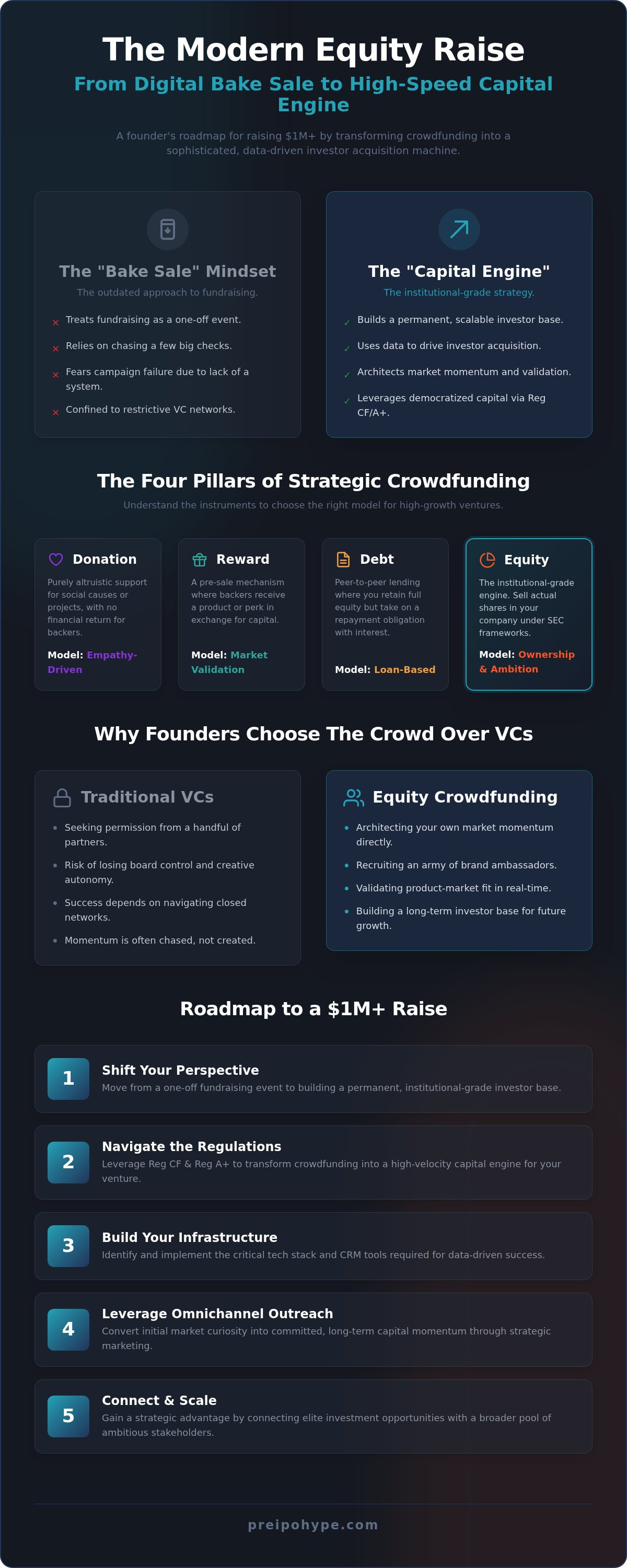
- Shift your perspective from one-off fundraising to an institutional-grade strategy that builds a permanent, scalable investor base.
- Navigate the regulatory landscape of Reg CF and Reg A+ to transform crowdfunding into a high-velocity capital engine for your venture.
- Identify the critical technical infrastructure and CRM tools required to avoid common campaign failures and ensure data-driven success.
- Learn how to leverage omnichannel outreach to convert initial market curiosity into committed, long-term capital momentum.
- Gain a strategic roadmap for raising $1M+ by connecting elite investment opportunities with a broader pool of ambitious stakeholders.
Beyond the Tip Jar: Redefining Crowdfunding for 2026
The gatekeepers have lost their keys. For decades, elite capital was a restricted territory, accessible only to those who could navigate the narrow corridors of traditional venture capital networks. That era is over. In 2026, the most ambitious founders are bypassing the traditional venture capital bottleneck to build high-velocity capital engines directly through their most loyal supporters. This is no longer about small-scale donations; it's about sophisticated investor acquisition. At its core, crowdfunding is the practice of funding a venture by raising capital from a large number of people via the internet, but the modern application is far more powerful than a simple digital collection plate.
The Evolution of Digital Fundraising
We've moved past the novelty phase of Kickstarter gadgets and artistic passion projects. The market has matured into an institutional-grade ecosystem where SEC-regulated equity offerings are the new standard. This shift represents a comprehensive overview of crowdfunding as it matures from a social experiment into a primary vehicle for wealth creation. 2026 is the Golden Era for democratized capital because the technology now exists to reach thousands of potential backers with the same precision once reserved for private placement memorandums. The modern ecosystem is a data-driven marketplace where digital sentiment is converted into institutional-grade equity through strategic investor data and attribution tracking.
Why Founders are Choosing the Crowd Over VCs
Why beg a handful of partners for permission when you can architect your own market momentum? Founders are increasingly choosing the crowd to maintain board control and creative autonomy. When you raise capital from five thousand investors instead of five, you aren't just filling a bank account; you're recruiting an army of brand ambassadors who are financially incentivized to see you succeed. This psychological shift is profound. You're no longer seeking a handout; you're offering an entry point into an exclusive opportunity.
The benefits extend far beyond the balance sheet. A successful equity raise validates your product-market fit in real-time, creating a groundswell of support that VCs often chase rather than create. It's about building a long-term investor base that grows with you, providing a foundation for future rounds or a eventual liquidity event. By leveraging crowdfunding as a strategic acquisition tool, you turn every marketing dollar into a dual-purpose asset that drives both sales and shareholder growth.
The Four Pillars of Strategic Crowdfunding
Not all capital is created equal. To scale an elite venture, you must understand the four distinct instruments of the modern crowdfunding landscape. Each pillar serves a specific purpose, ranging from tactical cash injections to strategic, long-term equity acquisition. Choosing the wrong model doesn't just slow you down; it can misalign your brand with the very investors you need to attract. High-growth founders must distinguish between these four categories:
- Donation: Purely altruistic. These are tactical tools for social causes with zero financial return.
- Reward: A pre-sale mechanism. You exchange products or perks for capital, making it ideal for market validation.
- Debt: Peer-to-peer lending. You retain equity but take on a repayment obligation with fixed interest.
- Equity: The institutional-grade engine. You sell actual shares in the company under SEC frameworks like Reg CF or Reg A+.
The risk-reward profile varies wildly across these pillars. Equity models demand the most rigorous regulatory compliance, yet they offer the greatest potential for market momentum. Recent research into crowdfunding success factors indicates that the choice of model often dictates the long-term viability of the investor network you build. If you're ready to move beyond tactical pre-sales and architect a strategic raise, you can schedule a strategy session to map out your infrastructure.
Donation vs. Equity: The Capital Divide
Donation models rely on empathy; equity models rely on ambition. When you ask for a donation, you're seeking a one-time gift. When you offer equity, you're inviting a partner into your cap table. This distinction is critical for company maturity. Early-stage concepts might start with rewards to prove demand, but scaling to a $1M+ raise requires the sophisticated framework of equity. Investors aren't looking for a "thank you" note. They're looking for a realization event.
Reward-Based Models for Product Validation
Kickstarter and Indiegogo are testing grounds, not terminal destinations. They're excellent for proving that people want your product, but they lack the infrastructure to build a permanent investor base. Most founders hit a ceiling with rewards because they aren't acquiring investors; they're acquiring customers. Transitioning to an equity round allows you to convert those customers into stakeholders who fuel your next phase of growth. This move shifts your focus from short-term revenue to long-term enterprise value.
Equity Crowdfunding: Engineering Momentum with Reg CF and Reg A+
Don't let outdated data fool you. While some observers still view crowdfunding as a way to scrape together a few hundred thousand dollars, the modern regulatory landscape tells a different story. We've entered an era where high-growth companies are routinely engineering multi-million dollar raises that rival traditional Series A rounds in both scale and speed. By leveraging Regulation Crowdfunding (Reg CF) and Regulation A+, you aren't just raising money; you're building a sophisticated capital engine that operates with institutional precision. Success in this arena requires more than a pitch deck; it demands a mastery of the Reg CF Marketing Services that drive the investor hype cycle.
Reg CF: The Democratized Seed Round
Reg CF has evolved into the primary entry point for startups looking to bypass the restrictive VC gatekeepers. As of 2026, SEC limits allow companies to raise up to $5 million within a 12-month period, a threshold that provides significant runway for early-stage scaling. The filing requirements, centered around a Form C disclosure, are manageable for agile teams ready to be transparent with their backers. The true power of this model lies in its inclusivity. You can accept capital from both accredited and non-accredited investors, turning your entire customer base into a financial foundation. Reg CF is the most powerful tool for early-stage capital velocity in the modern market.
Reg A+: The Path to Institutional Liquidity
If Reg CF is the spark, Reg A+ is the wildfire. Often described as a "Mini-IPO," this regulation allows companies to raise up to $75 million from the general public. It's the ultimate bridge to a traditional IPO, offering a level of national brand dominance that private rounds simply can't match. Tier 2 offerings under Reg A+ do require more rigorous auditing and ongoing SEC reporting, but the payoff is access to a massive pool of retail and institutional capital. This isn't just about the check; it's about creating a liquid-ready environment where your shares carry the weight of a public-tier asset. Companies using this path often find themselves in a position of extreme leverage when they eventually decide to pursue a full exchange listing.
Choosing between these frameworks depends on your current burn rate and your long-term exit strategy. Reg CF offers the speed needed for rapid iteration, while Reg A+ provides the heavy-duty infrastructure for global expansion. Both models share a common thread: they put the power back in the founder's hands. You set the valuation, you control the narrative, and you own the relationship with your investors. This is how elite ventures are built in 2026.
The Infrastructure of Success: Why Most Campaigns Fail
Why do 90% of equity raises stall after the first seven days? It isn't a lack of market interest or a flawed product. It is a fundamental lack of foundation infrastructure. Most founders treat crowdfunding as a social media contest. They hope a viral post will trigger a landslide of capital. This is an amateur mistake. Institutional-grade raises require a technical bedrock designed to capture curiosity and convert it into commitment. Without lead scoring and 60-day attribution, you're essentially flying blind. You must track the exact moment a prospect shifts from casual observer to committed stakeholder.
Social media posting is a tactic, not a strategy. An institutional raise demands a system that manages thousands of leads simultaneously. If you don't have a way to identify which leads are "hot" and which are just browsing, you'll waste your most valuable resource: time. High-growth ventures succeed because they use data to engineer momentum. They don't wait for the market to find them; they build an omnichannel machine that keeps their opportunity top-of-mind until the check is signed.
The Custom Investor CRM: Your Fundraising Nerve Center
A standard sales CRM is insufficient for the unique demands of a high-stakes crowdfunding raise. You need a custom investor CRM to act as your campaign's nerve center. This system tracks the entire journey from the first "curious click" to the final capital commitment. It allows you to score leads based on engagement levels, ensuring your team focuses on the highest-probability investors first. Crucially, this infrastructure ensures you own your data. Relying on platform-owned leads is a strategic dead end. When your raise concludes, those investor relationships should be your permanent assets, ready for your next round or realization event.
Omnichannel Outreach Mastery
Momentum isn't accidental; it's manufactured through persistent, multi-layered communication. You must integrate email, SMS, and retargeting ads into a cohesive narrative. This omnichannel approach ensures that once an investor enters your orbit, they stay there. Founders who reach elite targets often leverage pre-vetted audiences like the Invst Guru newsletter to jumpstart their momentum. This isn't just about reach; it's about access to a community that already understands the value of early-stage opportunity. By maintaining engagement across multiple touchpoints, you build the trust necessary for a $1M+ raise.
Stop guessing and start architecting your success. If your current setup feels like it's held together by duct tape, it's time to professionalize your approach. You can schedule a technical infrastructure audit to ensure your campaign is built for institutional-grade success.
Scaling to Exit: How Pre-IPO Hype Powers Capital Raises
Why settle for a fragmented campaign when you can deploy a proven capital acquisition engine? Success in the modern market isn't about luck; it's about the precision of your infrastructure and the strength of your narrative. Pre-IPO Hype operates as the informed insider for founders who refuse to leave their future to chance. We've facilitated over $100 million in funding and managed 230+ successful company raises. This track record isn't just a statistic; it's a testament to our ability to bridge the gap between early-stage curiosity and institutional-grade capital. We don't just help you raise money; we help you architect a movement.
Modern crowdfunding has moved beyond simple digital appeals. It now requires a sophisticated blend of digital marketing and advertising, custom investor CRM management, and high-level strategy. By connecting high-growth companies with a curated mix of institutional and retail capital, we ensure that your raise gains the momentum necessary for a significant realization event. This is the new standard for elite capital raises in 2026.
The Pre-IPO Hype Methodology
Our methodology begins with the creation of a high-stakes story framework that resonates with ambitious investors. We don't just run ads; we build the technical bedrock required for elite performance. This involves deploying our proprietary Foundation Infrastructure to ensure your raise is technically ready for the volume of a $1M+ round. Our approach integrates strategic consulting with omnichannel outreach, ensuring your brand stays top-of-mind across email, SMS, and retargeting channels. We turn your equity offering into a data-driven marketplace where every interaction is tracked, scored, and optimized for conversion.
Next Steps for Serious Founders
Evaluating your company's readiness for an equity raise is a critical first step. It requires an honest assessment of your current technical stack and your ability to maintain momentum once the campaign goes live. Decisive action is the hallmark of the elite entrepreneur. The market moves fast, and the window for capturing early entry interest in high-growth sectors is often narrow. If you're ready to stop chasing checks and start engineering a scalable investor base, the path forward is already paved. You can Book a strategy session with Fuzzy Wenzel to engineer your raise and secure your position in the next market movement. Don't wait for permission to scale; build the machine that makes it inevitable.
Architect Your Capital Future
The transition from digital bake sales to institutional-grade equity raises is final. To lead your sector in 2026, you must treat crowdfunding as a sophisticated investor acquisition engine rather than a one-off fundraising event. Success in this high-stakes environment demands more than just a compelling story; it requires the technical bedrock of a Custom Investor CRM and a data-driven strategy that tracks every dollar of attribution. We've refined this methodology across 230+ successful company raises, facilitating over $100M in funding for ambitious founders who refuse to leave their growth to chance. By prioritizing foundation infrastructure and omnichannel outreach, you turn market curiosity into a permanent capital advantage.
You now have the roadmap to bypass restrictive gatekeepers and build a loyal investor base that fuels your journey toward an exit. It's time to act with the calculated decisiveness that defines elite entrepreneurs. Schedule your 30-minute fundraising strategy session today to audit your readiness and engineer your next round. The momentum of the early-stage market is building; make sure your venture is the one leading the charge toward the next great realization event.
Frequently Asked Questions
What is the difference between equity crowdfunding and traditional crowdfunding?
Equity crowdfunding differs from traditional models by offering actual ownership stakes in a company rather than just perks or products. While traditional platforms focus on pre-sales or donations, equity models operate as regulated securities offerings. This shift allows you to build a permanent investor base that shares in your company's long-term growth. It's a strategic transition from simple customer acquisition to institutional-grade capital formation.
Can a startup raise more than $1 million through crowdfunding in 2026?
You can absolutely raise more than $1 million in 2026. Current SEC regulations for Reg CF allow for raises up to $5 million within a 12-month period, while Reg A+ offerings can scale to $75 million. These limits provide significant runway for high-growth startups to bypass traditional venture capital rounds. The key is having the technical infrastructure to manage the momentum of such a large-scale raise.
What are the legal requirements for a Reg CF offering?
Reg CF offerings require a Form C filing with the SEC and a disclosure of your company's financial health. Depending on the raise amount, you may need reviewed or audited financial statements from an independent CPA. You must also conduct the raise through a FINRA-regulated funding portal or broker-dealer. These requirements ensure transparency and protect both the founder and the retail investors participating in the round.
How long does it typically take to launch an equity crowdfunding campaign?
Launching a professional equity crowdfunding campaign typically takes 60 to 90 days. This timeline includes the time needed for legal disclosures, financial reviews, and building your marketing infrastructure. Rushing this phase often leads to campaign failure. You need this window to score leads and prime your audience before the round officially opens to ensure immediate momentum on day one.
Do I need to be an accredited investor to participate in equity crowdfunding?
No, you don't need to be an accredited investor to participate in most equity crowdfunding rounds. Regulations like Reg CF were specifically designed to democratize access to early-stage opportunities for the general public. While accredited investors often participate, retail investors can also buy shares, though they are subject to specific investment limits based on their annual income or net worth. This inclusivity is what powers capital velocity.
What is a funding portal, and why do I need one?
A funding portal is a regulated intermediary that hosts your offering and facilitates the transaction between you and your investors. It's a legal necessity for any Reg CF raise. These portals ensure that all participants are verified and that the capital is handled securely. Beyond compliance, the right portal acts as a storefront for your opportunity, connecting your venture with an existing ecosystem of active backers.
How much does it cost to run a professional equity crowdfunding campaign?
Running a professional raise involves several capital outlays, including legal fees, accounting audits, and portal success fees. Marketing and investor acquisition costs usually represent the largest portion of your budget. While these costs vary based on your target raise, it's vital to view them as an investment in your company's foundation. Cutting corners on infrastructure often results in a failed raise and lost market credibility.
What happens if my crowdfunding campaign doesn't reach its goal?
Most equity raises operate on an all-or-nothing basis regarding their minimum funding goal. If you don't reach the target specified in your filing, all committed funds are returned to the investors from escrow. This is why engineering momentum early is so critical. A failed campaign can stall your growth, but using a data-driven approach with a custom CRM significantly reduces the risk of missing your milestone.
Disclaimer
Educational only. Not investment, tax, or legal advice. Pre-IPO Hype is investor relations infrastructure for Regulation CF and Regulation A+ raises. We are not a broker-dealer, funding portal, or investment adviser, and we do not offer or sell securities or make investment recommendations. Any securities offering is made only by the issuer, through its own offering documents and, where required, a registered intermediary.