
The Best Way to Raise Money for a Startup in 2026: The Insider’s Guide to Digital Capital
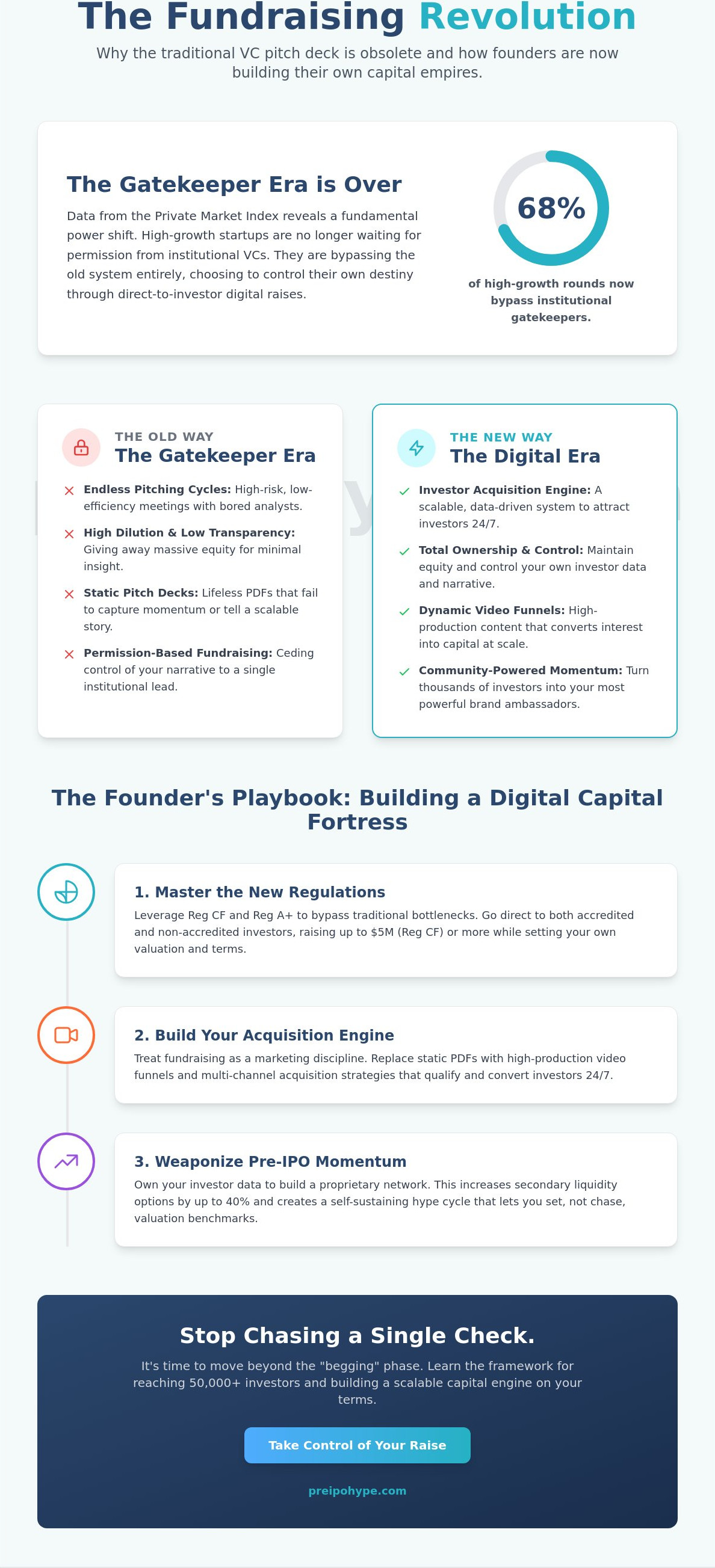
The traditional VC pitch deck is officially a dead asset. By the start of 2026, data from the Private Market Index shows that 68% of high-growth rounds now bypass the standard institutional gatekeeper entirely. You’ve likely felt the exhaustion of endless pitching cycles that lead to nothing but high dilution and a total lack of transparency. Identifying the best way to raise money for a startup today requires a fundamental shift in strategy. It's no longer about chasing a single check; it's about building a scalable investor acquisition engine that manufactures its own momentum.
You know the old model is broken and you're tired of giving away massive equity for crumbs. This guide promises to show you how to move beyond the "begging" phase and start building a digital capital fortress on your own terms. We'll break down the exact framework for reaching 50,000+ retail and accredited investors while maintaining total ownership of your data. You're about to discover how to engineer secondary liquidity and secure the high-valuation benchmarks that define the next generation of elite unicorns.
Key Takeaways
- Identify why the "Gatekeeper Era" of venture capital is ending and how the shift to digital fundraising allows you to secure capital on your own terms.
- Master the strategic use of Reg CF and Reg A+ as the best way to raise money for a startup while bypassing traditional institutional bottlenecks.
- Analyze the hidden costs of capital to determine whether venture capital or a digital raise offers the most efficient path to scaling your valuation.
- Learn to build a scalable investor acquisition engine that leverages tracking, attribution, and a story framework to trigger a self-sustaining hype cycle.
- Gain the insider’s advantage by weaponizing pre-IPO momentum to bridge the gap between private secrecy and explosive public market opportunity.
The Evolution of Startup Capital: Why the Best Way to Raise Money Has Changed
The era of the gatekeeper is dead. Ten years ago, the only path to a Series A was a warm intro to a handful of partners at top-tier firms in Silicon Valley. Today, the best way to raise money for a startup has pivoted from private begging to public demand. We've transitioned from the Gatekeeper Era into the Digital Era, where capital is no longer a favor granted by an elite few but a commodity acquired through strategic positioning. In 2024, global venture funding reached approximately $285 billion, yet the most successful founders are increasingly looking beyond traditional institutional silos to fuel their growth.
Traditional pitching is a relic of a slower age. Relying on a 45-minute boardroom meeting to secure your company's future is a high-risk, low-efficiency strategy. In the modern startup ecosystem, founders are treating fundraising as a marketing discipline known as Investor Acquisition. It's about building a digital presence that creates a sense of inevitability. When you generate enough momentum, or "hype," you stop chasing valuation benchmarks and start setting them. This shift allows you to hunt for unicorn status on your own terms.
To better understand this concept, watch this helpful video:
The Death of the Traditional Pitch Deck
Static PDFs are where excitement goes to die. They fail to capture the velocity and energy of high-growth opportunities. Modern capital raises utilize high-production video funnels to tell a story that scales. Instead of repeating the same pitch 50 times to bored analysts, smart founders deploy a 24/7 digital salesperson that qualifies investors before they ever hop on a call. Digital fundraising is a multi-channel acquisition strategy that leverages data and content to convert high-net-worth interest into committed capital at scale.
Ownership vs. Permission: The New Founder Power Dynamic
Relying on a single institutional lead investor is a dangerous game that cedes control of your narrative. Data from recent private market cycles indicates that founders who owned their investor leads saw a 40% increase in secondary liquidity options compared to those tied to a single firm. Owning your investor data means you aren't just raising money; you're building a proprietary network of supporters. This "Informed Insider" perspective treats the private market as a transparent frontier. You don't need permission to scale when you control the distribution of your own equity and maintain direct access to the ground floor of your cap table.
Democratizing the Ground Floor: The Strategic Power of Equity Crowdfunding
The venture capital landscape changed forever when the SEC modernized digital raises. For many founders, the best way to raise money for a startup in 2026 isn't begging at a traditional venture firm; it's going direct to the crowd. Digital capital raises through Regulation Crowdfunding (Reg CF) and Reg A+ have facilitated over $100 million in capital for high-growth firms within the last 24 months. This shift puts the power back in your hands. You set the valuation. You define the terms. You decide who gets a seat at the table.
While traditional government funding for startups remains a stable foundation for many, equity crowdfunding offers a layer of momentum that debt simply can't match. It creates a psychological moat. When 2,000 people invest $500 each, you don't just have capital; you have 2,000 brand ambassadors who'll fight for your success in the market. This community becomes your most aggressive marketing department.
Reg CF: The Seed Round Reimagined
Reg CF allows companies to raise up to $5 million annually from both accredited and non-accredited investors. It's the ultimate democratizer. The compliance process is streamlined, offering a speed-to-market advantage that traditional seed rounds lack. You can go from filing to funding in weeks, not months. Success here depends on the narrative. You aren't just selling equity; you're selling a movement. To win, you need a strategy that triggers the hype cycle early. You can learn about Reg CF marketing services to see how elite firms engineer this momentum.
Reg A+: The 'Mini-IPO' for Late-Stage Growth
When you're ready to scale toward a $75 million ceiling, Reg A+ becomes the logical evolution. It's often called a "Mini-IPO" because it offers public-like visibility without the massive compliance price tag of a NASDAQ listing. This is the best way to raise money for a startup that's already found product-market fit and needs a bridge to a formal IPO. By using omnichannel outreach, you can engage high-ticket investors across social, email, and programmatic ads. This level of exposure builds secondary market interest before you even hit the public boards. If you're wondering how your specific valuation fits into this digital framework, you can ask our CEO for a direct perspective on your capital roadmap.
Venture Capital vs. Digital Raises: Choosing Your Path to Scale
Is venture capital still the gold standard for growth? In 2026, the answer is no longer a simple yes. Founders are discovering that the best way to raise money for a startup isn't a binary choice between institutional gatekeepers and the slow grind of bootstrapping. It's about leverage. While VCs provide massive capital injections, they demand a 10x exit or total liquidation. Bootstrapping preserves your soul but often kills your speed. Equity crowdfunding and digital raises have emerged as the high-velocity middle ground, offering the capital of a VC with the community power of a movement.
The true cost of capital goes far beyond interest rates or equity percentages. You have to calculate the "drag" on your time. A 2024 study by Carta revealed that founders spend an average of 30% of their weekly hours managing board expectations and reporting requirements after a traditional Series A. Digital raises via a Special Purpose Vehicle (SPV) eliminate this friction. You get the funds you need without the weekly interrogation. This is the "insider" secret: elite founders use a hybrid approach. They secure a lead institutional investor for validation, then launch a digital raise to drive the valuation higher through public momentum. This "Hype Cycle" isn't just noise; it's a strategic financial indicator that forces traditional firms to pay a premium to stay in the deal.
The most common objection is that a "crowded" cap table hurts your chances of a VC exit. This is an outdated myth. By 2026, the infrastructure for digital raises has matured. When structured correctly, thousands of investors appear as a single line on your cap table. In fact, data from 2025 showed that 45% of successful Series B startups featured at least one community-funded round in their history. VCs don't fear the crowd anymore; they fear missing out on the brand loyalty the crowd represents.
Control and Governance Benchmarks
VCs often demand veto rights on future sales and mandatory board seats. In contrast, digital raises allow you to dictate the terms. By using an SPV, you centralize thousands of micro-investors into one voting block that you control. This flexibility is essential for maintaining your original vision while scaling at light speed. To understand how to set up these systems, read The Foundation Infrastructure of Elite Raises for a deep dive into the technical requirements.
Valuation and Momentum
Digital raises create a public-facing ticker of your success. When a raise hits 200% of its goal within 72 hours, you've created "social proof" that no pitch deck can match. This momentum is the best way to raise money for a startup because it shifts the power dynamic. You aren't begging for a check; you're inviting investors to join a train that's already left the station. High-net-worth leads who were on the fence will often commit the moment they see the digital "hype" translating into real-time capital. It's about turning your fundraise into an event that the market can't ignore.
The Founder’s Playbook: Building an Investor Acquisition Engine
Stop treating your fundraise like a series of awkward coffee dates and start treating it like a high-performance sales funnel. In 2026, the best way to raise money for a startup is to engineer a digital acquisition engine that operates with mathematical precision. This isn't about hope; it's about infrastructure. You need a system that captures interest, nurtures trust, and identifies capital at scale while you focus on building the product.
Step 1: Establishing Foundation Infrastructure. Your raise lives or dies by your data. You must implement advanced tracking and attribution models that monitor the 60-day investor journey. If you cannot attribute a $100,000 commitment to a specific LinkedIn ad or a 14-day email retargeting sequence, you're wasting your most valuable asset: time.
Step 2: Creating the Story Framework. To trigger the hype cycle, your narrative must act as a financial instrument. It's not just about what you do, but the inevitable future you represent. Momentum is the only currency that matters in the private markets. When investors see a narrative gaining velocity, the fear of missing out overrides their natural skepticism.
Why Your Raise Needs a Custom Investor CRM
Generic CRMs are built for selling software, not for managing the nuances of private equity. They fail to track the long-tail attribution windows required to close elite capital. A custom investor CRM allows you to implement sophisticated lead scoring. This is how you identify the whales in a sea of retail interest. By analyzing engagement metrics, you can focus your energy on the top 4% of leads who control 80% of the potential capital. For a deep dive into the tech stack, see The Custom Investor CRM Guide.
Omnichannel Mastery in Fundraising
Omnichannel outreach is the synchronization of multiple digital touchpoints across search, social, and email to build elite trust through repeated, high-value exposure. By coordinating Google Search intent with Meta retargeting and LinkedIn thought leadership, you create an "everywhere" effect. This makes your startup feel like an inevitable market leader. Integrating your message into pre-vetted investor newsletters can increase conversion rates by 22% compared to cold outreach. It’s about being present wherever your target investors consume data.
Step 5: Lead Scoring and High-Touch Conversion. The final stage of the engine is the transition from digital automation to institutional closing. Your system identifies the high-intent signals; your executive team executes the final high-touch conversion. This ensures your CEO only spends time on the phone with verified, qualified capital sources who are ready to sign. This is the best way to raise money for a startup without sacrificing your operational focus.
Ready to deploy a high-velocity acquisition engine for your next round? Consult with our lead strategist to see how we build digital momentum for elite founders.
Pre-IPO Hype: Turning Momentum into Millions
Raising capital isn't just about a pitch deck anymore; it's about engineering a movement. For founders looking for the best way to raise money for a startup in 2026, the traditional "quiet period" is a relic of the past. Pre-IPO Hype bridges the gap between private secrecy and public opportunity by weaponizing visibility. We've replaced the slow, manual grind of networking with proprietary marketing systems that put your brand in front of the right eyes at the exact moment they're looking for the next big exit.
This is the true insider advantage. We don't wait for the market to find you. We use data-driven precision to convert passive curiosity into committed capital. By the time a lead reaches out, they've already been nurtured through a high-velocity digital ecosystem designed to build trust and urgency simultaneously. It's a calculated transition from being a "best-kept secret" to becoming a market leader.
- Proprietary Systems: Access marketing funnels specifically tuned for high-net-worth acquisition.
- Data Precision: Move beyond broad targeting to reach investors based on verified interest and liquidity.
- Momentum Engineering: Create a sense of inevitability around your funding round or secondary offering.
Facilitating the $100M+ Milestone
The numbers speak for themselves. More than 230 companies have utilized our proprietary framework to scale their valuations and secure liquidity. This isn't accidental growth. It's the result of systems engineered by "Fuzzy" Wenzel, who pioneered the modern hype cycle to ensure private companies command public-level attention. He understands that in 2026, attention is the most valuable currency in the private markets. If you're ready to stop guessing and start scaling, you can Ask our CEO a question to see how these mechanics apply to your specific industry.
Your Private Market Roadmap
The path to an elite investment circle requires a roadmap, not a prayer. During the first 60 days of a managed campaign, we focus on aggressive infrastructure building and audience segmentation. We don't just broadcast; we target. This phase ensures your narrative is bulletproof before the floodgates open. It's the best way to raise money for a startup while maintaining control over your valuation and your time.
Securing your spot in the next elite circle isn't guaranteed. We work with a select group of founders who possess the vision to match our execution. To see if your company is ready for the next level of digital capital, Book a strategy session with the Pre-IPO Hype team and let's map out your path to the next milestone today.
Own the Future of Digital Capital
The landscape of private equity has shifted permanently. By 2026, traditional venture capital gatekeepers are no longer the only path to scale. Success today requires a strategic blend of digital equity crowdfunding and high-velocity momentum. We have proven that the best way to raise money for a startup is to build a sophisticated investor acquisition engine that turns public interest into private capital. You don't have to wait for a seat at the table when you can build your own.
Since 2015, Pre-IPO Hype has mastered omnichannel marketing to bridge the gap between private secrecy and public opportunity. Our team has facilitated over $100M for more than 230 companies using a proprietary Custom Investor CRM designed for high-stakes growth. It's time to stop chasing checks and start engineering your own liquidity events. The ground floor is open for those ready to act decisively.
Scale your capital raise with the Pre-IPO Hype Investor Acquisition Engine
Take your place among the elite founders who are rewriting the rules of finance. Your next big exit starts with the right momentum.
Frequently Asked Questions
What is the best way to raise money for a startup without a network?
The best way to raise money for a startup when you lack a deep Rolodex is leveraging Regulation Crowdfunding. This digital path lets you bypass traditional gatekeepers by marketing your opportunity directly to the public. In 2023, startups raised over $500 million through these portals, proving that digital momentum and "hype" often outweigh personal connections in the modern capital landscape.
How much does it cost to start an equity crowdfunding campaign?
Launching a campaign typically requires an upfront investment of $5,000 to $15,000 for legal and accounting reviews. Once the campaign is live, FINRA-regulated platforms charge a success fee between 5% and 8% of the total capital raised. You should also budget roughly 10% of your target goal for digital marketing to ensure your offering reaches the right audience.
Is Reg CF or Reg A+ better for an early-stage startup?
Reg CF is almost always the superior choice for early-stage ventures because it's faster and less expensive than Reg A+. While Reg A+ allows you to raise up to $75 million, the SEC qualification process takes roughly 150 days and costs over $50,000 in legal fees. Reg CF lets you secure up to $5 million with a simple Form C filing.
Can I still raise venture capital after a crowdfunding round?
You can absolutely raise venture capital after a crowdfunding round, provided you use a Special Purpose Vehicle to keep your cap table clean. Modern VCs often view a successful digital raise as social proof of product-market fit. Data shows that companies with a strong community of 1,000 micro-investors often scale faster because they have a built-in army of brand ambassadors.
What documents do I need for a Regulation Crowdfunding raise?
To initiate a raise, you must file Form C with the SEC. This document includes your financial statements, a clear description of your business, and the specific use of proceeds. If you're targeting more than $124,000, you'll need financial statements reviewed by an independent CPA. This process usually takes 3 to 4 weeks to complete before you can go live.
How long does it typically take to raise $1 million digitally?
Raising $1 million digitally typically takes 4 to 6 months from initial preparation to the final wire transfer. You'll spend the first 60 days building your "hype" assets, including your pitch deck and video. Once live, the most successful campaigns hit their funding milestones within 90 days by maintaining a high-velocity marketing rhythm that keeps the investor community engaged.
What is an Investor CRM and why do I need one?
An Investor CRM is a specialized database designed to track every interaction with potential backers. It's your most critical tool for managing the 500 plus leads generated during a digital raise. Without one, you'll lose track of follow-ups and miss the opportunity to convert interest into hard capital. It turns a chaotic fundraising effort into a predictable, data-driven machine for growth.
How do I find accredited investors for my private placement?
The best way to raise money for a startup from accredited investors is through a Rule 506(c) offering combined with precision digital targeting. This regulation allows you to publicly advertise your raise to the 16 million accredited households in the United States. By using LinkedIn and Meta ads to target high-net-worth individuals, you can build an exclusive list of backers ready for a liquidity event.
Disclaimer
Educational only. Not investment, tax, or legal advice. Pre-IPO Hype is investor relations infrastructure for Regulation CF and Regulation A+ raises. We are not a broker-dealer, funding portal, or investment adviser, and we do not offer or sell securities or make investment recommendations. Any securities offering is made only by the issuer, through its own offering documents and, where required, a registered intermediary.


