
The Hidden Costs of Raising Capital: The Founder’s Guide to Total Cost of Ownership in 2026
What if the most expensive part of your next round isn't the equity you're giving up, but the $200,000 in unbudgeted friction costs required to close it? Most founders fixate on the sticker price of legal retainers, yet they remain blind to the hidden costs of raising capital that quietly erode their ownership before the first wire hits. You've likely felt the anxiety of "dead air" during a campaign or the overwhelm of technical SEC compliance. These invisible drains can derail even the most promising market momentum.
This guide uncovers the financial, operational, and strategic leaks that threaten your cap table in 2026. We'll show you how to move beyond the "fundraising iceberg" by establishing a predictable budget and minimizing dilution through efficient scaling. You're about to learn how to deploy a professional, high-momentum investor acquisition system that treats fundraising as the high-stakes digital operation it has become. We'll explore the path to a cleaner close and a more secure future for your company.
Key Takeaways
- Recognize the "Iceberg Effect" where platform fees represent only a fraction of the total capital required to successfully close your round.
- Navigate the hidden costs of raising capital by budgeting for SEC-mandated compliance and the digital marketing gap that separates founders from elite investors.
- Protect your cap table from excessive dilution by calculating the opportunity cost of manual outreach and the technical price of fragmented data.
- Build a high-momentum acquisition system using foundation infrastructure and a Custom Investor CRM to automate your omnichannel outreach.
- Transition from a series of exhausting meetings to a scalable digital operation that leverages market momentum to secure capital efficiently.
The Fundraising Iceberg: Why the Sticker Price is Never the Total Cost
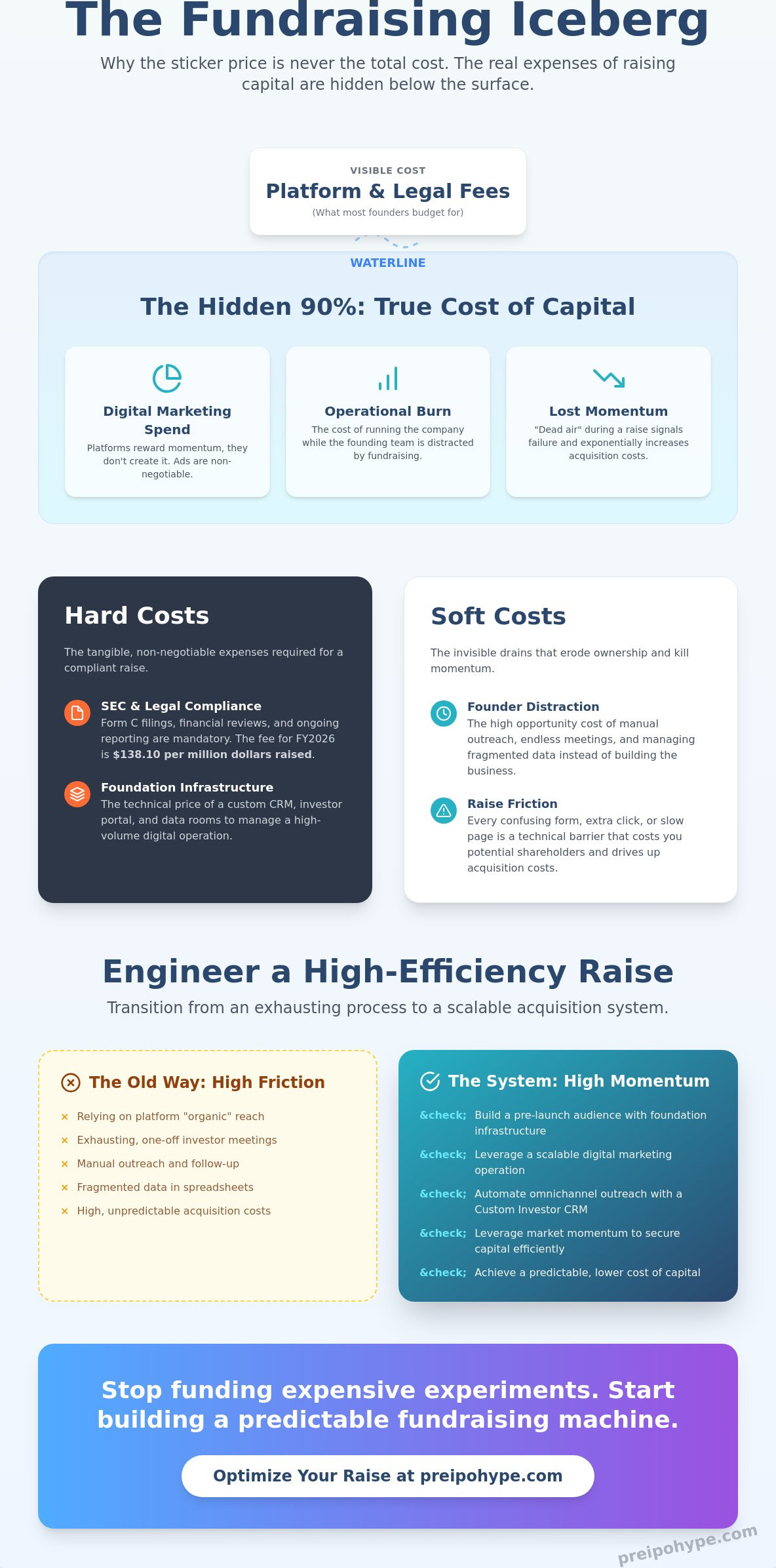
What is the true price of your capital? Most founders focus on the platform fee, usually a visible percentage of the total raise. That is a dangerous mistake. In the world of high-stakes finance, that fee is merely the tip of the iceberg. The hidden costs of raising capital represent the massive delta between that platform fee and the total capital deployed to actually close the round. This 90% below the surface includes the operational burn, marketing spend, and technical overhead that most budgets ignore until it's too late.
Calculating your true cost of capital requires a cold look at the Raise Efficiency Ratio. This metric defines exactly how much it costs your company to acquire $1 of investment. If you're spending $0.25 to bring in $1, your "successful" raise is actually a high-interest loan against your future. Understanding this ratio is the difference between scaling a sustainable business and simply funding a series of expensive marketing experiments.
To better understand how filing fees and regulatory requirements contribute to these figures, watch this helpful video:
Success in the 2026 market demands a shift in perspective. Digital-first raises under Reg CF and Reg A+ aren't just "fundraising"; they are high-volume digital marketing operations. Unlike traditional VC, where the costs are concentrated in legal fees and pitch decks, these modern rounds carry a different cost profile. You aren't just selling equity. You're buying attention in a crowded market. If your acquisition strategy isn't surgical, the hidden costs of raising capital will cannibalize your runway before you reach your milestones.
Beyond the Platform Fee: The Reality of Modern Raises
Relying on a crowdfunding platform's "organic" reach is a recipe for a flatline. These platforms are marketplaces, not growth agencies. They reward momentum; they don't create it. Without a robust Foundation Infrastructure in place before you spend your first dollar on ads, you're effectively pouring capital into a leaky bucket. Strategic outreach and pre-launch warming are essential to lower your long-term acquisition costs. It's about building a movement so that when the round opens, the capital follows the crowd you've already assembled.
The Psychology of Capital: Why Inefficiency Kills Momentum
Momentum is the only currency that matters in a public raise. "Dead air" during a campaign is more than just quiet. It's a signal of failure that breeds investor skepticism and drives up your follow-up costs. Every day your campaign stays stagnant, your acquisition cost spikes. Friction in the investor journey is another invisible drain on your resources. Every extra click, every confusing form, and every slow-loading page costs you potential shareholders. We define "Raise Friction" as the technical and psychological barriers that prevent a lead from becoming a shareholder.
The 'Hard' Costs: Legal, Compliance, and the Digital Marketing Gap
Hard costs are the non-negotiable tolls on the road to liquidity. Many founders treat these as secondary line items, but they are the structural framework of your entire raise. If the framework is weak, the whole structure collapses under regulatory scrutiny. SEC-mandated requirements represent a significant portion of the hidden costs of raising capital. For fiscal year 2026, the SEC fee rate for registration of securities is $138.10 per million dollars. While that sounds manageable, the true expense lies in the preparation of Form C filings, financial reviews, and the ongoing reporting requirements that keep your company in good standing.
The price of non-compliance is far higher than the cost of doing it right the first time. Unvetted ad copy or improper solicitation can trigger regulatory freezes that kill your momentum instantly. High-stakes financial authority requires elite Content Creation and Strategy to build trust with sophisticated investors. You aren't just posting updates; you're building a narrative of institutional-grade opportunity. This level of authority demands a budget for high-fidelity assets that reflect the future value of your enterprise.
Legal and Regulatory Bedrocks
The legal spend varies wildly depending on your chosen path. A typical Reg CF raise might require a financial "review," but moving into Reg A+ territory often necessitates a full financial audit and a much larger war chest for legal counsel. In 2026, legal fees for a standard Series A round typically range from $75,000 to $200,000. To navigate these complexities without draining your treasury, you must audit your Foundation Infrastructure. This technical bedrock ensures your data is ready for the intense scrutiny of due diligence.
The Digital Acquisition Engine
The Marketing Gap is where most raises fail. Founders often budget for ad spend but forget the management fees required for true omnichannel mastery. It's not enough to just run ads; you need a team to manage the Digital Marketing and Advertising engine across multiple platforms. You must also account for "Creative Fatigue." The hype cycle requires a constant stream of fresh assets to keep investor interest from stagnating. Smart founders also budget for newsletter exposure to prime the investor pump before the main campaign begins. If you are unsure how to allocate your resources for maximum impact, you can discuss your specific budget needs with an expert who understands the 2026 landscape.
The 'Soft' Costs: Dilution, Distraction, and the Price of Poor Data
Beyond the line items of legal retainers and filing fees lies a more insidious threat to your enterprise value. These are the soft costs, the invisible drains on your most precious resources: time, focus, and equity. The hidden costs of raising capital often manifest as the "Founder Distraction Tax." When a CEO spends 40 hours a week on manual outreach and lead qualifying, the core business stagnates. This opportunity cost is massive. Every hour spent playing the role of a junior SDR is an hour not spent on product innovation or strategic partnerships that actually drive the valuation you're trying to sell.
Data Leakage is another silent killer. Most founders operate with fragmented systems that lose track of 60-day attribution and investor lead scoring. Without institutional-grade tracking, you're effectively flying blind. This lack of precision leads to poor negotiation. When you're driven by the desperation of a slow, leaking funnel, you're more likely to accept restrictive covenants and deeper dilution. A messy cap table today doesn't just hurt your current ownership; it makes your Series A significantly more expensive. Institutional investors in 2026 are wary of "broken" cap tables, often demanding even more aggressive terms to clean up the debris of a poorly managed seed round.
Spreadsheets vs. Custom Investor CRM
The technical gap between a manual spreadsheet and a dedicated system is where momentum either lives or dies. Relying on manual tracking is a high-risk strategy that results in zero attribution and high investor churn. Transitioning to a Custom Investor CRM allows you to engineer momentum through data-driven precision. This shift enables true Omnichannel Outreach, drastically reducing the time-to-close for individual investors by keeping your brand present across every touchpoint they frequent.
| Feature | Manual Tracking (Spreadsheets) | Custom Investor CRM |
|---|---|---|
| Attribution | Zero visibility on lead source | Full 60-day multi-touch tracking |
| Follow-up | Manual, inconsistent, and slow | Automated, high-frequency sequences |
| Lead Scoring | Subjective "gut feel" | Algorithmic scoring based on engagement |
| Hidden Cost | High "Investor Churn" and wasted spend | Optimized CAC and high momentum |
The Opportunity Cost of Misaligned Momentum
In the current fundraising environment, where the average time to close a fund has reached a record 17.5 to 18 months, speed is your greatest competitive advantage. A slow raise is a public signal of weakness. It suggests that the market has looked at your deal and passed, which drives up the cost of any future capital you attempt to secure. Investor Churn is the direct result of this stagnation. Leads who express initial interest but leak out of the funnel due to a lack of sophisticated follow-up are essentially lost capital. Investor Attribution is the ability to track an investor from the first ad click to the final wire transfer. Without this capability, you're simply guessing which parts of your strategy are working, leading to thousands in wasted ad spend and unnecessary dilution.
Strategic Mitigation: Engineering a High-Efficiency Capital Raise
High-stakes fundraising is no longer a game of chance or a series of lucky meetings. It is a calculated engineering problem. To neutralize the hidden costs of raising capital, you must transition from a reactive posture to a proactive, data-driven operation. This shift begins long before you launch your campaign page. By treating your raise as a high-performance acquisition engine, you can protect your equity and ensure every dollar of your budget is working toward a close.
The first move is a rigorous audit of your Foundation Infrastructure. Launching without this technical bedrock is the fastest way to invite budget overruns. Once your foundation is secure, implement a Custom Investor CRM to automate your Omnichannel Outreach and lead scoring. This allows you to scale your presence without scaling your manual workload. You must also establish a Story Framework that speaks with authority to both institutional gatekeepers and retail investors. This dual-track narrative reduces acquisition costs by building trust faster. Finally, deploy Analytics and Performance Tracking to maintain a 48-hour kill window on underperforming ads, and leverage Consulting and Advisory Services to navigate the regulatory and strategic pitfalls that trap less-prepared founders.
Building the Technical Bedrock
A Custom Investor CRM isn't a luxury; it's the only way to manage the sheer volume of a modern Reg CF or Reg A+ campaign without losing your mind. In an environment where investor caution has extended due diligence to 6-9 months on average, you cannot rely on memory. Lead Scoring is your most powerful tool for protecting the CEO's time. By algorithmically identifying high-net-worth prospects based on engagement data, your executive team stays focused on closing the biggest checks while the system handles the rest. To see how these pieces fit into your specific roadmap, explore our Consulting and Advisory Services for a tailored infrastructure plan.
Optimizing the Acquisition Funnel
Omnichannel Mastery allows you to stay top-of-mind across LinkedIn, X, and financial newsletters without ballooning your daily ad budget. It's about frequency, not just reach. The secret lies in 60-Day Attribution. Most investors require multiple touchpoints across different platforms before they commit capital. If you only track the last click, you'll mistakenly kill the very ads that are priming your biggest investors. Reducing "Creative Friction" through pre-planned content cycles ensures your campaign maintains its rhythmic momentum, preventing the "dead air" that signals weakness to the market. Stop guessing where your next check is coming from. You can schedule a high-level strategy session to engineer a more efficient acquisition funnel today.
Navigating the Hype: How Pre-IPO Hype Optimizes the Raise
Fundraising is a high-velocity operation, not a series of polite requests. To successfully lead a round in 2026, you need more than a pitch deck; you need an elite system that eliminates the hidden costs of raising capital before they impact your cap table. Pre-IPO Hype acts as your insider guide to this gated financial world. We replace the standard, fragmented approach with superior technology that turns market momentum into a measurable asset. Our Omnichannel Outreach systems have already facilitated over $100 million in funding for our partners, proving that precision beats volume every time.
The ultimate goal is a capital raise that feels like a movement, not a transaction. When you deploy our Custom Investor CRM, you aren't just tracking leads. You're engineering curiosity into capital. This system allows you to maintain a steady pulse of opportunity, ensuring that every touchpoint reinforces your authority and drives the round toward a realization event. We specialize in connecting restricted information with broader opportunity, making your company's growth feel inevitable to those who act decisively.
The Pre-IPO Hype Advantage
Over 230 companies have chosen our data-driven marketing systems to power their raises. They recognize that in a crowded market, generic strategies lead to expensive stagnation. Our Foundation Infrastructure is designed specifically to prevent the data leakage that plagues most startups. We capture every interaction, ensuring your attribution is flawless and your spend is optimized. To prime the pump, we offer exclusive Newsletter Exposure through Invst Guru. This channel places your opportunity directly in front of a pre-qualified audience that is already looking for the next high-growth vehicle. It's about early entry into rare opportunities, backed by the credibility of an established financial voice.
Your Next Move in the Capital Markets
The 2026 fundraising environment doesn't reward those who guess. It rewards those who engineer. If you're tired of the "Founder Distraction Tax" and the anxiety of "dead air" during your campaign, it's time to change your strategy. You can stop wondering if your budget is sufficient and start deploying a system that guarantees efficiency. Every day you wait is a day of potential dilution or lost momentum. The keys to this gated world are within reach for founders who are ready to scale with institutional-grade precision.
Your path to a high-momentum close starts with a single decision. You can schedule a 30-minute strategy session with our team to begin auditing your infrastructure and planning your acquisition engine. If you have specific questions about the technical or regulatory hurdles ahead, you can also ask our CEO anything about your upcoming raise. The market is moving fast. Don't let the hidden costs of raising capital be the reason you fall behind.
Mastering the Capital Markets of Tomorrow
The era of "spray and pray" fundraising is over. You've seen how the hidden costs of raising capital can silently drain your treasury and dilute your ownership through technical friction and data leakage. By shifting from a reactive mindset to a calculated, infrastructure-first approach, you transform your raise from a source of anxiety into a scalable engine of growth. It's about maintaining momentum when the market demands proof of traction. Success in 2026 belongs to the founders who treat investor acquisition with the same surgical precision as their core product development.
We've already paved this path for over 230 companies, facilitating more than $100M in funding through high-velocity digital systems. Our proprietary Custom Investor CRM is the key to this gated financial world, ensuring that no lead is lost and every touchpoint is tracked with institutional-grade authority. You don't have to navigate these complexities alone or guess at your next budget. The tools to secure your future are ready for deployment.
The market rewards those who act with speed and data. Your next realization event is closer than it looks, and the opportunity to scale has never been more accessible for those who act decisively.
Frequently Asked Questions
What are the most common legal fees for a Reg CF raise?
Legal fees for a Regulation Crowdfunding raise typically cover the preparation of Form C filings, financial reviews, and the drafting of investor agreements. While a simple SAFE financing round might start around $5,000 for counsel, a full Reg CF campaign often requires a larger budget to handle the increased disclosure requirements and accounting reviews. These expenses are part of the hidden costs of raising capital that founders must account for to avoid late-stage budget shortfalls.
How much should a startup budget for marketing during a capital raise?
A strategic raise usually requires a budget between 10% and 20% of the total funding goal for investor acquisition. This isn't just overhead; it's a capital expense used to drive the digital acquisition engine across multiple platforms. In 2026, small businesses typically spend between $1,500 and $5,000 per month on digital marketing just to maintain visibility, but a high-momentum raise demands a more aggressive, targeted approach to cut through market noise.
Is a Custom Investor CRM necessary for a small funding round?
Yes, because efficiency is even more critical when margins are tight and every lead counts. A Custom Investor CRM prevents the data leakage that occurs when founders rely on manual spreadsheets to track interest. Even in a smaller round, the ability to automate omnichannel outreach ensures that no potential investor falls through the cracks, allowing the CEO to focus on high-value closings rather than administrative data entry.
What is the "Founder Distraction Tax" in fundraising?
The Founder Distraction Tax is the massive opportunity cost incurred when a CEO spends 40 or more hours a week on manual outreach instead of core business growth. When leadership focus shifts entirely to the raise, product development and strategic partnerships often stagnate. This distraction is one of the most expensive hidden costs of raising capital because it can lead to a lower valuation by the time the round actually closes.
How can I reduce the cost of investor acquisition?
Reducing acquisition costs requires a robust foundation infrastructure and a data-driven approach to targeting. By leveraging newsletter exposure to pre-qualified audiences and implementing automated lead scoring, you can identify high-intent investors faster. This precision allows you to kill underperforming ads quickly and double down on the channels that actually move the needle, preventing wasted spend on disinterested leads.
What happens if I don’t hit my funding goal?
If you don't hit the minimum funding goal in an all-or-nothing raise like many Reg CF structures, all committed funds are returned to investors. This scenario is the ultimate hidden cost, as the time, legal fees, and marketing capital spent on the campaign are completely lost. It's a public signal of weakness that can make future attempts to secure capital significantly more difficult and expensive.
How much does Pre-IPO Hype charge for campaign management?
Our fees are structured based on the specific scope of the campaign and the level of infrastructure required to meet your funding goals. We focus on creating a high-efficiency system that maximizes your raise efficiency ratio rather than charging a one-size-fits-all flat rate. Because every raise has unique technical and strategic needs, we recommend a consultation to determine the most effective roadmap for your company.
Can I raise capital without a digital marketing budget?
Raising capital without a digital marketing budget is possible but extremely high-risk in the current 2026 landscape. Relying solely on a platform's "organic" reach often leads to "dead air," which kills momentum and breeds investor skepticism. Without a dedicated budget for digital marketing and advertising, you lose the ability to control your narrative and reach the specific, high-net-worth individuals necessary to close a round efficiently.
Disclaimer
Educational only. Not investment, tax, or legal advice. Pre-IPO Hype is investor relations infrastructure for Regulation CF and Regulation A+ raises. We are not a broker-dealer, funding portal, or investment adviser, and we do not offer or sell securities or make investment recommendations. Any securities offering is made only by the issuer, through its own offering documents and, where required, a registered intermediary.


