
The Real Cost to Run a Reg CF Campaign in 2026: An Insider’s Budgeting Guide
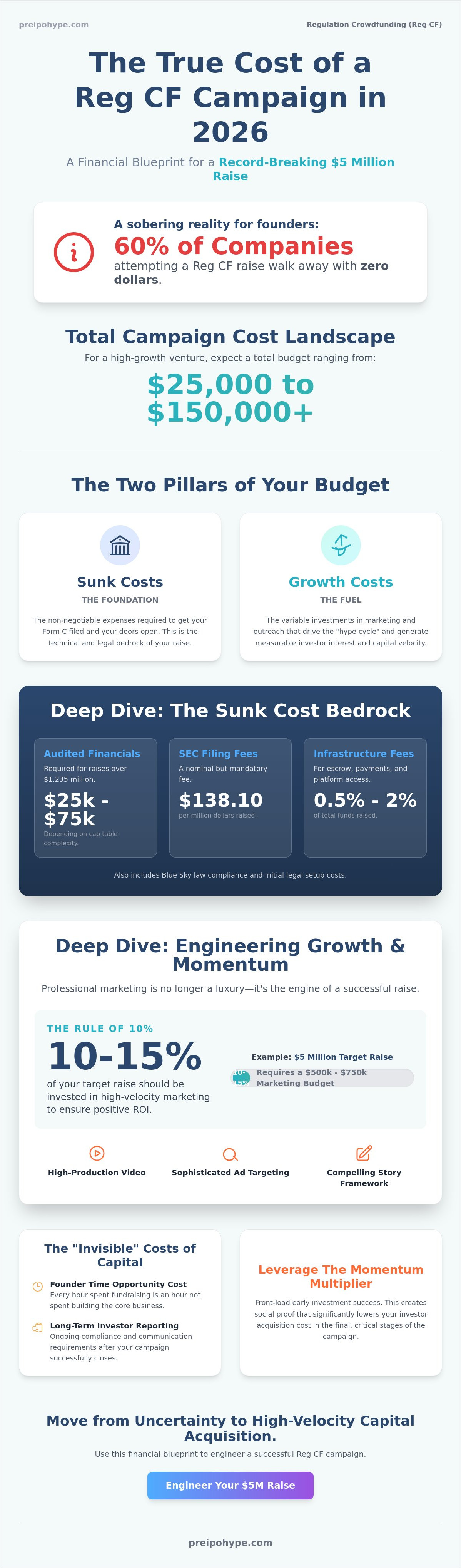
Did you know that 60% of companies attempting a Regulation Crowdfunding raise walk away with exactly zero dollars? It is a sobering reality for founders who treat capital raising like a lottery rather than a precision-engineered operation. Understanding the total cost to run a Reg CF campaign in 2026 is the primary difference between a stalled launch and a record-breaking $5 million exit.
You're likely feeling the pressure of hidden platform fees and the volatile nature of digital ad performance. It is frustrating to watch upfront legal and accounting costs climb before a single dollar hits your escrow account. We're here to change that narrative. This guide provides the exact financial blueprint you need to move from uncertainty to high-velocity capital acquisition. We will break down the $138.10 per million SEC filing fees, the 10% to 15% marketing spend required for market momentum, and how to structure your budget to ensure every dollar deployed generates measurable investor interest.
Key Takeaways
- Distinguish between static "sunk" costs like legal filings and the high-velocity marketing spend required to hit a $5M target.
- Master the "Rule of 10%" to accurately forecast the total cost to run a Reg CF campaign and ensure your marketing ROI remains positive.
- Understand how foundation infrastructure and custom investor CRM systems create a technical bedrock for seamless capital acquisition.
- Leverage the "Momentum Multiplier" to front-load early success, which significantly lowers your investor acquisition costs in the final stages.
- Quantify the "invisible" costs of capital, including the opportunity cost of founder time and the long-term requirements of investor reporting.
The 2026 Reg CF Cost Landscape: Fixed vs. Variable Expenses
Launching a high-growth venture requires more than just a vision; it demands a clear understanding of the capital velocity required to cross the finish line. In 2026, the total cost to run a Reg CF campaign typically ranges from $25,000 to over $150,000. This is a significant departure from the early days of crowdfunding when founders could scrape by on shoestring budgets. The expansion of the raise limit to $5 million has fundamentally shifted the market. It transformed these offerings from "digital bake sales" into institutional-grade capital events that require professional compliance and aggressive market positioning.
To better understand the mechanics of this regulatory framework, watch this helpful video:
Smart founders categorize their budget into two distinct buckets: "Sunk Costs" and "Growth Costs." Sunk costs are the non-negotiable expenses required to get your Form C filed and your doors open. Growth costs are the variable investments in marketing and outreach that actually drive the "hype cycle." Without a strategic roadmap to balance these, you risk budget leakage that can drain your reserves before you even go live.
The "Sunk" Costs: Legal, Accounting, and Filing
Compliance is the technical bedrock of your raise. Since the inception of Regulation CF, the SEC has refined its requirements to protect both issuers and investors. For fiscal year 2026, the SEC filing fee is set at $138.10 per million dollars raised. While that might seem nominal, the real weight lies in financial disclosures. If you are targeting a raise over $1.235 million, you must provide audited financials from an independent CPA. This can cost anywhere from $25,000 to $75,000 depending on the complexity of your cap table. Don't forget Blue Sky law compliance; even though Reg CF offers federal preemption, you'll still face state-level filing fees that add up when you're targeting a national audience of investors.
The "Growth" Costs: Where Momentum Is Built
If legal is the engine, marketing is the fuel. Professional Reg CF marketing services are no longer a luxury. They are a necessity for any founder serious about hitting a $5 million cap. You should expect to invest heavily in high-production campaign videos and sophisticated story frameworks. In a market flooded with opportunities, "cheap" or amateur content is a signal of risk to sophisticated retail investors. It leads to expensive rejection. High-velocity marketing spend usually mirrors 10% to 15% of your target raise. This ensures your cost to run a Reg CF campaign remains an investment in ROI rather than a drain on your balance sheet.
Regulatory and Infrastructure Costs: The Technical Bedrock
Building a $5 million raise requires more than a compelling narrative; it requires a robust technical foundation that withstands regulatory scrutiny. While the previous section touched on broad costs, the plumbing of your campaign-the portals, escrow accounts, and data tracking-represents a significant portion of your capital outlay. For a comprehensive breakdown of Reg CF campaign costs, one must look closely at the "success fees" and infrastructure subscriptions that power elite raises. These aren't mere expenses. They're the price of admission to a gated financial ecosystem where data integrity is the primary currency.
Expect to budget between 0.5% and 2% of your total raise for escrow and payment processing fees. While this sounds marginal, on a $5 million raise, you're looking at up to $100,000 just to move money. High-growth companies often opt for a "Platform Access" subscription model. This provides the elite data tracking and custom investor CRM capabilities necessary to monitor capital velocity in real time. Investing in professional foundation infrastructure ensures that your back-end operations don't crumble under the weight of thousands of retail investors.
Portal Fees: Wefunder vs. StartEngine vs. Custom Solutions
The choice of intermediary is one of the most consequential decisions you'll make regarding the cost to run a Reg CF campaign. Most major portals, such as Wefunder and StartEngine, charge success fees ranging from 6.5% to 8% of the total funds raised. However, the fine print often hides "onboarding" or "listing" fees that can range from $5,000 to $15,000 before you even launch. If your company demonstrates massive market momentum, these fees are often negotiable. Portals want winners on their platform; use your early traction as leverage to reduce the cash or equity percentage they take at closing.
Accounting Audits: The Price of the $5M Ceiling
To access the full $5 million cap, you must provide audited financials. As of June 2026, the threshold for this requirement remains at raises exceeding $1.235 million. For a company with a clean cap table, a two-year audit typically costs between $25,000 and $75,000. Beware of "stale" financials. If your campaign drags on, your audit may expire, forcing a costly and time-consuming update that can kill your momentum. Hiring a CPA who specializes in equity crowdfunding is often cheaper in the long run. They understand the specific SEC requirements and can help you avoid the filing delays that lead to budget leakage. If you're unsure where your current financials stand, you can ask an insider for a baseline assessment of your raise readiness.
Marketing and Investor Acquisition: Engineering ROI
Marketing is not an expense; it is the engine of capital velocity. In the high-stakes world of 2026 fundraising, the "Rule of 10%" has become the industry standard for successful founders. This rule suggests that your marketing budget should mirror approximately 10% to 15% of your target raise. If you're aiming for the $5 million cap, you should be prepared to deploy roughly $500,000 into the market. While the legal and regulatory costs of crowdfunding are largely fixed and defensive, your spend on digital marketing and advertising is your primary offensive tool. It is what separates the 60% of companies that raise zero from the elite few that reach oversubscription.
Engineering a positive ROI requires moving beyond simple social media posts. Elite campaigns utilize sophisticated investor acquisition platforms to target high-intent retail investors across multiple touchpoints. This omnichannel approach includes aggressive email sequencing, social proof amplification, and targeted newsletter exposure. By synchronizing these channels, you create a sense of market inevitability that drives early commitments. This momentum is critical because the cost to run a Reg CF campaign actually decreases on a per-dollar basis as your "social proof" grows and your acquisition funnel becomes more efficient.
The Ad Spend Reality: CAC vs. LTV
In 2026, the Cost Per Acquisition (CPA) for a retail investor typically ranges from $100 to $250 depending on the sector's "hype" factor. To keep these costs manageable, rigorous A/B testing is essential to eliminate the "cost of curiosity"-money wasted on clicks that don't convert to capital. One of the most effective high-yield levers is newsletter exposure, specifically through channels like Invst Guru. These curated audiences already possess the intent to invest, allowing you to bypass the expensive "awareness" phase of the traditional funnel and move straight to conversion.
Budget vs. Elite Raise Comparison
The difference between a "DIY" attempt and an elite blitz isn't just the dollar amount; it's the speed of execution. Time is a hidden cost that many founders overlook. A protracted campaign drains internal resources and risks investor fatigue. The following table illustrates how a higher upfront investment in marketing and infrastructure drastically alters the campaign trajectory.
| Feature | DIY Raise | Elite Blitz |
|---|---|---|
| Target Raise | $1,000,000 | $5,000,000 |
| Marketing Budget | $50,000 (5%) | $500,000 (10%) |
| Time to Close | 10-12 Months | 4-6 Months |
| Infrastructure | Basic Portal Tools | Custom CRM & Analytics |
Choosing an elite path does more than just secure capital faster. Utilizing professional foundation infrastructure and advanced analytics tracking reduces long-term investor management fees by automating communication and reporting from day one.
Managing the "Invisible" Costs of Capital Velocity
Strategic founders mitigate these costs by utilizing "Rolling Closings." This mechanism allows you to access capital in tranches as you hit specific milestones rather than waiting for the campaign to terminate. It provides immediate liquidity to fuel your marketing engine and offset the burn rate of the campaign itself. By maintaining this liquidity, you ensure that your momentum never stalls due to a lack of available cash. To see how these mechanics fit into your specific raise, you can schedule a strategy session to map out your capital timeline.
Lead Scoring and CRM Efficiency
Manual follow-up is the silent killer of campaign budgets. Deploying a custom investor crm allows you to automate lead scoring and prioritize high-intent prospects without human intervention. This technical infrastructure provides 60-day attribution, letting you see exactly which ad sets are driving commitments versus which ones are merely generating "vanity" clicks. By cutting underperforming spend early, you drastically lower your overall cost of capital and reduce the friction in your conversion funnel.
Post-Campaign Compliance Costs
The financial obligation doesn't end when the ticker stops. Managing a cap table of 2,000 or more retail investors requires professional administration to avoid a logistical nightmare. You'll face annual reporting requirements, such as the Form C-AR, which carries its own set of legal and accounting fees. These post-raise expenses are the necessary groundwork for your next stage of growth. Whether you're transitioning to a Reg A+ offering or a traditional Series A, maintaining clean, automated investor relations today prevents a massive "cleanup" bill tomorrow.
Optimizing Your Raise: How to Maximize Capital per Dollar Spent
Optimization is the final bridge between a planned budget and a realized $5 million raise. While previous sections detailed the technical and marketing outlays, the most successful founders recognize that the ultimate cost to run a Reg CF campaign is the price of lost momentum. Pre-IPO Hype operates as a strategic partner to ensure your capital deployment isn't just an expense; it's a high-velocity investment in market dominance. By engineering the "Momentum Multiplier" early in your raise, you can drastically lower your later investor acquisition costs. When the market sees early success, the perceived risk drops and the "fear of missing out" takes over. This makes every dollar spent in the final weeks significantly more effective than those spent at launch. It's a compounding effect that only the most prepared founders ever experience.
Maintaining institutional-grade financial reporting and analytics tracking from day one is not just about compliance. It is about building the trust necessary to attract larger checks from sophisticated retail investors and family offices. They look for transparency and precision. If you're ready to move beyond generic advice and secure a tailored path to capital, you should consult with the CEO for a custom roadmap that aligns with your specific growth milestones and capital needs.
The Insider Strategy for Cost Efficiency
True cost efficiency is found in omnichannel mastery. By leveraging existing investor databases and professional newsletter exposure like Invst Guru, you can kickstart your hype cycle without waiting for social media algorithms to catch up. This head start is vital. It prevents "ad fatigue" and ensures your budget burn is focused on conversion rather than awareness. Our consulting and advisory services act as a shield. We help you avoid the "rookie" compliance mistakes that often lead to expensive filing amendments or campaign pauses. This proactive approach keeps your cost to run a Reg CF campaign predictable and your trajectory steep.
Next Steps: From Budgeting to Boardroom
Execution begins with a 60-day pre-launch countdown. This period is dedicated to stress-testing your foundation infrastructure and finalizing your content strategy. You need a checklist that covers everything from CPA-reviewed financials to your custom investor CRM setup. Don't leave your 2026 fundraising roadmap to chance. The window for elite capital raises is open for those who act with precision and authority. You can scale your raise with an insider strategy today and transform your budgeting plan into a definitive boardroom victory.
Secure Your Capital Velocity
The landscape of 2026 demands a total shift in perspective. You aren't just filing paperwork; you're launching a sophisticated financial product into a competitive marketplace. We've established that the true cost to run a Reg CF campaign is a calculated blend of non-negotiable compliance fees and the high-velocity marketing spend required to trigger the Momentum Multiplier. By automating lead scoring through a custom investor CRM and mastering omnichannel outreach, you transform these necessary outlays into a measurable engine for growth.
Success in this arena isn't accidental. It's engineered. Having facilitated over $100M in funding, we provide the foundation infrastructure and real-time ROI tracking necessary to cut underperforming spend before it drains your reserves. You now possess the blueprint to navigate hidden fees and unpredictable ad performance with the precision of an institutional insider. This is your gateway to elite investment circles that were once restricted to the few.
The window for elite opportunity is open for those who move with authority. Secure your 2026 fundraising roadmap by consulting with our CEO to turn your capital goals into market reality. It's time to act decisively and claim your place in the next generation of market leaders. We're ready to help you build the future.
Frequently Asked Questions
How much does it cost to launch a Reg CF campaign in 2026?
The total capital required to launch a professional Reg CF campaign in 2026 typically ranges from $25,000 to $150,000. This initial outlay covers the technical bedrock of your raise, including Form C legal preparation, CPA-reviewed or audited financials, and the creation of high-velocity marketing assets. While smaller raises can be initiated for less, aiming for a $5 million cap requires an institutional-grade launch budget to ensure market momentum from day one.
What are the typical marketing costs for a $5 million raise?
Successful founders follow the "Rule of 10%" to "15%" when budgeting for a $5 million raise. This means you should expect to deploy between $500,000 and $750,000 into digital marketing and advertising to reach your target. These funds drive omnichannel outreach across social platforms, email sequences, and high-intent newsletters. This level of spend is necessary to engineer the capital velocity required to cross the finish line in a crowded market.
Do I have to pay portal fees if my Reg CF campaign fails?
You won't pay the primary success fee if your campaign fails to reach its minimum goal, but you'll still be responsible for upfront costs. Most funding portals charge a success fee of 5% to 8% only on funds successfully raised. However, many platforms also charge non-refundable listing or onboarding fees that range from $5,000 to $15,000. These are considered sunk costs regardless of whether your raise hits its target or not.
How much should I budget for legal and accounting fees?
Budget between $25,000 and $75,000 for legal and accounting fees if you're targeting the $5 million limit. The primary driver of this cost is the requirement for audited financials for any raise exceeding $1.235 million. SEC-compliant legal counsel for Form C filings and Blue Sky state compliance adds several thousand more. Hiring specialized professionals early prevents the budget leakage caused by filing errors and regulatory delays that can stall your momentum.
What is the "success fee" for equity crowdfunding platforms?
The standard success fee for equity crowdfunding platforms in 2026 ranges from 5% to 8% of the total capital raised. This fee is the most significant component of the cost to run a Reg CF campaign and is typically paid at the close of the offering. Some portals may also request a small percentage of equity as part of their compensation. It's a performance-based cost that aligns the interests of the portal with your fundraising success.
Can I use campaign funds to pay for marketing expenses?
You cannot use investor funds to pay for your initial marketing expenses because these costs are incurred before the capital is released from escrow. You must have the liquidity to fund your own investor acquisition campaigns upfront. However, once you hit your minimum funding goal and execute a "rolling closing," you can use those released tranches to fuel your ongoing marketing spend. This strategy helps maintain capital velocity during the later stages of the raise.
How much does an SEC-compliant campaign video cost?
An institutional-grade campaign video typically costs between $10,000 and $30,000 in 2026. This isn't just a creative expense; it's a critical conversion tool that signals authority to potential investors. High-production value is a proxy for risk in the eyes of retail investors. While DIY options exist, they often lead to expensive rejection. Investing in professional content creation ensures your story resonates and justifies the high-stakes nature of a $5 million opportunity.
What are the hidden costs of running a Reg CF raise?
The most significant hidden cost to run a Reg CF campaign is the opportunity cost of founder distraction, which can exceed $100,000 in lost productivity. Beyond time, you must budget for escrow and payment processing fees, which typically take another 0.5% to 2% of the total raise. Don't forget post-campaign compliance costs, such as the annual Form C-AR reporting, which requires ongoing legal and accounting support to maintain your good standing with the SEC.
Disclaimer
Educational only. Not investment, tax, or legal advice. Pre-IPO Hype is investor relations infrastructure for Regulation CF and Regulation A+ raises. We are not a broker-dealer, funding portal, or investment adviser, and we do not offer or sell securities or make investment recommendations. Any securities offering is made only by the issuer, through its own offering documents and, where required, a registered intermediary.


