
The Ultimate Reg A+ Marketing Strategy & Compliance Checklist for 2026
Is your Reg A+ marketing strategy a $75 million engine or a ticking legal time bomb? Most founders view the SEC qualification process as a bureaucratic hurdle that stalls momentum. You're likely feeling the pressure of managing 20,000 retail leads while fearing that one non-compliant ad could trigger a devastating audit or a six-figure legal delay. It's a high-stakes environment where a single misstep during the 90 to 120 day qualification period can evaporate your capital runway.
This article delivers a comprehensive roadmap to navigate SEC requirements while building an elite investor acquisition engine that scales to the Tier 2 limit of $75 million. You'll learn how to secure a qualified Form 1-A with minimal comments and implement the robust data infrastructure required for post-raise reporting. We'll explore the transition from "Testing the Waters" to a seamless, automated raise powered by precise attribution and the technical discipline of a public company. By the end, you'll have the keys to a gated financial world, turning regulatory compliance into your primary competitive advantage.
Key Takeaways
- Master the strategic selection between Tier 1 and Tier 2, leveraging federal preemption to accelerate your 2026 growth trajectory.
- Deploy a compliant Reg A+ marketing strategy that turns "Testing the Waters" into a high-octane investor waitlist without triggering SEC red flags.
- Navigate the Form 1-A filing process with a narrative that satisfies institutional scrutiny while maintaining the energy of a venture-scale opportunity.
- Implement the technical bedrock required to manage 20,000+ retail leads and ensure seamless escrow management throughout your $75M raise.
- Understand the post-qualification requirements for 253(g) supplements to keep your offering circular current and your momentum uninterrupted.
Strategic Selection: The Tier 1 vs. Tier 2 Compliance Framework
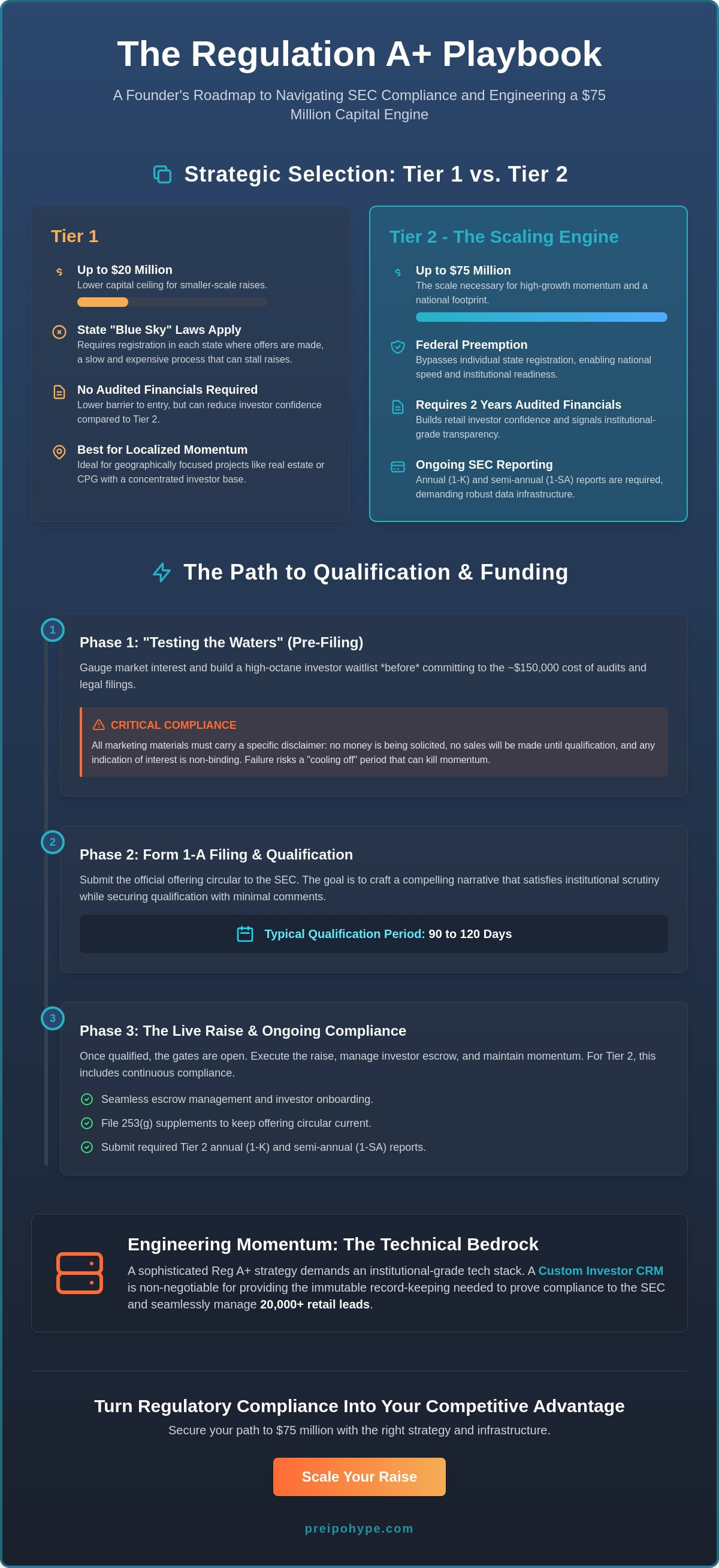
Choosing between Tier 1 and Tier 2 isn't just a legal checkbox; it's a strategic decision that dictates your entire capital trajectory. For founders aiming for a national footprint, the $75 million cap of Tier 2 offers the scale necessary for high-growth momentum. While Tier 1 remains capped at $20 million, the real differentiator lies in the regulatory friction you're willing to endure. Most elite issuers view Regulation A+ as a gateway to democratization, but the path you choose determines how fast you can open those gates.
To better understand how these choices impact your bottom line and your overall Reg A+ marketing strategy, watch this breakdown of marketing costs and execution expectations:
The Tier 2 Advantage: Federal Preemption
Tier 2 is the preferred vehicle for $75 million raises because it bypasses the "Blue Sky" paradox. While you face higher federal oversight, you gain federal preemption. This means you don't have to register your offering in every individual state, a process that is notoriously slow and expensive. The trade-off is ongoing reporting, including annual reports on Form 1-K and semi-annual reports on Form 1-SA. For companies with the right infrastructure, these filings are a small price for national speed and institutional readiness.
Tier 1: Localized Momentum or Strategic Stepping Stone?
Tier 1 serves a specific, localized niche. It's often the right move for geographically focused CPG or real estate raises where the investor base is concentrated in a few specific states. Since it doesn't require audited financials, the barrier to entry is lower for early-stage startups. However, the lack of federal preemption means your legal team must navigate state-level merit reviews. These can stall a raise for months. Tier 1 is a stepping stone for niche projects, not a scaling engine for those seeking a $75 million realization event.
The "Testing the Waters" Checklist: Compliant Marketing Pre-Filing
"Testing the waters" (TTW) is the most powerful tool in your Reg A+ marketing strategy, yet it's also where most founders invite unnecessary SEC scrutiny. This phase allows you to gauge market interest before spending $150,000 on audits and legal filings. But here is the catch: you aren't just "posting on social." You are conducting a regulated solicitation. Every post, email, and landing page must carry a specific, non-negotiable disclaimer stating that no money is being solicited and no sales will be made until the offering is qualified. This isn't just a legal formality; it's the foundation of your brand's integrity and long-term momentum.
Failing to maintain these standards can result in a "cooling off" period that kills your raise just as you're ready to scale. According to the SEC Regulation A Guidelines, you must clearly communicate that an indication of interest involves no obligation or commitment of any kind. This protects the investor, but it also protects your company from future litigation. Managing this volume of data without losing your compliance status requires institutional-grade tools. A Custom Investor CRM is essential here. It provides the immutable record-keeping needed to prove to the SEC that every single lead was handled within regulatory boundaries, tracking every touchpoint from the first click to the final indication of interest. This record-keeping is not just for the SEC; it's a vital asset for your future reporting obligations as a Tier 2 issuer.
Digital Outreach Compliance Standards
Standardizing disclaimers across Facebook, LinkedIn, and Google is a technical necessity. Your copy must avoid the "guaranteed return" trap. In the world of elite finance, certainty is a red flag for regulators. Instead, focus on the magnitude of the opportunity and the milestones your company has already achieved. We use 60-day attribution models to map the journey from first click to interest. This ensures you're harvesting a pre-heated, compliant audience that understands the risks and the potential rewards.
Investor Lead Scoring and Attribution
The TTW phase is your laboratory. You must segment institutional leads from retail investors immediately to maximize your conversion efficiency. Retail investors respond to the disruptive vision, while institutional players demand robust data infrastructure and clear exit paths. By scoring leads during pre-qualification, you can deploy targeted follow-ups the moment your Form 1-A is qualified. If you want your pre-filing hype to translate into a $75M reality, you should discuss your TTW roadmap with a specialist today.
The Form 1-A Filing: Documenting the Vision for Qualification
The Form 1-A is where your vision is codified into a legal instrument. It's the mini-prospectus that bridges the gap between a bold idea and a qualified $75M raise. While Part I handles the notification data, and Part III manages the heavy lifting of exhibits, from material contracts to legal opinions, Part II is the actual soul of your offering. The Offering Circular is where your Reg A+ marketing strategy meets federal reality. This is your opportunity to craft a narrative that converts retail investors while maintaining the technical precision required to satisfy SEC regulators.
Navigating the SEC comment period requires a calculated response framework. Expect questions; they are a sign of progress, not failure. Founders who succeed treat these comments as a refinement process to ensure their disclosure is bulletproof. This level of precision is impossible without foundation infrastructure that serves as the technical bedrock for disclosure accuracy. By centralizing your data early, you ensure that every claim in your circular is backed by verifiable internal records, reducing the risk of costly legal delays.
Integrating credible Reg A+ Marketing Tips into your narrative helps align your growth story with market expectations. It's about showing, not just telling, how your company will dominate its sector.
Financial Disclosures and Audit Readiness
Tier 2 issuers must provide two years of audited financial statements. This is a non-negotiable gatekeeper. You need an SEC-qualified auditor who understands the pace of private markets and the specific nuances of capital formation. Common pitfalls, such as improper revenue recognition or missing equity documentation, can delay your qualification by months. Start your audit preparation at least 90 days before you intend to file to maintain your market momentum and investor interest.
Modern Asset Disclosures for 2026
By 2026, the SEC has refined its focus on how companies address tokenization and digital assets. If your cap table involves on-chain mechanics or digital-native structures, your Form 1-A must explicitly detail these assets. High-growth sectors like robotics and health-tech face additional scrutiny regarding intellectual property and regulatory risk factors. Your cap table management must be as sophisticated as your technology, reflecting the rare opportunity you're presenting to the broader market. A forward-thinking Reg A+ marketing strategy uses this transparency to signal institutional readiness to every potential investor.
Post-Qualification Execution: Maintaining Compliance During the Raise
Qualification isn't the finish line. It's the starting gun. Once the SEC clears your Form 1-A, your Reg A+ marketing strategy shifts from gauging interest to capturing capital at scale. This phase demands a level of operational discipline that most founders underestimate. You aren't just selling shares; you're managing a live, public offering subject to real-time regulatory scrutiny. Maintaining your "insider" status requires absolute transparency and a technical infrastructure that prevents selective disclosure in public forums.
Operational compliance during the raise often hinges on the 253(g) supplement. If your business experiences a material change, such as a major partnership or a shift in financial outlook, updating your Offering Circular via a 253(g) filing is non-negotiable. Stale data is a litigation magnet. Simultaneously, your escrow management must be flawless. Tracking the flow of funds from initial commitment to final close ensures that every dollar is accounted for before it ever hits your operating account. In 2026, the standard for AML/KYC (Anti-Money Laundering and Know Your Customer) checks has never been higher. Every retail investor must be vetted with digital-native tools that verify identity in seconds without breaking the momentum of the investment flow.
The Role of the SEC-Registered Transfer Agent
A transfer agent is the unsung hero of a successful Tier 2 raise. They are essential for managing the cap table of thousands of unaccredited investors, handling everything from dividend distributions to stock transfers. To maintain a seamless experience, you must integrate your transfer agent data directly with your investor acquisition platform. This connectivity allows you to monitor real-time conversion rates and manage secondary market liquidity expectations. Investors today expect the ability to track their holdings with the same ease they track a crypto wallet or a Robinhood account.
Ongoing SEC Reporting Duties
Tier 2 issuers carry ongoing reporting obligations that mirror the discipline of a public company. Failure to meet these deadlines can decimate your market reputation and trigger immediate SEC inquiries. You must stay ahead of the following filings:
- Form 1-K: The annual report, including audited financials, due within 120 days of your fiscal year-end.
- Form 1-SA: The semi-annual report, providing an interim look at your company's progress.
- Form 1-U: The current report, used to announce fundamental changes or "breaking news" within the company.
Leveraging your CRM data to automate these reports is the only way to scale to $75 million without drowning in paperwork. If you want to ensure your post-qualification operations are as elite as your marketing, book a compliance strategy call to audit your current infrastructure.
Engineering Momentum: The Technical Infrastructure for Reg A+ Success
Is your tech stack a bridge to $75 million or a bottleneck that invites an audit? Most founders treat their CRM as a simple Rolodex, but in the high-stakes world of Tier 2 raises, basic tools fail the compliance and volume test. When you're managing 20,000 retail leads, a standard out-of-the-box solution won't cut it. Your Reg A+ marketing strategy requires a technical bedrock that can track every touchpoint while maintaining an immutable audit trail for the SEC. This isn't just about efficiency; it's about protecting your capital runway from the friction of manual data management.
Building a "Foundation" involves creating a system that supports massive capital volume without breaking. It requires omnichannel mastery to track engagement across the entire hype cycle, from the first social media click to the final escrow deposit. This technical discipline does more than just power your current raise. It positions your company for a future realization event or an institutional IPO by proving you have the reporting maturity of a public entity. If you're unsure if your current systems are up to the task, you should book an Ask CEO session to audit your raise strategy before you hit the gas.
The Custom Investor CRM Advantage
A custom-built CRM provides a level of lead scoring that generic platforms can't match. You need the ability to segment institutional players from retail investors instantly, deploying different content strategies for each. It automates essential compliance disclaimers in high-volume email sequences, ensuring you never send a non-compliant solicitation. Most importantly, it delivers real-time ROI tracking for your digital marketing and advertising spend. You'll know exactly which channels are driving qualified capital and which are just burning your budget.
Ready to Scale Your Capital Raise?
Pre-IPO Hype bridges the gap between rigid SEC rules and the high-energy hype required to close a $75 million round. We help you move beyond spreadsheets and into a digital-native infrastructure that turns curiosity into commitment. Precision matters in 2026. High-growth markets don't wait for your data to catch up. Take the time to review your fundraising tech stack for 2026 readiness to ensure you're built for the scale you're promising your investors. For those ready for strategic alignment, the next step is clear: schedule your 30-minute consultation and let's engineer your momentum.
Secure Your $75M Growth Trajectory
You now possess the blueprint to transform regulatory hurdles into a high-velocity capital engine. A successful Reg A+ marketing strategy in 2026 demands more than just creative ads; it requires the technical discipline of a public company and the agility of a venture-backed startup. By aligning your "Testing the Waters" phase with robust disclosure and automated technical infrastructure, you ensure that your path to $75 million remains uninterrupted by SEC friction. Compliance isn't a burden. It's the technical bedrock of an elite momentum engine.
To complement this regulatory discipline, establishing a clear and modern company mission is essential. Branding TITANS™ provides a roadmap for building a powerful presence that leverages the latest in marketing technology to engage the next generation of investors.
Don't leave your momentum to chance. Pre-IPO Hype has already facilitated over $100 million in funding and helped 230+ companies scale through the complexities of private markets. With our Custom Investor CRM and elite tracking capabilities, we bridge the gap between restricted information and broader opportunity. It's time to act decisively and join the movement of founders democratizing the financial world.
Master Your Reg A+ Strategy with Pre-IPO Hype
Your vision deserves a platform that matches its ambition. Let's build it together.
Frequently Asked Questions
What is the maximum amount I can raise under Regulation A+ Tier 2 in 2026?
The maximum raise under Regulation A+ Tier 2 remains $75 million within a 12-month period as of 2026. This threshold allows founders to scale aggressively while bypassing state-level merit reviews. It's the primary vehicle for companies looking to establish a national footprint and signal institutional readiness to the broader market.
Do I need to be a profitable company to qualify for a Reg A+ offering?
You don't need to be profitable to qualify for a Regulation A+ offering. The SEC focuses on full and fair disclosure of your financial status and risk factors rather than your current bottom line. This makes it an ideal path for high-growth tech or biotech firms that are prioritizing market capture over immediate earnings.
How long does the SEC qualification process typically take for Form 1-A?
The SEC qualification process for Form 1-A typically takes between 90 and 120 days. This timeline includes the initial filing and subsequent rounds of comments from SEC staff. A precise Reg A+ marketing strategy involves using this period to "Test the Waters" and build a robust waitlist so you can hit the ground running the moment you're qualified.
Can non-accredited investors participate in a Reg A+ Tier 2 raise?
Non-accredited investors can absolutely participate in a Tier 2 raise. However, they're limited to investing no more than 10% of the greater of their annual income or net worth. This democratization is what makes the Reg A+ framework so powerful for building a massive, loyal retail shareholder base.
What is the difference between "Testing the Waters" and a live offering?
"Testing the Waters" is a pre-qualification phase where you gauge investor interest without accepting binding financial commitments. A live offering only begins after the SEC qualifies your Form 1-A, allowing you to actually close on capital. TTW is the laboratory where you refine your Reg A+ marketing strategy before the high-stakes execution of the main raise.
Is a Private Placement Memorandum (PPM) required for Regulation A+?
A Private Placement Memorandum (PPM) isn't required for Regulation A+. Instead, you'll use the Offering Circular, which is part of the Form 1-A filing. The Offering Circular serves as your primary disclosure document, providing the same level of detail as a mini-prospectus for a public company.
How much does a typical Reg A+ compliance and marketing setup cost?
The typical "all-in" cost for a Regulation A+ setup, including legal, audit, and initial marketing, ranges from $150,000 to $300,000. These costs are incurred before any capital is officially raised. Founders should view this as a strategic investment in their company's long-term capital-raising infrastructure.
What happens if my company fails to file annual reports after a Reg A+ raise?
Failing to meet reporting deadlines can result in disqualification from future raises and significant damage to your market reputation. Tier 2 issuers have ongoing obligations, such as annual reports on Form 1-K and semi-annual reports on Form 1-SA. Staying current with these filings is essential for maintaining the trust of your retail investors and ensuring long-term secondary market liquidity.
Disclaimer
Educational only. Not investment, tax, or legal advice. Pre-IPO Hype is investor relations infrastructure for Regulation CF and Regulation A+ raises. We are not a broker-dealer, funding portal, or investment adviser, and we do not offer or sell securities or make investment recommendations. Any securities offering is made only by the issuer, through its own offering documents and, where required, a registered intermediary.


