
Tokenization of Real World Assets: The 2026 Insider Guide to the $30 Trillion Frontier
The $30 trillion wall protecting legacy finance is finally starting to crumble. While traditionalists cling to paper contracts and 45-day settlement cycles, the tokenization of real world assets is quietly rewriting the rules of ownership for the 2026 market. You already know that private equity is plagued by suffocating illiquidity and administrative costs that often eat up 20% of your operational budget. It's frustrating to hold a world-class asset but remain unable to tap into a global pool of retail investors who are hungry for ground floor opportunities.
You're ready to stop watching from the sidelines and start positioning yourself as an informed insider. This guide shows you exactly how RWA tokenization is dismantling traditional investment barriers and how you can leverage this technology to power elite capital raises. We'll provide a clear roadmap for fractionalizing assets and a deep dive into the mechanisms that enhance investor acquisition. From secondary liquidity to global reach, this is your blueprint for the final frontier of wealth creation.
Key Takeaways
- Identify why institutional capital is pivoting from speculative coins to utility-backed tokens in the $30 trillion RWA revolution.
- Discover how the tokenization of real world assets uses digital twins and smart contracts to automate compliance and eliminate costly middlemen.
- Learn to leverage fractionalization to open previously gated investment circles, turning high-barrier private equity into accessible, liquid opportunities.
- Navigate the 2026 regulatory frontier using Reg CF and Reg A+ to build a secure, SEC-aligned framework for your next capital raise.
- Master the art of the "hype cycle" to create a sense of exclusivity and urgency that converts curious observers into committed elite investors.
The Silent Revolution: What Is Tokenization of Real-World Assets in 2026?
The silent revolution isn't silent anymore. In 2026, the tokenization of real-world assets has moved from a niche crypto experiment to the foundational architecture of global finance. At its core, this process involves the digital representation of physical assets, such as commercial real estate, private credit, or fine art, on a blockchain. This year marks a definitive pivot in market sentiment. We've moved past the era of chasing speculative coins with no intrinsic value. Today, the smart money is flowing into utility-backed tokens that represent legal ownership of tangible, income-producing wealth.
Institutional giants like BlackRock and Franklin Templeton aren't just testing these waters; they've rewritten their entire playbook around them. With market projections hitting the $30 trillion mark, these firms are racing to migrate trillions in legacy assets onto the chain. This shift provides a unique window for retail investors. It's the democratization of the ground floor, offering institutional-level access to elite investment circles that were previously gated behind million-dollar minimums.
To better understand how this technology is reshaping the financial landscape, watch this helpful video:
From Illiquid to Instant: The Core Value Proposition
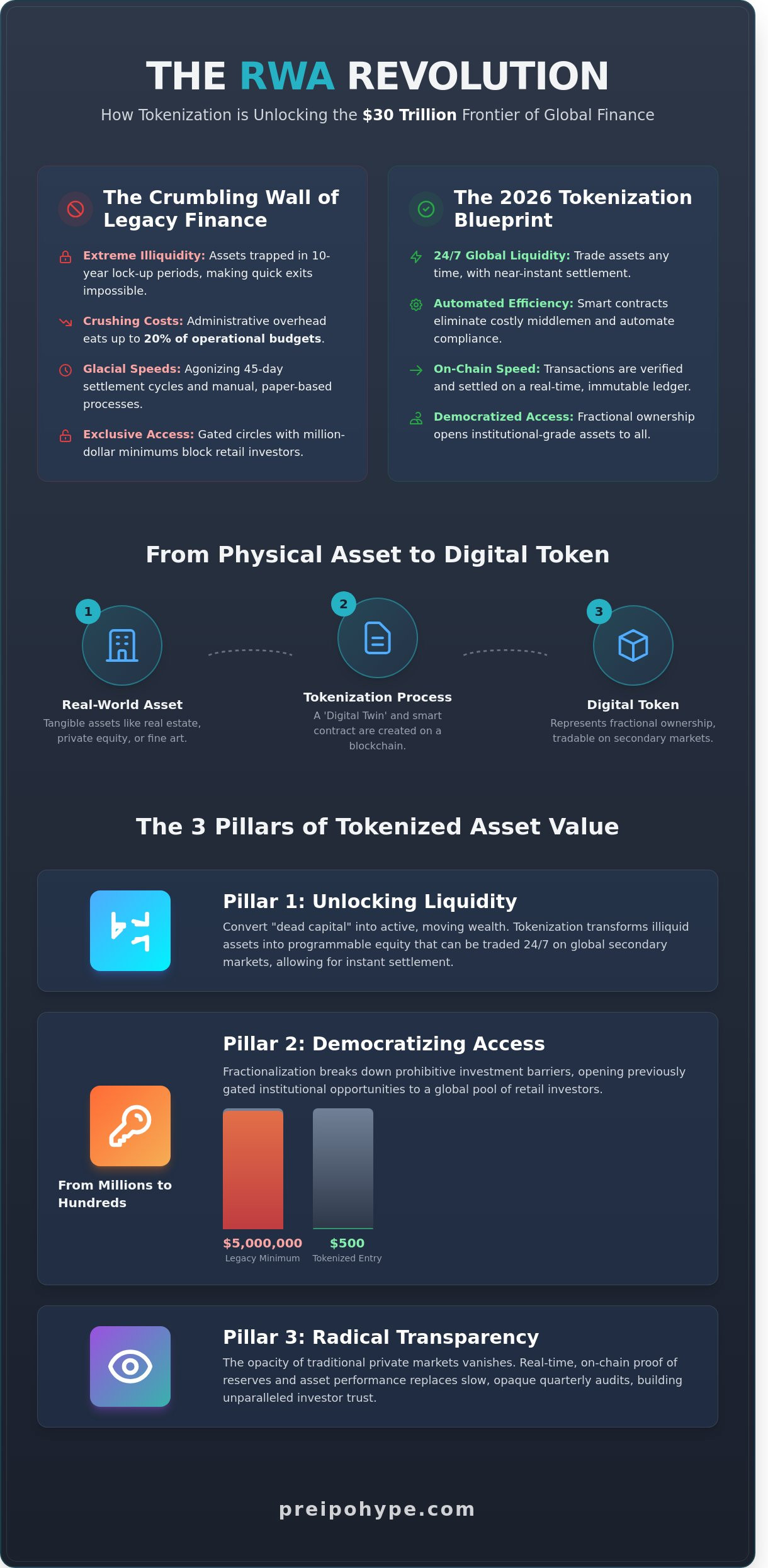
The old financial world relied on paper deeds, manual escrow, and agonizing 10-year lock-up periods. Tokenization kills that friction. By converting physical value into programmable equity, we've unlocked secondary market potential for assets that were once impossible to exit quickly. You can now trade a fractional interest in a pre-IPO company or a luxury hotel at 3 AM on a weekend. This leap from "locked" to "liquid" is why 2026 is the official tipping point for the tokenization of real world assets. The transition allows for instant settlement and 24/7 trading, turning "dead" capital into active, moving wealth.
The "Hype" vs. The Reality of Asset Backing
Don't let the word hype scare you. We view hype as a legitimate financial indicator of momentum. It's the sound of the market realizing a massive valuation gap is about to close. However, the 2026 landscape demands a clear distinction between empty utility tokens and true asset-backed security tokens. Real-world asset tokens are anchored by legal frameworks and physical collateral, providing a level of transparency that traditional private markets never could.
- On-Chain Transparency: Real-time proof of reserves replaces the quarterly, opaque audit.
- Reduced Barriers: Entry points have plummeted from $5 million institutional minimums to $500 for the informed insider.
- Automated Yield: Smart contracts handle dividend distributions without the need for a middleman.
The reality is that transparency builds the trust necessary to sustain high-growth momentum. If you want to see how we identify these high-stakes opportunities before they hit the mainstream, explore our exclusive insider breakdown. This isn't just a new way to invest; it's the final frontier of significant wealth creation.
Under the Hood: How RWA Tokenization Bridges Private Secrecy and Public Opportunity
The tokenization of real world assets isn't a futuristic concept; it's the current plumbing of the $30 trillion frontier. At its core, this process relies on the "Digital Twin" mechanism. This isn't just a digital receipt. It's a cryptographic mirror that maps the legal rights, cash flows, and physical value of an asset directly onto the blockchain. When an apartment complex in Tokyo or a private credit fund in New York is tokenized, every cent of value is accounted for in real-time. The opacity of traditional private markets vanishes, replaced by a ledger that's both immutable and transparent.
Smart contracts act as the digital architects of this new era. These self-executing lines of code automate the grueling manual labor that usually kills deal momentum. They handle compliance checks, trigger dividend distributions, and manage voting rights without a single high-priced middleman. By 2026, firms that fail to automate these processes will face a 40% higher operational cost than their tokenized competitors. However, a brilliant smart contract is useless without a rock-solid foundation infrastructure. If your technical bedrock is weak, your capital raise will collapse under the weight of institutional scrutiny.
The "privacy paradox" is the final hurdle. High-net-worth investors demand secrecy, yet the blockchain thrives on transparency. Modern RWA protocols solve this using Zero-Knowledge Proofs (ZKPs). This allows an investor to prove they meet accreditation standards without revealing their net worth or identity to the entire network. You get the security of a vault with the liquidity of a public exchange.
The 3-Step Tokenization Workflow
Interoperability: The 2026 Standard
Siloed blockchains are the graveyards of liquidity. By 2026, the gold standard for any raise is cross-chain interoperability. Institutional investors won't be trapped on a single network; they want the freedom to move assets between Ethereum, Polygon, and private bank-led chains. This requires institutional-grade custody solutions that offer more than just a "hot wallet." We're talking about multi-party computation (MPC) that keeps assets safe from 99.9% of external threats.
Smart contracts also execute the "Story Framework" of your raise. They don't just move money; they enforce the narrative of growth by hitting specific milestones before unlocking capital. It's about building trust through code. If you're ready to see how this technical precision can transform your next round, you might want to ask our CEO how we bridge the gap between private secrecy and public opportunity.
Beyond the Hype: The 3 Pillars of Tokenized Asset Value
Legacy private equity is a dinosaur. It relies on opaque 90-day reporting cycles, restrictive gates, and a "pay to play" model that excludes most ambitious investors. The tokenization of real world assets flips this script by moving the entire investment lifecycle onto the blockchain. While traditional private equity often demands a $250,000 minimum buy-in, tokenized models allow for granular entry points that maintain the same legal protections as institutional shares. This isn't just a technical upgrade; it's a structural revolution that replaces trust with math.
Liquidity has long been the "Holy Grail" of the private market, yet it remained out of reach for decades. Historically, investors in private credit or real estate were locked into 7 to 10 year cycles with no viable secondary market. Tokenization changes the math. By representing ownership as digital tokens, these assets can be traded on secondary exchanges 24/7. You're no longer waiting for a decade-long exit; you're participating in a live, moving market where value is realized in real-time.
Fractional Ownership: Unicorn Hunting for the Masses
High-value assets like a $10 million Class A office building or a late-stage growth company were once reserved for the elite 1%. Through the tokenization of real world assets, these massive holdings are broken into affordable units. Now, a $1,000 investment grants the same proportional rights as a $1 million check. This shift creates a powerful psychological impact. You aren't just holding a fund share; you're an "insider" with a direct stake in a specific, tangible asset. For issuers, this means scaling an investor base from 50 institutional partners to 5,000 micro-investors instantly, creating a ground-floor momentum that was previously impossible to manufacture.
Automated Compliance: The Regulatory Shield
Compliance used to be a manual, expensive bottleneck that drained profits. In the old world, KYC and AML checks were repeated for every transaction, slowing down the pace of capital. Today, smart contracts bake these protocols directly into the token's DNA. If an investor doesn't meet specific regulatory criteria, the token simply won't transfer. This technical automation slashes project-based setup fees by up to 40% compared to traditional legal structuring. Real-time auditing replaces the quarterly report slog, providing an immutable trail that satisfies regulators and investors alike. It's the ultimate insider advantage: maximum security with zero friction.
- Instant Settlement: Transactions clear in minutes, not weeks.
- 24/7 Access: The private market no longer closes at 4 PM EST.
- Reduced Overhead: Automation eliminates the need for middle-man administrative layers.
Navigating the Frontier: Regulatory Compliance and Infrastructure
Regulation isn't a roadblock; it's the moat that protects your empire. By 2026, the SEC has pivoted from reactive enforcement to a structured framework that demands transparency while fueling innovation. The agency now views the tokenization of real world assets as a vital component of capital formation, provided you play by the rules. To win in this $30 trillion frontier, you must treat compliance as a feature, not a bug. Your tech stack is your primary defense. If your smart contracts don't bake in KYC/AML protocols at the protocol level, you're building on sand.
The heavy lifting for retail raises happens through Reg CF and Reg A+. Since the SEC raised the Reg CF limit to $5 million, it's become the go-to for early-stage momentum. For those hunting bigger game, Reg A+ remains the "mini-IPO" powerhouse, allowing raises up to $75 million from non-accredited investors. Managing these massive cap tables manually is a recipe for disaster. You need a custom investor CRM to track thousands of fractional owners, automate distributions, and ensure every token holder is verified in real-time.
Is Tokenization Legal for My Startup?
The short answer is yes, but your asset is almost certainly a "Security Token." This designation means you're governed by federal securities laws, requiring you to partner with SEC-registered Transfer Agents to maintain the official record of ownership. In 2026, the Howey Test remains the definitive legal yardstick, classifying digital assets as investment contracts when capital is pooled in a common enterprise with a reasonable expectation of profits derived from the efforts of others. Don't try to "utility token" your way out of equity obligations; the insiders know that compliance is the only path to secondary liquidity.
The Technical Bedrock: Foundation Infrastructure
You can't "bolt-on" tokenization to a weak marketing system and expect institutional results. Success requires integrating your tokenized assets with omnichannel outreach strategies that hit investors where they live. Your infrastructure must handle the "hype" without breaking. When a lead lands on your page, your investor platform demo must showcase seamless token management, proving that your backend is as sophisticated as your vision. Scaling the tokenization of real world assets requires a tech stack that breathes with the market, converting interest into capital with zero friction.
Ready to build your compliant tokenization engine? Book a 30-minute strategy session to audit your infrastructure today.
Executing the Raise: Leveraging Tokenization for Elite Investor Acquisition
The tokenization of real world assets isn't just a technical upgrade; it's a high-velocity conversion engine. Traditional private raises often suffer from a 40% lead drop-off rate due to cumbersome onboarding and paper-heavy compliance. Tokenization eliminates these barriers, turning curiosity into capital through instant engagement. By fractionalizing high-value assets, you aren't just selling a piece of a company; you're selling a liquid, digital experience that fits into a modern investor's portfolio as easily as a stock trade.
Smart founders use the hype cycle as a strategic tool rather than a buzzword. By creating tiered access and limited-time token drops, you build a sense of exclusivity that drives urgency. This isn't about artificial scarcity. It's about using the tokenization of real world assets to offer ground-floor opportunities to a global audience that was previously locked out. When you lower the entry point, you don't just get more investors; you get a more diverse, resilient cap table.
Data-driven marketing is the fuel for this fire. In a fractionalized raise, every click and wallet connection provides a data point. You can track exactly where your "whales" are coming from and which narrative hooks are driving the most minting activity. This allows you to move an investor from a passive holder to a vocal advocate. Recent 2025 benchmarks show that tokenized loyalty structures can increase investor referral rates by 35% compared to traditional private placements.
Omnichannel Mastery for Tokenized Raises
Success requires more than a landing page. You need to track token-holder engagement directly through your CRM to identify your most loyal backers. Use aggressive A/B testing to refine your "Story Framework," ensuring your asset's value proposition resonates across every social and financial channel. If you're unsure how to align your tech with your narrative, founders should ask the CEO about integrating tokenization into their roadmap to ensure maximum market impact.
The Future of Exit Events
The old model of waiting 7 to 10 years for an IPO is dead. Secondary liquidity acts as a perpetual exit strategy, allowing investors to trade in and out of positions without disrupting the company's operations. This liquidity profile significantly reduces the friction of M&A and IPOs, as the cap table is already digitized and transparent. Ready to architect your tokenized raise? Book a strategy session today and secure your place in the $30 trillion frontier.
Seize the $30 Trillion Liquidity Shift
The window for early-stage dominance in the private market is narrowing fast. By 2026, the tokenization of real world assets will no longer be a fringe experiment; it’s the definitive standard for institutional liquidity. You’ve seen how bridging private secrecy with public opportunity creates a secondary market that didn't exist five years ago. Compliance isn't a hurdle anymore; it’s the structural foundation for every elite raise in this new frontier.
We’ve already facilitated over $100M in funding for visionaries who refuse to wait for the legacy system to catch up. PreipoHype leverages a proprietary Custom Investor CRM and elite omnichannel outreach mastery to put your asset in front of the world’s most aggressive capital. The technology is ready and the regulatory pathways are clear. It’s time to stop watching the frontier move and start owning your piece of it.
Architect Your Elite Tokenized Raise—Book a Strategy Session
The future of global wealth isn’t just coming; it’s being minted right now.
Frequently Asked Questions
Is tokenization of real-world assets legal in the United States?
Yes, the tokenization of real world assets is legal in the United States when issuers comply with SEC frameworks like Regulation D, Regulation A+, or Regulation S. These digital assets are classified as securities under the 1933 Securities Act and must follow strict registration or exemption protocols. By 2024, the legal landscape has matured, allowing firms to leverage blockchain for cap table management while maintaining full federal compliance.
What are the main benefits of tokenizing an asset for a startup?
Startups gain access to instant global liquidity and a broader investor base by lowering entry minimums to as low as $100. This shift eliminates the heavy administrative burden of manual cap table management through the use of automated smart contracts. By 2026, companies using blockchain-based issuance will likely reduce settlement times from T+2 days to near-instant, providing a significant competitive advantage in the high-stakes venture capital race.
Can I use Reg CF for a tokenized real estate or equity raise?
You can use Regulation Crowdfunding (Reg CF) to raise up to $5 million annually using tokenized real estate or equity structures. This regulation democratizes the ground floor opportunity, allowing startups to leverage retail hype legally and efficiently. Since the SEC increased the limit from $1.07 million to $5 million in 2021, the volume of tokenized Reg CF offerings has surged, making it a primary vehicle for modern capital raises.
What is the difference between a tokenized asset and a traditional security?
The primary difference lies in the delivery mechanism and the speed of the settlement layer rather than the legal rights. While a traditional security relies on manual intermediaries and T+2 settlement cycles, a tokenized asset enables T+0 settlement and programmable compliance. Tokenized assets use smart contracts to automate dividends and cap table updates, replacing the clunky legacy databases used by traditional financial institutions for decades.
How much does it cost to set up a tokenized capital raise infrastructure?
Expect to budget between $30,000 and $150,000 for a professional-grade tokenization infrastructure setup. This total includes $15,000 for legal drafting of the private placement memorandum and roughly $20,000 for technical smart contract auditing. While the upfront investment is higher than a standard paper-based raise, the long-term savings on transfer agent fees and secondary market administration often offset these initial costs within 18 months of operation.
What happens if the underlying physical asset is damaged or lost?
Legal recourse and insurance policies protect token holders just like traditional asset ownership because the token represents a legal interest in a Special Purpose Vehicle. If a $10 million physical property is damaged, the insurance policy pays out to the holding entity, and proceeds are distributed to token holders via smart contracts. The digital ledger simply tracks ownership, ensuring your claim to the recovery funds remains enforceable in any court.
Do I need a special blockchain wallet to invest in tokenized assets?
How does tokenization impact the secondary market and liquidity?
Tokenization creates a 24/7 secondary market that bypasses the traditional 7 to 10 year lock-up periods common in private equity. This shift allows investors to trade their stakes on Alternative Trading Systems after the required one-year Rule 144 holding period. By 2030, this increased liquidity is projected to unlock a portion of the $30 trillion RWA market, making private investments as flexible as public stocks.
Disclaimer
Educational only. Not investment, tax, or legal advice. Pre-IPO Hype is investor relations infrastructure for Regulation CF and Regulation A+ raises. We are not a broker-dealer, funding portal, or investment adviser, and we do not offer or sell securities or make investment recommendations. Any securities offering is made only by the issuer, through its own offering documents and, where required, a registered intermediary.


