
Valuation Calculator Guide: How to Benchmark Your Startup for a 2026 Capital Raise
The number your valuation calculator provides is a starting point, not the finish line. It's a critical piece of data, but it's not the whole story behind a company's price tag.
You're right to be obsessed with that number. Price it too high, and you risk a failed round. Price it too low, and you're leaving millions on the table before your 2026 capital raise even begins. This tightrope walk between ambition and reality is where most founders stumble, paralyzed by conflicting methodologies and the fear of getting the math wrong. It’s the single greatest point of failure in an otherwise successful pitch.
This guide is your key to mastering both sides of the equation: the hard math of financial models and the soft art of market momentum. We'll show you how to forge a defensible valuation that not only stands up to investor scrutiny but also captures the 'hype' that defines today's most successful funding rounds. You'll learn the frameworks to benchmark your startup correctly, defend your price with confidence, and turn market energy into a higher multiple.
Key Takeaways
- Go beyond outdated spreadsheets by understanding the 2026 market dynamics that now dictate a startup's true potential.
- Master the core pre-revenue valuation models, including the Berkus and Scorecard methods, to build a defensible financial baseline.
- Discover why a standard valuation calculator misses the "hype factor" and learn how to quantify investor momentum to justify a premium.
- Execute a founder's pre-raise checklist to ensure your cap table and investor data are pristine, preventing last-minute deal friction.
The Evolution of the Startup Valuation Calculator in 2026
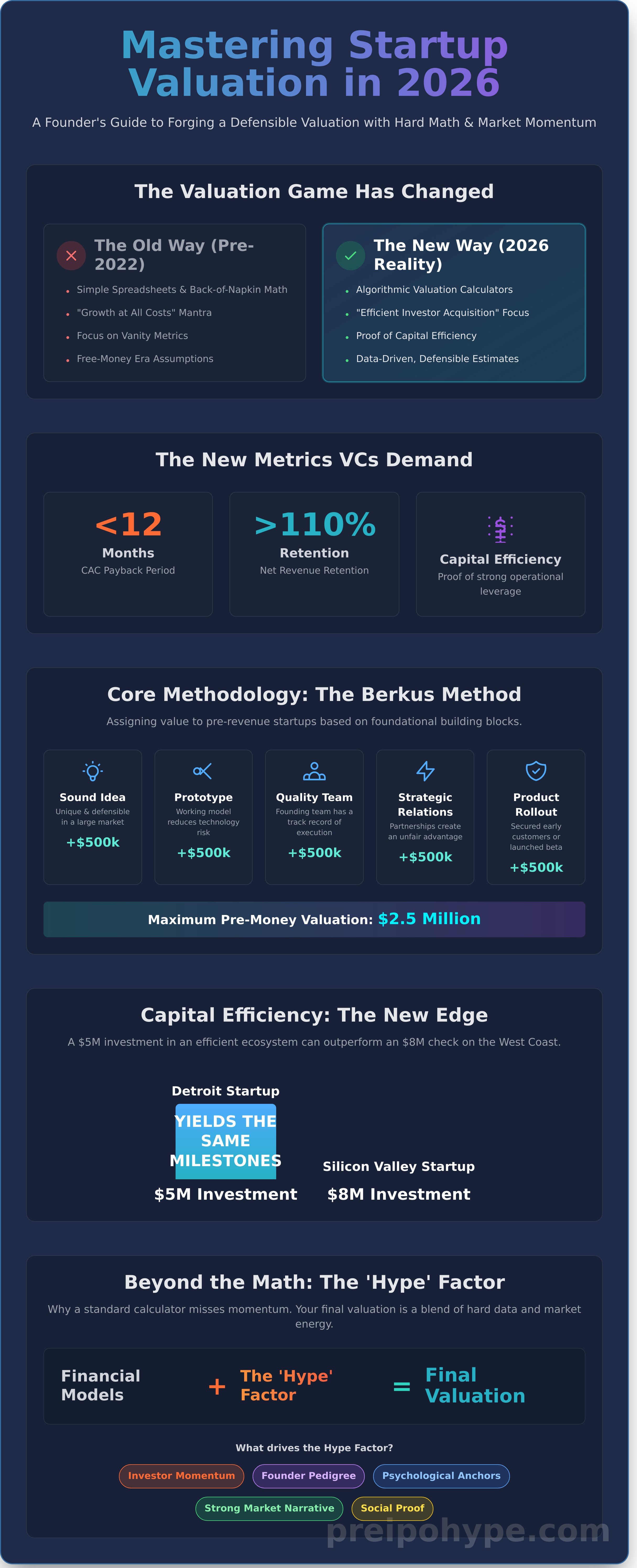
Forget everything you thought you knew about startup valuation. The game has changed. In 2026, the back-of-the-napkin math and simple spreadsheets that defined the last decade are artifacts. Today's market demands a weapon, not a worksheet. A modern valuation calculator is an algorithmic tool that synthesizes dozens of quantitative and qualitative inputs, from your Total Addressable Market (TAM) to the pedigree of your engineering team, to produce a defensible estimate of your company's worth.
The free-money era that ended in 2022 is over. The mantra of 'growth at all costs' has been replaced by a brutal focus on 'efficient investor acquisition'. Venture capitalists are no longer impressed by vanity metrics; they now demand proof of capital efficiency, with sub-12-month CAC payback periods and net revenue retention above 110% becoming the new table stakes for a Series A. This complex, multi-variable reality is precisely where old methods fail and a dynamic valuation calculator becomes indispensable.
This shift has created a ground-floor opportunity for founders outside traditional tech hubs. Detroit-based startups, with their inherent capital efficiency, are now leveraging these sophisticated tools to go head-to-head with Silicon Valley for national funding. By modeling their lower burn rates and stronger operational leverage, they can prove a $5 million investment in Michigan yields the same milestones as an $8 million check on the West Coast, making their case for elite valuation multiples undeniable.
Pre-Money vs. Post-Money: The Critical Distinction
Pre-money valuation is your company's value before the first dollar of a new round hits the bank. Sophisticated calculators model the "option pool shuffle," where investors require founders to expand the employee stock option pool before the investment, protecting the VC's ownership percentage at the founders' expense. For crowdfunding investors on platforms like Republic, a high post-money valuation acts as a powerful psychological anchor, creating hype and social proof that drives campaign momentum.
Why Benchmarking Matters for Detroit Founders
Detroit founders must anchor their valuations in reality, yet aim for the stars. Citing the early-stage valuations of local unicorns like StockX or the $3.8 billion valuation achieved by battery innovator Our Next Energy (ONE) in 2023 sets an ambitious but credible floor. These tools help founders move beyond standard business valuation methods by layering in regional data. The Detroit innovation economy, supported by world-class engineering talent from the University of Michigan and a lower cost of living, presents a unique risk-reward profile that savvy national investors are actively hunting.
Core Methodologies: How the Math Actually Works
Ever wonder what’s behind the number in a term sheet? It’s not magic. It’s math. Investors use a handful of core models to translate your Detroit grit into a defensible pre-money valuation. While a valuation calculator automates the process, the real power comes from understanding the logic driving the output. Knowing the models allows you to build your company in a way that maximizes every input. Let's break down the code.
The Berkus Method for Pre-Revenue Startups
Before you have a single dollar of revenue, you have assets. The Berkus Method values those foundational building blocks. It’s the classic angel investor scorecard for pre-seed ventures, assigning a specific dollar value to your progress against key milestones. The model breaks your startup into five core components, with most frameworks capping each at $500,000 in value, for a maximum pre-money valuation of $2.5 million.
- Sound Idea (up to $500k): Is the core concept unique and defensible in a large market?
- Prototype (up to $500k): Have you reduced technology risk with a working model?
- Quality Management Team (up to $500k): Does the founding team have a track record of execution?
- Strategic Relationships (up to $500k): Do you have partnerships that create an unfair advantage?
- Product Rollout (up to $500k): Have you secured early customers or launched a successful beta?
For a Detroit mobility startup, a working prototype immediately puts $500k on the board. Landing a pilot program with Ford or GM? That’s another $500k in the Strategic Relationships column. Your job isn't to just build a product; it's to systematically build value across these five pillars.
Scorecard Method: Comparing Your Raise to the Market
Once you have traction, the game shifts from internal milestones to external benchmarks. The Scorecard Valuation Method calculates your worth by comparing your startup to similar, recently funded companies. The key is finding the right "comps." Using valuation data from the capital-rich environment of 2021 for a 2026 funding round is a rookie mistake that will get you laughed out of a pitch meeting. You must use current market data. A typical scorecard might assign a 30% weight to your management team's strength, 25% to the size of the market opportunity, and 10% to your sales channels. Getting this data right is non-negotiable; consider it part of Preparing Your Data: A Founder’s Checklist before you even open a spreadsheet.
The final two methodologies add layers of financial rigor. The Risk Factor Summation method starts with an average valuation for similar companies and then adjusts it based on 12 standard risks, such as management risk, competition, and funding risk. Each factor can adjust the valuation up or down by as much as $500,000, turning abstract fears into a concrete number. Finally, Discounted Cash Flow (DCF) is the institutional gold standard. While difficult for early-stage companies with unpredictable revenue, a DCF model forces you to build a defensible narrative about your future, grounding your "hype" in a financial forecast that serious investors expect to see. Understanding these models is the first step. The next is seeing how top-tier private companies are valued right now. You can explore live market data to sharpen your own projections.
The 'Hype' Factor: Why Calculators Miss Momentum
Let’s address the single biggest misconception in early-stage fundraising: that valuation is purely a financial calculation. It’s not. While metrics like ARR and EBITDA provide a baseline, they only tell the story of where your Detroit startup is. They say nothing about where it’s going. The most sophisticated valuation calculator on the market can’t price in the one asset that matters most to VCs: momentum.
Momentum is the invisible force that creates a premium. It’s the difference between a company that has to chase capital and a company that capital chases. This investor demand is fueled by a narrative that extends far beyond a balance sheet. Think about it. Why would a waitlist of 10,000 accredited investors be more valuable than a 10% lift in EBITDA? Because the EBITDA increase is a trailing indicator of past performance. That waitlist is a leading indicator of future liquidity, market validation, and a massively oversubscribed next round. It’s a signal that institutional money can’t ignore.
This dynamic is amplified by the modern capital markets. The intense competition for late-stage, pre-IPO shares in giants like Databricks and Plaid has a direct trickle-down effect. VCs are now paying premiums in Series A and even Seed rounds to secure their foothold in companies that demonstrate even a fraction of that future potential. They aren't just buying your current traction; they're buying a call option on your future hype cycle.
Quantifying Investor Interest with a CRM
You can prove this momentum isn't just smoke and mirrors. By tracking investor engagement in a CRM like Affinity, you can assign lead scores based on intent signals: a partner opening 5 emails gets 10 points, watching a 30-minute demo gets 50. This creates a quantifiable "Capital Intent Score" that proves demand to auditors and future investors. Furthermore, 60-day attribution tracking can validate that 85% of your high-intent leads originated from a targeted Q4 2023 PR push, proving your valuation’s stability is tied to recent, repeatable actions.
The Momentum Multiplier
This quantifiable demand creates what we call the Momentum Multiplier: the premium paid for a high-velocity capital raise, often ranging from 1.5x to 3x the baseline valuation. This isn't achieved by accident. It's the result of strategic, omnichannel outreach that creates a sense of omnipresence. When a fund sees your founder featured in TechCrunch, hears them on a top VC podcast, and gets a targeted outreach from your team all in the same 14-day window, it signals an institutional-grade operation. This is the "omnipresence" they crave.
It transforms your raise from a transaction into an event. It proves you can command attention, a skill that's critical for recruiting top talent, landing enterprise clients, and eventually, executing a successful exit. Digital 'hype' is the market pricing in future demand, making it a leading indicator of secondary market liquidity long before an IPO.
Preparing Your Data: A Founder’s Checklist for Accurate Calculation
Your valuation is not a guess; it's an algorithm. The number a valuation calculator spits out is a direct reflection of the data you feed it. Garbage in, garbage valuation out. Sophisticated investors can spot lazy data from a mile away, and it's the fastest way to kill a deal before it even begins. Before you input a single digit, you need to weaponize your data. This isn't just about accuracy; it's about building an unshakeable, defensible narrative for your Detroit startup.
Run through this checklist. Don't skim it. Execute it. Your funding depends on it.
- Audit your cap table. Every share must have a home. Unallocated options pools or "ghost" shares from departed advisors create immediate red flags during due diligence. A clean cap table from day one signals operational discipline.
- Clean your investor CRM. A list of 500 names is useless. A segmented list of 75 investors, scored by engagement (e.g., >60% email open rate) and verified net worth from sources like PitchBook, is a strategic asset.
- Validate your TAM/SAM/SOM. Stop using 2023 market reports. Investors want to see where the puck is going. Reference a Gartner 2026 forecast or a similar forward-looking source. Show you’re building for a market that will exist in 36 months, not one that existed last year.
- Document your 'Foundation.' Your tech stack is part of your valuation. Can you prove your infrastructure, built on AWS Graviton3 processors, can handle 100x user growth with only a 15% increase in server costs? Document it. This is your scalability proof.
- Run three scenarios. Never go into a negotiation with a single number. Model a conservative, target, and high-hype case. This shows you understand risk and have a command of market dynamics.
Cleaning the Data for the Calculator
Bad data leads to the 'valuation trap'-a number that looks great on paper but collapses under the slightest pressure of due diligence. An investor seeing a "10,000 user" claim will immediately ask for the DAU/MAU ratio. If it's below 15%, they'll slash your perceived value by 40%. Your lead scoring directly fuels the 'Management Quality' input; a CRM showing 50+ pre-qualified investor meetings justifies a premium. Frame your Detroit operational costs as a weapon: "Our 35% lower engineering overhead extends our runway by 9 months versus a Bay Area competitor."
The Three-Scenario Approach
This isn't about hedging; it's about control. Your 'Floor' is the valuation if the raise stalls, based on hard assets and a conservative 4x multiple on your current ARR. The 'Target' is your defensible number for a Reg CF filing, backed by validated projections of capturing 0.5% of your SAM by 2027. The 'Hype' is what happens when your omnichannel marketing hits. It's the 12x ARR multiple you can command after a feature in TechCrunch drives 5,000 waitlist signups in 48 hours, triggering investor FOMO. Don't guess your inputs. Access our proprietary data sets to validate your market size now.
From Calculation to Capital: Maximizing Your Raise with Pre-IPO Hype
A valuation calculator gives you a number. It’s a clean, logical starting point grounded in metrics like ARR and market comparables. But investors don’t write checks to a spreadsheet. They invest in momentum. They invest in a story backed by undeniable market traction. Your calculator provides the floor; we build the skyscraper on top of it. The gap between your 'calculator number' and your 'raise goal' isn't bridged by a better formula. It's closed by a superior strategy.
This is where data-driven marketing becomes your most powerful fundraising asset. Pre-IPO Hype translates your Detroit grit into a quantifiable narrative that sophisticated capital can't ignore. We don't just amplify your message; we track every single interaction to build a case for your valuation that’s irrefutable. Skeptics want proof, and we deliver it in the form of hard engagement data. This entire process is built on our ‘Foundation’ infrastructure, a proprietary system designed not just for a successful raise but as the secret weapon for a landmark Detroit exit. It ensures your operational, financial, and narrative frameworks are primed for diligence from day one, making an acquisition or a major funding round a seamless transition, not a frantic scramble.
Leveraging the Custom Investor CRM
Your valuation isn't just what you claim; it's what you can prove. Our Custom Investor CRM is engineered to do exactly that. We show potential investors a literal 'heat map' of interest in your company, visualizing which VCs are spending the most time on your data room and which slides in your pitch deck command the most attention. This transforms vague interest into a powerful negotiation tool. We then apply a proprietary lead scoring algorithm, converting every email open, deck view, and forward into a quantifiable metric. This process turns abstract 'hype' into a line item that justifies your valuation to even the most cynical investor groups.
- Prove Engagement: Demonstrate that 25 of the top 50 Midwest VCs have viewed your deck for an average of 8.5 minutes.
- Quantify Hype: Show that investors with a lead score above 80 are 60% more likely to request a follow-up meeting.
- Justify Your Ask: This data-first approach is exactly why your Detroit startup needs a specialized investor CRM.
Building Your Fundraising Roadmap
A number from a valuation calculator is a destination without a map. A fundraising roadmap is your turn-by-turn guide to securing the capital you deserve. We move you beyond static calculations and into a dynamic, multi-channel outreach strategy. Pre-IPO Hype’s omnichannel mastery ensures your valuation is validated by the right investors at the right time. We orchestrate targeted campaigns across platforms where your ideal investors are already active, from hyper-personalized LinkedIn sequences targeting partners at funds like Detroit Venture Partners to exclusive virtual events for curated angel networks. The result? Your valuation is met with term sheets, not skepticism.
It's time to stop calculating and start acquiring. The investors who will pay your price are out there, but they won't find you by accident. Let us build the bridge from your ambition to their capital. Book a Demo of Our Detroit Investor Platform and turn your valuation into your reality.
Turn Your Valuation Into Venture Capital
Your 2026 valuation is more than just a number. As we've detailed, even the most advanced valuation calculator is only a baseline; it can't quantify the market momentum or the narrative that truly commands premium investor interest. Accurate data is your foundation, but the story you build on top is what secures the capital. At Pre-IPO Hype, we’ve systemized it. Since 2015, we've helped founders facilitate over $100M in funding by moving beyond spreadsheets. We deploy omnichannel investor acquisition strategies and a specialized Custom Investor CRM built for Reg CF and Reg A+ raises to connect your vision with high-conviction capital.
Ready to justify your valuation? Build your Investor Foundation with Pre-IPO Hype. The calculation is complete. Now, let’s get you funded.
Frequently Asked Questions
How much does a valuation calculator cost for a startup?
A basic online valuation calculator is typically free. These tools are designed to give you a preliminary estimate to anchor your strategy. However, for a more robust and defensible figure, a formal 409A valuation performed by a third-party firm is the standard. For a Detroit-based seed-stage startup, expect to pay between $2,000 and $5,000 for this essential report, which is required by the IRS for issuing stock options.
What is the most accurate valuation method for a pre-revenue company?
The Scorecard Valuation Method is widely considered the most accurate for pre-revenue startups. This method bypasses the need for financial projections by comparing your company to other funded startups across seven key criteria: team strength, market size, product, competitive environment, marketing, partnerships, and funding. It provides a qualitative yet structured approach that resonates with early-stage investors who are betting on potential, not just performance.
Can I change my valuation after filing for a Reg CF or Reg A+ raise?
Yes, you can change your valuation post-filing, but it’s a serious move that can spook investors. You must file an official amendment with the SEC (a Form C/A for Reg CF or Form 1-A/A for Reg A+) and notify all existing investors, who then have the right to withdraw their funds. This typically happens only in response to overwhelming market feedback or a significant pivot, as it signals uncertainty and can slow fundraising momentum.
How do Detroit startups differ in valuation compared to Silicon Valley firms?
Detroit startups are typically valued 25-40% lower than their Silicon Valley counterparts at the same seed stage. For example, a Detroit SaaS company might command a $5 million pre-money valuation, while an identical company in Palo Alto could be valued at $7-8 million. This difference is driven by the lower cost of operations in the Midwest and a less saturated capital market, allowing investors' capital to secure a larger equity stake.
What is a 'Momentum Multiplier' in private market investing?
A 'Momentum Multiplier' is a venture capital concept used to adjust a company's baseline valuation upward based on its "hype" or viral growth. It isn't a formal accounting metric but a way to quantify non-linear progress, such as a 40% month-over-month increase in user sign-ups or significant media attention. This multiplier, often ranging from 1.2x to 2.0x, helps investors price in the explosive potential that traditional financial models often miss.
Do I need a professional appraisal, or is a calculator enough for an equity crowdfunding raise?
A valuation calculator is a great starting point, but it is not sufficient for a serious equity crowdfunding campaign. While a formal appraisal isn't legally required to launch a Reg CF offering, investors expect to see a defensible number. A 409A valuation provides that credibility and is mandatory if you plan to issue stock options to your team. For larger Reg A+ raises, a full, independent appraisal is the non-negotiable standard.
How does an investor CRM impact my company's valuation?
An investor CRM indirectly boosts your valuation by demonstrating high demand and operational sophistication. A well-organized CRM showcasing a pipeline of over 100 engaged investors proves you have competitive interest in your deal. This allows you to negotiate from a position of strength, often justifying a 10-15% premium on your valuation because you’ve successfully de-risked the fundraising process before the round even officially opens.
What happens if my valuation is too high during my capital raise?
An excessively high valuation will cause sophisticated investors to walk away, leading to a failed or under-subscribed round. This failure becomes public knowledge in a crowdfunding context, damaging your reputation. If you do succeed in raising at an inflated price, you create immense pressure for the next round. This dramatically increases the risk of a "down round" (raising money at a lower valuation), which crushes founder equity and employee morale.
Disclaimer
Educational only. Not investment, tax, or legal advice. Pre-IPO Hype is investor relations infrastructure for Regulation CF and Regulation A+ raises. We are not a broker-dealer, funding portal, or investment adviser, and we do not offer or sell securities or make investment recommendations. Any securities offering is made only by the issuer, through its own offering documents and, where required, a registered intermediary.


