
Venture Capital in 2026: The Insider’s Guide to Engineering Elite Momentum
Why are 90% of founders still begging for meetings when the most successful 1% are now forcing investors to compete for their cap table? You’ve likely felt the weight of opaque gatekeeping in the vc space, where building early-stage momentum often feels like a dark art rather than a calculated strategy. It’s frustrating to have a world-class product but lack the data-driven tools to prove that institutional-grade interest is already surging behind the scenes.
This article is your blueprint to mastering the mechanics of venture capital in 2026. You’ll learn how to engineer elite momentum and build significant leverage before you ever hop on a call with a GP. We’ll break down the modern lifecycle of a deal, show you how to bypass traditional roadblocks, and identify the alternative paths to capital that define the next generation of unicorn hunting. The era of the informed insider has arrived, and it’s time you took your seat at the table.
Key Takeaways
- Master the mechanics of the 2026 vc lifecycle by building the foundation infrastructure required to transition from seed-stage proof to Series A growth.
- Navigate the evolved investment landscape by leveraging secondary liquidity and late-stage growth strategies to maintain "unicorn" momentum.
- Learn to deploy a hybrid funding model that uses retail investor interest to create the high-octane momentum required to attract institutional check-writers.
- Discover how to engineer leverage before the pitch by creating a sense of exclusivity and urgency through strategic omnichannel outreach.
- Bridge the gap between private secrecy and public opportunity by using a Custom Investor CRM to track engagement and scale your path to elite capital.
Beyond the Term Sheet: What Venture Capital Really Means in 2026
Venture capital isn't a loan; it's high-octane fuel for the next generation of market dominators. By 2026, the industry has shed the "growth at all costs" mantra that defined the early 2020s. Investors now hunt for sustainable momentum, a disciplined approach where capital scales proven unit economics rather than subsidizing endless losses. This evolution means Venture capital (VC) has become more selective, focusing on companies that can reach unicorn status while maintaining a clear path to profitability.
The 2026 landscape is defined by the maturity of secondary liquidity. Unlike previous cycles where founders were locked in for a decade, the secondary market grew by 25% between 2024 and 2026, allowing early stakeholders to de-risk before an IPO. This shift has turned late-stage growth into a sophisticated game of engineering exits. To better understand how these mechanisms function, watch this helpful video:
The Anatomy of a Venture Capital Firm
Why Founders Pursue VC Funding
Founders chase venture backing for the signaling effect. A lead investment from a top-tier firm validates a startup's market position to future hires and customers alike. It provides immediate access to elite networks that would take years to build organically. Speed remains the ultimate weapon. In a world where AI-driven competitors can spin up products in weeks, institutional capital allows a founder to capture 60% or more of a market segment before the "copycats" can even clear their first round of seed funding.
The VC Lifecycle: From Seed to Unicorn Status
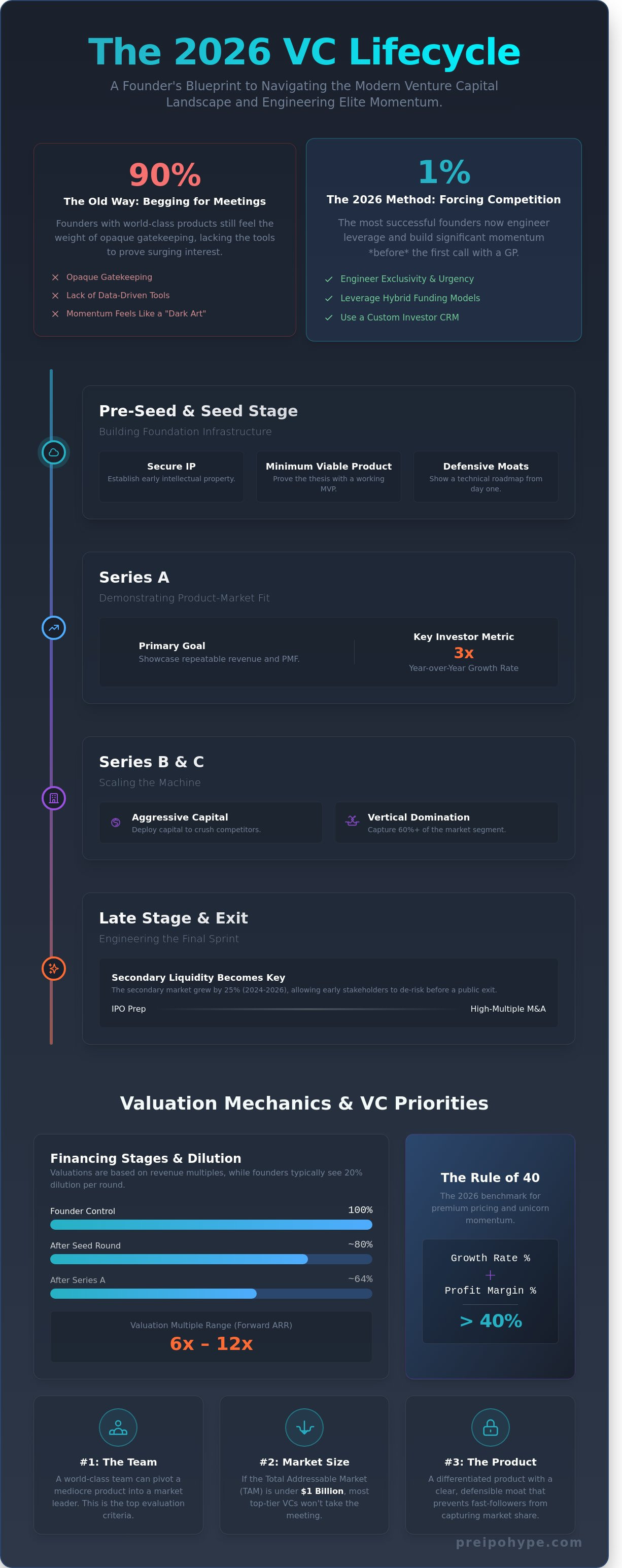
The path from a garage concept to a $1 billion exit isn't a straight line. It's a series of high-pressure filters designed to separate the elite from the average. At the Pre-Seed and Seed stages, you aren't just selling a dream. You're building the foundation infrastructure. This means securing early intellectual property and proving your thesis with a minimum viable product. By 2026, the vc landscape requires more than a pitch deck; it demands a technical roadmap that shows defensive moats from day one.
Series A marks the shift from "maybe" to "how fast." This is where you demonstrate product-market fit and repeatable revenue. Investors look for a 3x year-over-year growth rate at this stage. Moving into Series B and C, the game changes to scaling the machine. You're no longer just finding customers. You're dominating the vertical and crushing competitors through aggressive capital deployment. Late-stage rounds are the final sprint. This is the realm of secondary liquidity and preparing for an IPO or a high-multiple M&A exit.
Financing Stages and Valuation Benchmarks
Valuations aren't pulled from thin air. They're calculated using revenue multiples, often ranging from 6x to 12x forward ARR depending on the sector. Dilution is the price of entry. Founders typically see their ownership decrease by 20% during each major round. Balancing founder control with capital needs is a delicate dance. In 2026, valuation benchmarks have shifted to prioritize the Rule of 40, where the sum of growth rate and profit margin must exceed 40% to command premium pricing.
What Venture Capitalists Look For
The real insider secret is that VCs invest in lines, not dots. They want to see consistent progress over six months, not just a single impressive data point. They're looking for a narrative that builds momentum with every update. If you want to understand how the elite bridge the gap between private secrecy and public opportunity, you can watch our exclusive strategy breakdown to see the mechanics of momentum in action.
- Team: 70% of the initial decision is based on founder resilience and domain expertise.
- Market: The opportunity must be large enough to return the entire fund.
- Product: It must be 10x better than the incumbent, not just incrementally improved.
VC vs. Equity Crowdfunding: Leveraging the New Private Market
The wall between institutional vc and the public has collapsed. By 2026, the private market is no longer a gated community for the ultra-wealthy. It's a high-velocity ecosystem where retail momentum and institutional capital collide. Founders are increasingly using a hybrid approach. They build a base of thousands of retail advocates first, then use that social proof to negotiate better terms with a traditional vc firm. This isn't just about the money. It's about engineering a "hype" cycle that proves market demand before a single term sheet is signed.
Control and governance remain the primary differentiators. A crowdfunding round via Reg CF or Reg A+ allows a founder to maintain absolute control. These investors are typically "silent," bundled into a single line item on the cap table through a Special Purpose Vehicle (SPV). In contrast, institutional players expect board seats, veto rights, and a say in the exit strategy. The "ground floor" is now open to everyone, but the cost of entry for founders is a strategic choice between community-led growth and expert-led scaling.
The Rise of the Retail Investor
Equity crowdfunding has evolved from a niche alternative to a primary engine for early-stage momentum. Since the SEC increased Reg CF limits to $5 million in March 2021, the volume of successful raises has scaled exponentially. These retail investors do more than provide capital; they act as a 24/7 marketing army. Every investor is a brand ambassador with a vested interest in the company's success. To master this, you must learn how Reg CF marketing services engineer the hype cycle to turn passive observers into active shareholders. This democratization has forced the private market to become more transparent and accessible than ever before.
When to Choose VC Over Crowdfunding
Engineering the Hype: How Founders Build Leverage Before the Pitch
Leverage isn't requested; it's engineered. By the time a founder sits down with a vc partner in 2026, the deal should already feel like a foregone conclusion. This shift requires moving away from reactive fundraising and toward a sophisticated "Hype Cycle" that manufactures exclusivity. Founders who win use omnichannel strategies to ensure they appear in every digital corner an investor frequents. It's about psychological dominance. When an investor sees your brand narrative on their morning news feed, their LinkedIn timeline, and their private Slack groups, the perceived value of the round skyrockets. This creates a sense of urgency that forces vc firms to move faster than their standard 30-day due diligence window.
Data-driven marketing is the new "proof of work" for the private markets. Instead of claiming market interest, elite founders show it. They use tracking pixels and engagement analytics to prove that 84% of their target investor list has already consumed their core thesis. A 15-minute "Video Funnel" serves as the ultimate gatekeeper. This tool pre-qualifies potential backers by educating them on the technical moats and scalability of the business before a single meeting is scheduled. It turns a standard pitch into a confirmation of existing knowledge.
Digital Investor Acquisition Strategies
Building a lead generation machine for the private market requires the same precision as a high-growth SaaS product. It's about identifying where capital congregates and inserting your narrative into those streams. Smart founders A/B test their story frameworks to see which value propositions drive the highest engagement. For instance, a Q1 2026 case study showed that highlighting "secondary liquidity pathways" increased pitch deck click-through rates by 22% compared to standard "growth" messaging. Watch our video funnel strategy in action to see how this automation filters out low-conviction leads.
Building the "Informed Insider" Brand
Positioning yourself as a thought leader is no longer optional; it's a requirement for commanding a premium valuation. You must dominate your specific niche by leveraging digital marketing and advertising to showcase your expertise. Investor social proof in a digital context is the quantifiable footprint of market validation, represented by high-intent engagement metrics, waitlist velocity, and the visible endorsement of tier-one industry peers across secure digital channels. When you own the narrative, you own the terms of the raise.
Ready to flip the script on your next round and command the leverage you deserve? Consult with our CEO today to build your momentum.
Scaling with Pre-IPO Hype: Your Gateway to Elite Capital
The private market is no longer a walled garden defined by secret handshakes and closed-door meetings. By 2026, the barrier between private secrecy and public opportunity will vanish for founders who master the science of visibility. Pre-IPO Hype serves as the essential bridge in this new economy. We transform your company from a quiet contender into a visible market leader by engineering the kind of momentum that forces the vc community to take notice. This isn't about hope. It's about a calculated transition from the shadows into the spotlight where elite capital lives.
Efficiency in a modern raise depends entirely on data. Utilizing a Custom Investor CRM allows you to track every layer of engagement, from the first ad click to the final digital signature. We execute sophisticated omnichannel campaigns across LinkedIn, specialized financial networks, and direct outreach channels. This multi-channel mastery ensures your brand stays top-of-mind for institutional players. It converts passive curiosity into committed capital. Your cap table shouldn't just be a list of names. It's a strategic asset designed to attract secondary liquidity and long-term growth partners who align with your vision.
The Pre-IPO Hype Advantage
Our systems aren't built on guesswork. We've developed data-driven marketing frameworks that have facilitated over $100 million in funding for our partners. You gain direct access to the Foundation infrastructure, which is the same battle-tested engine used to power elite capital raises in competitive sectors. This isn't just about finding any vc firm. It's about identifying the specific partners who fuel your 2026 trajectory. If you're ready to scale your visibility and dominate your niche, book a 30-minute strategy session with Jeff "Fuzzy" Wenzel to review your roadmap.
Next Steps for the Ambitious Founder
Execution is the only currency that matters in the 2026 private market. You must evaluate your current hype level with total honesty. Is your narrative strong enough to withstand institutional scrutiny? Do you have the systems in place to manage a surge in investor interest? If you have a specific roadblock or a question about your current positioning, ask our CEO a specific question about your raise. Don't wait for the market to find you. Act decisively to secure your place in the 2026 private market. The window for elite momentum is opening now.
Master Your Path to Elite Capital
The landscape of private equity is shifting toward those who control their own narrative before the first pitch deck is even sent. By 2026, the most successful founders won't just wait for a vc to validate their business model. They'll engineer the demand that makes a term sheet inevitable. You've seen how the lifecycle from seed to unicorn status now relies on bridging the gap between institutional backing and the new private market liquidity. Success in this elite circle requires more than just a vision. It requires proven infrastructure and a strategic pulse on the market.
PreipoHype provides the keys to this gated financial world. We've facilitated over $100M in funding and supported raises for more than 230 companies using our Proprietary Custom Investor CRM. This isn't about luck or timing. It's a calculated approach to building momentum that lasts through every stage of growth. Ready to engineer your hype cycle? Book a strategy session now. Your path to elite status is ready for the taking. The next big exit is closer than you think, and the ground floor is waiting for your move.
Frequently Asked Questions
What is the difference between venture capital and private equity?
VC and private equity differ by the maturity of the target company and the size of the equity stake. Venture capital firms invest in high-growth startups for a minority stake, usually under 25%. Private equity firms typically buy mature, underperforming companies and take a majority stake of 51% or more to restructure them. While PE seeks steady 20% annual returns, it's the vc firm that hunts for the 100x exits that redefine entire industries.
How much equity do venture capitalists typically take?
Venture capitalists typically take between 15% and 25% of a company's equity during a single funding round. In a standard Series A, the lead investor aims for a 20% ownership stake to justify the risk. This dilution is a calculated trade for the capital and momentum needed to scale. Founders should expect to retain roughly 50% to 60% of their company after completing three major funding rounds.
Can a startup get VC funding with just an idea?
Securing funding with just an idea is rare, as 99% of investors require at least a Minimum Viable Product (MVP) or early traction. Founders with a history of successful exits, such as those from the "PayPal Mafia," can sometimes raise $1 million rounds on a slide deck alone. Elite founders don't just sell ideas; they sell a vision of the future that commands 1,000 user waitlists before a single line of code is written.
What is a "Unicorn" in venture capital terms?
A "Unicorn" is a private startup with a valuation exceeding $1 billion. This term was coined by Aileen Lee in 2013 when only 39 companies met the criteria. By 2024, the global count surpassed 1,200 firms, though the prestige remains high. These companies represent the elite tier of the private market, often serving as the primary targets for secondary liquidity and high-stakes acquisition events.
How long does the venture capital funding process take?
The venture capital funding process usually takes between 3 and 6 months from the first pitch to the wired funds. Initial meetings and partner pitches occupy the first 4 weeks, followed by a 60 day due diligence period where legal and financial records are scrubbed. Speed is a competitive advantage in the 2026 market, but founders must prepare for a 90 day marathon of intense scrutiny before closing.
Is venture capital better than equity crowdfunding for early-stage startups?
Venture capital is superior for startups requiring deep industry connections and follow-on capital, while equity crowdfunding is better for consumer brands with a loyal fan base. A vc brings institutional weight and board-level guidance that crowdfunding platforms can't match. However, Regulation CF allows startups to raise up to $5 million from the public, providing a democratic alternative for those who want to avoid traditional gatekeepers.
What is a "lead investor" and why do I need one?
A lead investor is the firm that commits the largest portion of capital and sets the legal terms for the entire round. You need one because other investors rarely commit until a lead sets the valuation and completes due diligence. The lead typically contributes 50% of the total raise and takes a board seat to steer the company toward a high-value liquidity event or IPO.
How do VCs value a pre-revenue company?
VCs value pre-revenue companies using qualitative frameworks like the Berkus Method or the Scorecard Valuation Method. The Berkus Method assigns a maximum value of $500,000 for each key milestone, such as a quality management team or a functional prototype, capping the pre-money valuation at $2.5 million. Investors look at the $100 billion total addressable market and the team's ability to capture it, rather than current cash flow.
Disclaimer
Educational only. Not investment, tax, or legal advice. Pre-IPO Hype is investor relations infrastructure for Regulation CF and Regulation A+ raises. We are not a broker-dealer, funding portal, or investment adviser, and we do not offer or sell securities or make investment recommendations. Any securities offering is made only by the issuer, through its own offering documents and, where required, a registered intermediary.


