
What Does an Investor Relations Agency Do? The 2026 Guide to Capital Acquisition
Why are most issuers still treating their investor relations like a passive PR department while the elite few are using it as a high-velocity capital engine? You've likely felt the sting of fragmented communication or the silence that follows a funding round when momentum should be peaking. It's frustrating to run campaigns without knowing which efforts actually drive capital. If you're asking, what does an investor relations agency do to solve this, the answer has changed radically in the last 24 months.
In 2026, the gap between simple reporting and aggressive growth has widened. With 42% of IR teams now leveraging AI and the SEC's new $2 billion threshold for large accelerated filers, the old playbook is obsolete. This guide reveals how modern agencies have evolved into data-driven powerhouses that manage market sentiment with surgical precision. We'll explore the specific deliverables of an elite partner and provide a framework for choosing a firm that uses omnichannel tech to bridge the gap between restricted information and broader market opportunity. It's time to turn your IR from a cost center into a momentum machine.
Key Takeaways
- Understand what does an investor relations agency do in 2026 by shifting your focus from passive communications to high-velocity capital acquisition.
- Discover why spreadsheets are the "death of a raise" and how a Custom Investor CRM tracks real-time engagement to maintain market momentum.
- Learn to engineer the strategic "Hype Cycle" to create urgency and exclusivity without sacrificing your institutional credibility.
- Identify the critical markers of an elite IR partner, from their Foundation Infrastructure to their mastery of omnichannel outreach.
- Gain a clear framework for choosing a data-driven partner that can bridge the gap between restricted information and massive market opportunity.
What is an Investor Relations Agency? A 2026 Definition
An investor relations agency is no longer just a compliance department in a suit. It's the strategic intermediary between a high-growth company and the global investment community. If you're asking what does an investor relations agency do in 2026, you're likely looking for more than just earnings call scripts. You're looking for a partner that engineers fair valuation through transparent, data-backed storytelling. These firms have shifted from reactive reporting to proactive investor acquisition, acting as the primary engine for market momentum.
Broadly defined, Investor relations (IR) is the integration of finance, communication, and marketing to provide an accurate picture of a company's performance and prospects. In the modern era, this means moving beyond the balance sheet to capture the imagination of both institutional and retail markets. It's about ensuring that your market cap reflects your true potential, not just your current cash flow.
To better understand this concept, watch this helpful video:
Traditional IR vs. Modern Capital Acquisition
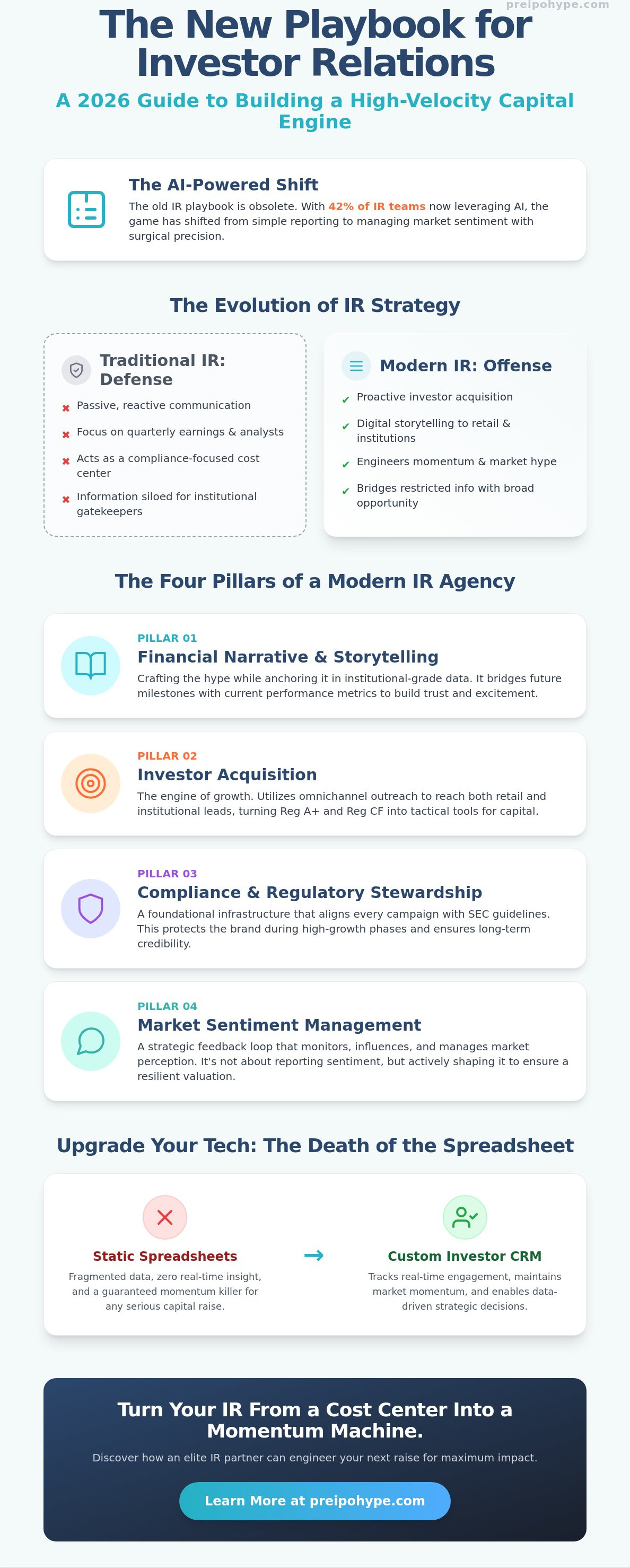
Traditional IR was built for the giants. It focused on quarterly earnings, managing analysts, and keeping institutional gatekeepers at bay. It was a game of defense. Modern capital acquisition is a game of offense. With the 2026 SEC proposals raising the "large accelerated filer" threshold to $2 billion, many mid-cap and high-growth companies now have more breathing room to tell their story before facing heavy regulatory burdens. Modern agencies use this space to deploy digital storytelling and retail investor syndicates. They've turned Reg CF and Reg A+ offerings into standard playbooks for pre-IPO firms. It's not about waiting for a bank to notice you; it's about going direct to the source of capital.
The Role of the "Informed Insider"
The best agencies act as the informed insider for your brand. They hold the keys to gated financial worlds that were previously inaccessible to the broader market. This role requires a delicate balance. You must maintain professional financial authority while simultaneously building the kind of market excitement that drives volume. It's about connecting restricted information with broader opportunity. By navigating the complexities of venture capital and private equity, these agencies ensure your narrative reaches the right desks at the right time. They don't just answer the question of what does an investor relations agency do; they show you how to win the capital race before your competitors even leave the starting block.
The Four Pillars of Strategic Investor Relations
To win in 2026, you can't rely on a single press release or a static pitch deck. The market moves too fast for that. A modern firm builds its strategy on four specific pillars that transform a company from a hidden gem into a high-volume target for capital. If you're still wondering what does an investor relations agency do, look at how they leverage these pillars to bridge the gap between restricted information and massive opportunity.
- Financial Narrative & Storytelling: This is about crafting the hype while anchoring it in institutional-grade data. This duality is essential. Investors want to see the future milestones, but they need the performance metrics to trust the trajectory.
- Investor Acquisition: This is the engine. Unlike traditional firms that only talk to a handful of analysts, a modern agency uses omnichannel mastery to reach both retail and institutional leads. They've turned Reg CF and Reg A+ frameworks into tactical tools for democratizing access to elite investment circles.
- Compliance & Regulatory Stewardship: Regulatory stewardship isn't just a checkbox; it's about ensuring every marketing system and outreach campaign aligns with SEC guidelines. This foundation infrastructure protects your brand while you scale.
- Sentiment Management: Agencies act as a strategic feedback loop, monitoring and influencing how the market perceives your growth. They don't just report sentiment; they manage it to ensure your valuation remains resilient during market volatility.
Crafting the Story Framework
You need a narrative that converts curiosity into capital. This requires moving beyond the pitch deck to a multi-channel content strategy. We call this controlled ambition. It's the emotional tone that signals you have the discipline to execute and the vision to disrupt. When your story is told through the lens of an informed insider, it creates a sense of exclusivity that attracts high-caliber partners. If your current outreach feels disjointed, it might be time to book a strategy session to align your pillars.
Omnichannel Outreach Mastery
A fragmented approach is the death of a raise. You must integrate email, social, and newsletter exposure like the Invst Guru into a single, rhythmic campaign. This ensures a consistent voice across all digital touchpoints. High-net-worth individuals don't just want facts; they want to feel the momentum of a movement. By maintaining this steady pulse of opportunity, an agency ensures that your brand stays top-of-mind until the realization event occurs.
Engineering the Raise: The Evolution of IR Technology
If you're still using Excel to manage a multi-million dollar raise, you're not just behind the curve; you're inviting failure. In 2026, spreadsheets are the death of a raise. They lack the velocity and visibility required to capture market momentum before it evaporates. So, what does an investor relations agency do to solve this? They replace manual tracking with a high-performance digital acquisition funnel. This transition isn't just about convenience. It's about engineering a system where no lead is left to chance.
A Custom Investor CRM is the heart of this evolution. With 42% of IR teams now using AI in 2026, the shift toward automation is no longer optional. It allows agencies to track engagement with surgical precision. We're talking about lead scoring that identifies exactly which investors are ready to commit and which need more nurturing. Attribution tracking tells us precisely which ad or email triggered a $50k investment. This level of granularity is what separates elite capital raises from the noise. Professional standards, such as those advocated by the National Investor Relations Institute (NIRI), increasingly point toward this kind of rigorous, data-centric approach as the baseline for success.
The Technical Bedrock: Foundation Infrastructure
Your fundraising tech stack is now as important as your pitch. Without a solid foundation infrastructure, you're building on sand. Modern IR firms use these systems to automate the 60-day attribution cycle, ensuring that long-term leads are nurtured through tailored content. This isn't just about a database. It's about a scalable engine that turns cold interest into a predictable stream of capital. It's the difference between a one-off funding round and a sustained valuation growth strategy.
Data-Driven Decision Making
We don't guess which message resonates; we prove it. By A/B testing financial messaging, agencies can optimize for ROI in real-time. If a specific narrative around market disruption isn't converting, the system flags it immediately. Real-time campaign monitoring allows for rapid pivots, ensuring that capital is always flowing toward the most effective channels. This algorithmic nurturing turns curiosity into capital by delivering the right information at the exact moment an investor is ready to act. It's about moving at the speed of the market, not the speed of a quarterly board meeting.
Managing the Investor Hype Cycle
Market excitement isn't a fluke. It's a calculated byproduct of strategic positioning. When you look at what does an investor relations agency do, the most sophisticated firms are actually engineering the "Hype Cycle." They don't just wait for the market to notice; they dictate the pace. This cycle isn't about empty noise. It's about aligning your company's milestones with the market's appetite for growth. By using data-driven triggers, an agency creates a sense of momentum that feels organic to the outside world but is strictly controlled from within.
The goal is to drive valuation through consistent market momentum. Agencies do this by managing realization events and pre-IPO milestones with surgical precision. They ensure your narrative stays fresh, even between funding rounds. This prevents the "funding fatigue" that often kills high-growth startups. Instead of a flat line, your trajectory looks like a series of escalating peaks, each one building institutional credibility while inviting new participants into the movement.
Building Exclusivity and Urgency
Elite capital raises thrive on exclusivity. You need to frame your investment opportunity as a rare, time-sensitive entry point into a gated financial world. This is where the psychology of the early-stage investor comes into play. You aren't just fighting for capital; you're managing the tension between FOMO and rigorous due diligence. By leveraging proprietary investor data, an agency can target specific retail syndicates through Reg CF or Reg A+ frameworks. This democratizes access while maintaining a "private club" atmosphere where participation feels like joining an exclusive syndicate rather than just executing a transaction.
Sustaining Momentum Post-Raise
Your IR strategy shouldn't stop just because the round closed. In fact, that's when the real work of managing secondary market perception begins. You're preparing the market for the next realization event, whether that's a Series B or a full IPO. With the 2026 SEC rules allowing companies to stay on the "IPO on-ramp" for 60 months, you have a massive window to build a loyal investor base. Agencies help manage liquidity events and secondary market interest to ensure your valuation stays resilient. Ultimately, what does an investor relations agency do is ensure your brand remains a vehicle for wealth creation long after the initial check is signed. If you want to see how this technical infrastructure can power your next round, schedule a strategy call with our team.
How to Select the Right IR Agency for Your Raise
Choosing a partner to manage your market presence is a high-stakes decision that dictates your company's terminal value. Many founders make the mistake of hiring a firm that offers generic advice without the technical infrastructure to back it up. When evaluating what does an investor relations agency do for your specific capitalization table, you must look past the polished pitch decks. You need a partner that functions as a high-velocity campaign management engine, not just a group of consultants who provide surface-level feedback.
A disciplined agency process is often marked by "Project-Based Setup Fees." This isn't just an administrative cost. It's a sign that the firm is investing in your Foundation Infrastructure before a single outreach email is sent. They're building the custom triggers and attribution models required to win. The right agency acts as a gateway to your future valuation, ensuring that every marketing dollar spent contributes to a measurable increase in investor interest and market momentum.
Questions Every Founder Should Ask
Don't settle for vague promises of "increased visibility." Demand technical specifics. If an agency can't answer these three questions with data, they aren't equipped for the 2026 market:
- "Do you own your investor CRM, or are you using my spreadsheets?" If they don't have a proprietary system to track real-time engagement, they can't manage the hype cycle effectively.
- "How do you track 60-day attribution across omnichannel campaigns?" You need to know exactly which touchpoint converted curiosity into capital.
- "What is your experience with Reg CF and Reg A+ marketing?" Modern IR requires mastery of these retail frameworks to build a diverse and resilient investor base.
The Pre-IPO Hype Advantage
Execution is everything. At Pre-IPO Hype, we've moved beyond the traditional consulting model to provide a true capital-acquisition powerhouse. We've facilitated over $100 million for more than 230 companies by connecting restricted information with broader market opportunity. Our approach is built on the Ask CEO direct access model, which strips away the gatekeepers and puts your narrative directly in front of the people who matter.
The transition from a promising startup to a market leader requires more than just a good product. It requires a relentless focus on how the world perceives your growth trajectory. We provide the keys to elite investment circles that were once inaccessible. If you're ready to stop guessing and start engineering your raise, it's time to act. Book a strategic fundraising roadmap session today and let's build your market momentum together.
Master Your Market Momentum
The landscape of capital acquisition has shifted. You now understand that what does an investor relations agency do in 2026 is far more than drafting press releases; it's about engineering a technical acquisition funnel that captures and converts high-net-worth interest. By leveraging foundation infrastructure and surgical sentiment management, you move from chasing checks to commanding market attention. You've seen how the right tech stack and a strategic hype cycle can bridge the gap between a hidden gem and a market leader.
Success in this gated financial world requires more than a vision. It requires the data to prove it. Pre-IPO Hype has facilitated over $100 million in funding by deploying a Custom Investor CRM with full 60-day attribution and omnichannel mastery across Reg CF and Reg A+ campaigns. We don't just consult. We execute the strategy that powers elite raises and sustains momentum long after the round closes.
Ready to engineer your next capital raise? Explore what Pre-IPO Hype can do for you.
The future of your valuation is waiting for those who act decisively. Let's build it together.
Frequently Asked Questions
What is the difference between an IR agency and a PR firm?
An IR agency focuses specifically on capital markets and valuation, while a PR firm handles general brand awareness and consumer sentiment. When asking what does an investor relations agency do compared to PR, the focus is on the financial narrative. IR partners manage the strategic intermediary role between a company and its investors, using data-driven campaigns to drive capital acquisition rather than just media mentions.
How much does an investor relations agency cost in 2026?
Pricing for investor relations services isn't standardized and varies based on the scope of services and the agency's track record. Most modern firms use a combination of project-based setup fees and monthly retainers. These costs cover the technical infrastructure and campaign management required for a raise. You'll find that fees are typically proprietary and reflect the level of omnichannel mastery provided.
Do startups really need an IR agency before an IPO?
Establishing market momentum early is critical for achieving a high terminal valuation. Pre-IPO firms use investor relations to engineer the hype cycle and build a loyal base through Reg CF or Reg A+ frameworks. Waiting until the IPO to start your IR strategy means you're missing out on years of sentiment management. It's about building a movement before you hit the public markets.
Can an IR agency guarantee that my funding round will close?
No agency can provide guaranteed funding results or act as a securities brokerage. Their role is to build the technical bedrock and financial storytelling that maximizes your probability of success. They provide the acquisition campaigns and performance tracking needed to reach the right desks. The final investment decision always rests with the market and the strength of your company's fundamentals.
What is an Investor CRM and why is it necessary for fundraising?
An Investor CRM is a specialized platform that tracks lead scoring, engagement, and 60-day attribution for capital raises. It's necessary because it replaces inefficient spreadsheets with real-time data on investor behavior. This technology allows teams to identify which leads are ready to commit and which need more nurturing. It ensures no capital is left on the table during a high-velocity funding round.
How do IR agencies help with Reg CF and Reg A+ crowdfunding campaigns?
Agencies provide the digital marketing and omnichannel outreach required to reach thousands of retail investors simultaneously. They manage the content creation and newsletter exposure needed to turn a regulated offering into a viral movement. This proactive approach ensures the company meets its funding goals while maintaining the institutional-grade credibility required for future milestones. It's about democratizing access without losing authority.
How is IR performance measured by founders?
Founders measure performance through tangible metrics like lead conversion rates, cost per acquisition, and shifts in market sentiment. While some teams struggle with measurement, elite partners provide clear analytics through their fundraising tech stack. Success is seen in a more resilient valuation and a steady pulse of investor interest. You're looking for a clear connection between marketing efforts and capital flow.
What is the role of an IR agency in managing a company’s valuation?
An agency manages valuation by ensuring the market accurately perceives a company's future potential instead of just its current status. Ultimately, what does an investor relations agency do for valuation is bridge the gap between restricted information and broader market opportunity. They act as a strategic feedback loop, using data-backed storytelling to minimize volatility and maximize momentum throughout the company's growth lifecycle.
Disclaimer
Educational only. Not investment, tax, or legal advice. Pre-IPO Hype is investor relations infrastructure for Regulation CF and Regulation A+ raises. We are not a broker-dealer, funding portal, or investment adviser, and we do not offer or sell securities or make investment recommendations. Any securities offering is made only by the issuer, through its own offering documents and, where required, a registered intermediary.


