
What Does Wefunder Charge? The Definitive Founder’s Guide to Fees in 2026
Most founders lose 12% of their total raise to invisible costs before they hit their minimum funding goal. While equity crowdfunding is the ultimate engine for democratizing early-stage growth, the gap between a successful $5 million raise and a capital-draining mistake often comes down to one question: what does wefunder charge when the hype settles into hard data? You're right to be cautious. The 2026 landscape for Reg CF is more competitive than ever; a miscalculated budget can erode your runway before the first investor check clears.
We've decoded the fee structures so you don't have to. This guide delivers a definitive breakdown of the 7.5% platform success fee, the 2% average for Form C compliance, and the strategic marketing spends required to hit your milestones. You'll gain a clear framework for managing carry and escrow costs while comparing Wefunder’s ROI against its top competitors. We're moving beyond surface-level FAQs to give you the insider's playbook for a high-velocity, cost-optimized raise.
Key Takeaways
- Master the core 7.5% success fee model to navigate the Reg CF landscape with the precision of a seasoned financial insider.
- Expose the "Shadow Budget" of marketing and PR to ensure your $5M raise isn't derailed by unforeseen liquidity leaks.
- Get the definitive answer to what does wefunder charge in 2026, including the subtle nuances of investor carry and escrow fees.
- Benchmark Wefunder’s pricing against Republic and StartEngine to secure the most aggressive net capital for your next growth stage.
- Pivot your focus from platform costs to high-velocity ROI by leveraging conversion funnels that turn retail interest into institutional-grade momentum.
Understanding the Wefunder Fee Structure for Reg CF Raises
Detroit founders are no longer waiting for permission from coastal venture capitalists to build the next generation of industry. The Motor City is leveraging a shift in capital access through Equity crowdfunding, and Wefunder sits at the center of this movement. As a leading Regulation Crowdfunding (Reg CF) portal, Wefunder operates on a percentage-based model that aligns its success with your own. When Detroit founders ask what does wefunder charge, the answer starts with a performance-based incentive designed to lower the barrier to entry for early-stage startups.
The platform primarily utilizes a "no raise, no fee" promise. This means if your campaign doesn't reach its minimum funding goal, you don't owe Wefunder a dime in platform fees. It's a risk-mitigation strategy that allows you to test market demand without burning through your initial seed capital. However, it's vital to distinguish between the core success fee and the peripheral costs of doing business. While Wefunder doesn't charge an upfront listing fee, you'll still be responsible for third-party costs like CPA reviews for your financial statements, which can range from $2,000 to $4,000 depending on your company's complexity.
Wefunder's revenue comes from a 7.5% success fee on the total amount raised. This is a straight percentage taken from the capital once the round closes. It covers the essential infrastructure required to manage thousands of small-check investors. You aren't just paying for a landing page; you're paying for the regulatory plumbing that keeps your raise legal under SEC guidelines. Understanding exactly what does wefunder charge ensures you aren't leaving equity on the table during the closing process.
The 7.5% Success Fee: What is Included?
This 7.5% slice covers the heavy lifting of your campaign. It includes your campaign hosting, the investor relations dashboard, and the software tools needed to track commitments in real-time. Wefunder also provides the legal templates for your Form C filing, which is the mandatory document you must submit to the SEC. While they don't provide bespoke legal advice, their "all-in" approach handles the standardized filing process that would otherwise cost thousands in billable hours. The 7.5% success fee represents the gold-standard industry benchmark for 2026 as the competitive landscape for retail capital intensifies.
- Platform Support: Access to a dedicated account manager to optimize your pitch.
- Payment Processing: Handling the flow of funds from thousands of individual bank accounts.
- Compliance: Automated bad actor checks and investor accreditation verification.
Reg A+ vs. Reg CF: How Fees Scale
As your ambition grows, the fee structure evolves. Reg CF is capped at $5 million per year, but if you're eyeing a "mini-IPO" via Reg A+, you can raise up to $75 million. For these larger rounds, the 7.5% flat fee often becomes a point of negotiation. High-growth companies with significant momentum can often leverage their brand to reduce the percentage or structure a mix of cash and warrants. Wefunder frequently handles institutional "side-cars" in these rounds, where a lead VC invests alongside the crowd. These institutional funds are typically processed through a Special Purpose Vehicle (SPV), and Wefunder may charge separate management fees to the investors rather than the founder to keep the cap table clean.
Breaking Down Issuer Fees: What Founders Pay to Play
Accessing the private markets isn't a free ride. It's a calculated investment in momentum. For a Detroit startup looking to scale, understanding the raw numbers is the difference between a successful exit and a cash flow crisis. When asking what does wefunder charge, you're looking at a standard success fee of 7.5% of the total fundraise in cash for most Reg CF offerings. This is a performance-based model; you only pay if your round hits its minimum target. In the current 2026 market, Wefunder also typically takes a 2% equity stake in the securities you're issuing, aligning their long-term interests with your growth trajectory.
The Cost of Financial Transparency
Compliance is the price of entry for elite investment circles. Under the current Regulation Crowdfunding framework, the SEC demands specific levels of disclosure that scale with your ambitions. If your Detroit-based firm is raising between $124,000 and $1.24 million, a CPA review of your GAAP financials is non-negotiable. These reviews typically cost between $2,000 and $4,500 depending on the complexity of your cap table. It's a mandatory hurdle that proves your company's fiscal health to sophisticated backers.
If your vision pushes toward the $5 million Reg CF limit, the requirements intensify. You'll need a full financial audit, which often costs between $10,000 and $18,000. While these numbers might seem high, they're the foundation of investor trust. Cutting corners on legal prep is a rookie mistake. A single filing error on your Form C can trigger SEC delays that stall your momentum for 60 days or more, killing the "hype" that drives successful rounds. You can calculate your true net proceeds by factoring these professional fees into your initial budget.
Escrow and Payment Processing
The logistics of moving capital from thousands of retail investors into your corporate bank account requires a robust, secure infrastructure. Wefunder simplifies this through a Special Purpose Vehicle (SPV), which keeps your cap table clean by grouping small investors into a single line item. This convenience comes with administrative costs. While investors typically cover the 2% credit card processing fee, issuers are responsible for the underlying wire and ACH costs associated with the escrow account. On a $1 million raise, these bank charges and escrow maintenance fees often account for $5,000 to $7,500 in additional costs.
Beyond the close of the round, the clock keeps ticking on compliance. Annual reporting via Form C-AR is a recurring requirement for all companies that have successfully utilized Reg CF. These filings must be submitted no later than 120 days after the end of your fiscal year. Budget at least $2,000 annually for the accounting support needed to maintain these records. When you analyze what does wefunder charge, remember that the initial commission is just the first layer. The true cost includes the ongoing maintenance of your status as a transparent, high-growth entity in the eyes of the market.
- Success Fee: 7.5% of total cash raised.
- Equity Carry: 2% of securities issued.
- CPA Review: $2,000 to $4,500 for mid-tier raises.
- Full Audit: $10,000+ for raises approaching $5M.
- Annual Reporting: $2,000+ per year for Form C-AR compliance.
The Investor's Side: Transaction Fees and Carry
The barrier to entry for private equity has historically been a high wall of "who you know" and seven figure minimums. Wefunder dismantles this wall, but the infrastructure of democratization isn't free. When analyzing what does wefunder charge, the focus often shifts to the founder, yet the investor's side of the ledger is equally vital for maintaining a healthy ecosystem. Investors pay a 2% transaction fee on their investment, which is capped at a maximum of $1,000. This cap is a strategic move that attracts high net worth "whales" alongside retail participants. If an angel investor commits $100,000 to a Detroit tech startup, they aren't hit with a $2,000 bill; they pay the same $1,000 fee as someone investing $50,000.
Retail participants investing the $100 minimum see a nominal $2 charge. This low friction entry point is essential for the "hype" cycle that drives momentum in a Regulation Crowdfunding (Reg CF) campaign. While traditional brokerages like Charles Schwab or Fidelity have moved toward zero commission trades for public equities, the private market is a different beast. The 2% fee covers the heavy lifting of regulatory compliance, escrow services, and the complex logistics of managing thousands of individual line items on a cap table. It's a small price for ground floor access to companies that were previously the exclusive domain of Sand Hill Road VCs.
How Carry Works in the Wefunder SPV
Carried interest, or "carry," is the mechanism that aligns Wefunder's success with your own. Wefunder typically charges a 10% carry on investor profits. If you invest $1,000 and the company exits at a valuation that returns $11,000 to you, Wefunder takes 10% of that $10,000 profit. This is significantly more aggressive for the investor than the 20% carry standard in the traditional venture capital world. By taking a smaller slice of the upside, the platform ensures more capital stays in the pockets of the early believers.
Founders must understand carry because it impacts the payout dynamics during an IPO or acquisition. Unlike some competitors like StartEngine, which may have different carry tiers depending on the service level, Wefunder’s 10% is a benchmark for the industry. This structure incentivizes the platform to curate high quality deals; they only see significant revenue from carry if the companies they host actually deliver a liquidity event. It's a calculated bet on the future of the Detroit startup scene.
Transaction Fee Transparency
Efficiency costs money, but Wefunder provides multiple avenues to fund an investment. ACH transfers are the gold standard for those looking to minimize costs, as they are often free or carry negligible fees. Credit card transactions, while convenient for the "buy now" impulse, hit the investor with an additional 3.5% processing fee. For a serious investor, a wire transfer is often the most professional route for large sums, despite the flat fees banks charge on the back end. These investor fees are designed to keep the platform free for low-capital participants while ensuring the technical infrastructure remains robust.
The psychology of these fees is fascinating. Data suggests that a 2% fee rarely hurts conversion rates for investors who are already sold on a company's vision. When an investor sees the potential for a 10x or 50x return, a 2% entry fee feels like a rounding error. It acts as a minor filter, ensuring that the people joining the movement are serious about their commitment. In the high stakes world of private markets, the cost of the ticket is far less important than the quality of the show.
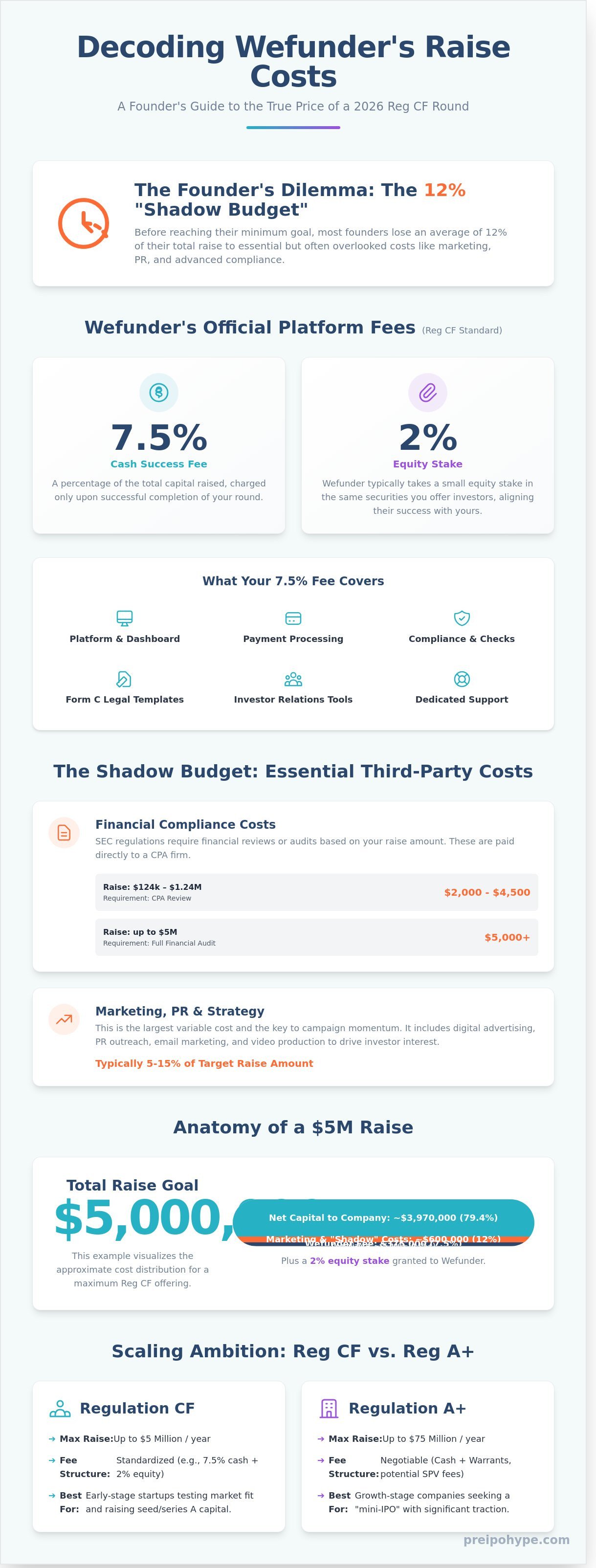
Beyond the Platform: The Hidden Costs of a Successful $5M Raise
Detroit founders often fixate on the headline commission. While understanding what does wefunder charge is the logical starting point, it's only the baseline of a $5M roadmap. The real expense lives in the "Shadow Budget." If you're planning to scale from a local startup to a national powerhouse, you can't rely on organic platform traffic. The platform provides the plumbing; you provide the water. For a $5M raise, savvy CEOs budget for an aggressive 3% to 5% marketing-to-capital ratio. This means you should prepare to deploy $150,000 to $250,000 in external capital to secure your target. This isn't a fee paid to the platform, but it's the cost of the momentum required to close.
The "build it and they will come" mentality is a death sentence in the private markets. Statistics from 2024 indicate that 63% of equity crowdfunding campaigns fail to reach their maximum target because they lack a proactive acquisition strategy. You aren't just selling shares; you're competing for attention in a crowded marketplace. Without a dedicated budget for lead generation, your offering will sit dormant on page four of the discovery feed. Momentum is the only currency that matters on Wefunder.
Marketing and Investor Acquisition
Digital ad spend is the engine of a high-growth raise. You'll need a coordinated strike across Meta, Google, and LinkedIn to find high-net-worth individuals who resonate with the Detroit comeback story. Pre-IPO Hype optimizes these costs by using data-driven omnichannel outreach, ensuring your message hits the right screens at the right time. We focus on reducing wasted spend by deploying Foundation Infrastructure, which creates a seamless funnel from the first click to the final investment. This infrastructure ensures that every dollar spent on ads is tracked, measured, and optimized for conversion.
Wefunder vs. The Competition: 2026 Comparison
By 2026, the landscape of equity crowdfunding has bifurcated into distinct models. When you analyze what does wefunder charge compared to its peers, the distinction becomes clear:
- Wefunder: Charges a flat 7.5% success fee. It remains the most "founder-friendly" niche because it doesn't charge investors high transaction fees, keeping the "ground floor" accessible.
- StartEngine: Uses an "investor-centric" model. Fees vary between 7% and 12%, often including equity kickers and a 2% processing fee charged directly to the investor.
- Republic: Typically takes 6% to 8% in cash plus 2% in the form of a Crowd SAFE (equity). It feels more institutional but can be more expensive long-term due to the equity carve-out.
The "cheapest" platform often results in the most expensive cost of capital. If a platform charges only 6% but lacks internal traffic, you'll spend double that amount on external marketing just to get eyes on the page. Wefunder’s strength is its massive, active user base, but you still need a custom investor CRM to track attribution. You need to know exactly which LinkedIn ad led to a $25,000 check. Without this data, you're flying blind. Successful raises require a surgical approach to ROI, treating every investor lead like a high-value sales prospect.
Ready to dominate your next funding round? Partner with Pre-IPO Hype to build the momentum your Detroit-based company deserves.
Maximizing ROI: Why Your Marketing Strategy Matters More Than Fees
Detroit founders often get stuck on a single line item: the platform fee. While asking what does wefunder charge is a necessary step in your due diligence, it's the wrong metric for scaling a potential unicorn. The 7.5% fee is a fixed cost of entry; your marketing strategy is the variable that determines whether you raise $50,000 or $5,000,000. You must shift your focus from "fees paid" to "net capital raised." A campaign that spends $50,000 to raise $2,000,000 is objectively more successful than one that spends $0 to raise $150,000. Efficiency is found in the spread, not the savings.
High-conversion video funnels and strategic investor newsletters are the engines that offset platform costs. In our internal tracking, campaigns utilizing a structured video funnel see a 3.8x lift in average check size compared to those relying on organic platform traffic alone. We utilize the Pre-IPO Hype methodology to create a sense of inevitable momentum. This isn't about vanity metrics; it's about engineering a liquidity event before you even hit the public markets. By the time a founder asks what does wefunder charge, they should already have a roadmap to outpace those costs through aggressive, data-driven acquisition. We treat every Reg CF launch as a high-stakes premiere where the audience is already primed to buy.
The Power of Attribution and CRM
Tracking every dollar of ad spend is the difference between a failed launch and a $5M oversubscription. You can't manage what you don't measure. Our Custom Investor CRM turns "curiosity into capital" by capturing lead data the moment an investor engages with your story. We track 100% of the journey across a 60-day attribution window. This is vital because 72% of retail investors require at least seven touchpoints before committing capital. Without a CRM, those leads evaporate into the digital ether; with it, they become a permanent asset for your current and future rounds.
Your Next Steps to a Funded Future
Stop guessing your marketing budget. Successful Detroit-based raises are built on cold, hard math. Use a valuation calculator to set your baseline and develop a marketing roadmap that accounts for a 5:1 return on ad spend. If you aren't auditing your fundraising framework every 14 days, you're losing ground to more agile competitors. The private market moves fast; your strategy must move faster. Don't wait for the platform to find your investors. Go get them.
- Audit your current investor deck for "hype" triggers and institutional clarity.
- Calculate your cost per lead based on a 2.4% conversion benchmark.
- Analyze your secondary liquidity options to increase investor confidence.
- Final CTA: Schedule a 30-minute consultation with Fuzzy Wenzel to map your Wefunder strategy and secure your spot in the next elite cohort.
The gap between private secrecy and public opportunity is closing. The founders who win are those who realize that the cost of capital is secondary to the speed of execution. Your Detroit-based company has the grit; we provide the megaphone and the metrics to ensure the world hears your story.
Mastering the Economics of Your Equity Crowdfunding Campaign
Knowing what does wefunder charge is the baseline for any founder eyeing a $5M maximum raise in 2026. While the platform typically takes its 7% cut on Reg CF raises, the real differentiator between a stagnant campaign and a viral success is how you deploy your remaining capital. You've seen that hidden costs like the $4,000 to $10,000 for independent audits can eat into your runway if you aren't prepared. Don't let the administrative fees distract you from the bigger picture. The most successful issuers treat their raise as a high-velocity marketing machine rather than a passive listing.
At Pre-IPO Hype, we've facilitated over $100M in funding for startups that refuse to settle for average. Our team leverages a custom Investor CRM to provide total clarity with 60-day attribution; this ensures every dollar spent on omnichannel mastery converts into capital. You've got the vision; we have the high-octane systems to fuel it. Ready to dominate your Reg CF raise? Ask our CEO about our high-octane investor acquisition systems.
Your journey to the next liquidity event begins with a single, decisive move toward growth.
Frequently Asked Questions
Is the Wefunder fee negotiable for larger companies?
Wefunder's standard 7.5% fee is generally firm for Regulation CF raises, but larger Regulation A+ campaigns exceeding $5 million often see negotiated rates as low as 5%. These high-volume deals allow institutional-grade startups to leverage the platform's infrastructure while protecting their margins. If your Detroit firm is targeting a standard $5 million cap, expect the 7.5% rate to apply without deviation.
What happens to the fees if my Wefunder campaign fails?
You pay nothing if your campaign fails to reach its minimum funding goal. Wefunder operates on a success-based model where the fee only triggers once you successfully close the round. If the $50,000 minimum isn't met, all funds return to investors. This ensures the platform's interests align perfectly with your company's momentum and protects your remaining capital.
Does Wefunder charge for the legal setup of the SPV?
Wefunder includes the standard Special Purpose Vehicle setup within their primary fee structure for most Regulation CF raises. This setup prevents your cap table from becoming cluttered with 1,000 individual names, which is a critical requirement for 90% of Series A venture capitalists. You won't see a separate $2,000 legal bill for the SPV formation itself during the onboarding process.
How much should a Detroit startup budget for marketing on top of Wefunder fees?
Detroit startups should budget between 5% and 10% of their total funding goal for external marketing and digital ad spend. If you're wondering what does wefunder charge for promotion, the answer is that their fee covers the platform infrastructure, not your private ad budget. A $1 million raise typically requires a $75,000 marketing war chest to generate the necessary hype and investor traffic.
Are there ongoing annual fees for being on the Wefunder platform after the raise?
There are zero ongoing annual maintenance fees charged by Wefunder after your fundraise concludes. Once the round closes and the success fee is deducted, your only recurring obligations are the annual Form C-AR filings required by the SEC. These compliance filings usually cost between $1,500 and $3,000 if you hire an outside CPA to handle the financial disclosures.
Can I use my own escrow provider instead of Wefunder’s partner?
You cannot use your own escrow provider because Wefunder mandates the use of their integrated partners like North Capital or Boston Private. This integration ensures that the 100% automated closing process remains seamless and compliant with federal regulations. Using a third-party provider would break the technical workflow that allows Wefunder to process thousands of small-dollar investments simultaneously without manual intervention.
What is the difference between Wefunder’s fee and a broker-dealer’s fee?
Wefunder charges a flat 7.5% fee as a funding portal, while broker-dealers often take a 5% to 10% cash commission plus equity warrants. When asking what does wefunder charge compared to a broker, remember that portals cannot legally offer investment advice. Broker-dealers might charge a higher total percentage but they actively solicit their private network of elite, high-net-worth individuals to fill your round.
How does Wefunder’s carry impact my cap table during a Series A?
Wefunder's 10% carry is a share of investor profits and doesn't dilute your founder equity during a Series A. When a liquidity event occurs, Wefunder takes 10% of the upside from the investors' portion only. This structure is a massive win for Detroit founders because it keeps the cap table clean and ensures the platform is incentivized to help you reach a billion-dollar valuation.
Disclaimer
Educational only. Not investment, tax, or legal advice. Pre-IPO Hype is investor relations infrastructure for Regulation CF and Regulation A+ raises. We are not a broker-dealer, funding portal, or investment adviser, and we do not offer or sell securities or make investment recommendations. Any securities offering is made only by the issuer, through its own offering documents and, where required, a registered intermediary.


