
What is an Investor Relations Platform? The Founder’s Guide to Capital Momentum
Most founders treat their cap table like a static spreadsheet, but the elite 1% recognize it as a live fuel source for their next round. You've likely felt the friction of fragmented data and the manual grind of onboarding new backers while trying to project an institutional-grade image. At its core, asking what is an investor relations platform is the first step toward reclaiming your time. It isn't just a place to store PDFs; it's a strategic command center that turns passive reporting into an active engine for capital acquisition.
For founders who supplement their digital presence with live investor days, a streamlined Conference Registration process is a vital part of maintaining a professional brand across all touchpoints.
We know the pressure of maintaining market momentum while the SEC shifts the goalposts, such as the May 2026 proposal to raise the large accelerated filer threshold to $2 billion. This article will show you how to leverage modern IR infrastructure to automate lead tracking and professionalize your brand for the world's most sophisticated investors. You'll discover how to transition from manual reporting to a scalable system that secures your seat in elite investment circles and ensures your narrative remains disciplined in a high-growth market.
Key Takeaways
- Discover what is an investor relations platform by moving beyond the "digital filing cabinet" model and embracing it as a high-performance capital engine.
- Shift your focus from post-deal reporting to pre-raise acquisition by using IR infrastructure to engineer market hype before you even open the round.
- Replace static, unvisited portals with omnichannel intelligence that tracks investor engagement across every digital touchpoint.
- Identify five critical features for 2026 that automate manual friction and professionalize your brand for institutional scrutiny.
- Learn how a custom investor CRM integrates proprietary tech with strategic execution to turn passive data into a scalable acquisition machine.
Defining the Investor Relations Platform: More Than a Digital Filing Cabinet
The days of passive filing are over. If you're still relying on a folder of PDFs and a prayer, you're leaving capital on the table. To understand what is an investor relations platform, you must view it as a high-performance engine rather than a static archive. It's a centralized ecosystem where data, communication, and capital tracking converge. This isn't just about administrative ease; it's about bridging the gap between restricted internal data and the broader market opportunity. By modernizing your Investor relations (IR) strategy, you transform your company from a black box into a transparent, momentum-driven vehicle.
Modern IR hubs represent a massive shift from legacy systems. While old-school IR relied on manual updates and reactive reporting, today's platforms are proactive. They act as the definitive source of truth for both the founder and the investor community. This shift is fueling significant growth in the sector. The investor relations solutions market is projected to reach $3.64 billion in 2026, growing at a 10.3% CAGR, according to Research and Markets. This expansion reflects a global move toward automated, digital-first capital management.
To better understand this concept, watch this helpful video:
The Core Components of an IR Ecosystem
A modern platform functions as the ultimate command center. It starts with a secure, institutional-grade data room where due diligence documents live. This isn't Google Drive; it's an encrypted vault that tracks who sees what and when. Next is the investor portal, a digital window where stakeholders access real-time performance metrics without needing to call the CEO. Finally, the communication layer allows for omnichannel outreach. Whether it's a monthly update or a flash alert about a new milestone, this layer ensures your narrative stays front and center. It's about maintaining a steady pulse of opportunity.
Why the "Spreadsheet Method" is a Liability
Founders often start with manual spreadsheets, but this is a dangerous gamble. Sharing unencrypted documents via email creates massive security risks that institutional backers won't tolerate. Beyond the tech vulnerability, there's the cost of friction. Fragmented data leads to delayed communication. In the fast-moving world of venture capital, a 24-hour delay can kill a deal. Manual systems also hit a wall during public-facing raises like a Reg CF or Reg A+. When you're managing thousands of micro-investors, spreadsheets don't just fail. They implode. A sophisticated platform provides the foundation infrastructure needed to scale without losing control. If you're ready to see how this looks in action, you can ask our CEO about building your custom command center.
The Architecture of Modern IR: Post-Raise Management vs. Pre-Raise Acquisition
Most founders make the fatal mistake of thinking investor relations begins the moment the wire hits the bank. That's a legacy mindset that leaves you reactive and vulnerable. In the current high-velocity market, the most successful companies treat IR as a front-end growth engine. When you ask what is an investor relations platform in 2026, you aren't just looking for a portal to host updates. You're looking for the architecture that powers the pre-IPO hype cycle. It's about engineering market momentum long before the deal is signed.
A truly integrated platform tracks the entire lifecycle. It starts with a curious lead clicking an ad and ends with committed capital sitting on your cap table. This strategic asset turns your fundraising from a desperate scramble into a predictable, data-driven process. It's the difference between hoping for a lead and manufacturing a movement. By the time you open a round, the market should already be primed for your entry.
Investor Acquisition: The Front-End of the Platform
The front-end of your IR ecosystem is where the real work happens. By leveraging investor acquisition platforms, you can build a massive pre-launch waitlist of eager backers. Lead scoring allows you to stop wasting time on "tire kickers" and prioritize high-value institutional prospects who show genuine intent. With 60-day attribution tracking, you gain total clarity on which marketing channels actually drive capital. You'll know exactly where your next $10 million is coming from. If you want to refine this strategy, you might schedule a strategy session to map out your acquisition funnel.
Stakeholder Management: The Back-End Efficiency
Why Static Portals Fail: The Need for Omnichannel Investor Intelligence
A static portal is a ghost town. If your data room sits empty while you wait for a phone call, you've already lost the round. When founders ask what is an investor relations platform, they often expect a digital vault, but the elite players demand a lighthouse. Omnichannel mastery is the differentiator here. It's the ability to project your narrative across every digital touchpoint, ensuring your brand isn't just a bookmark, but a constant presence in the investor's peripheral vision. This is where the transition from passive storage to active acquisition happens.
Consistency breeds institutional trust. When a fund manager encounters your brand on social media, receives a crisp update in their inbox, and then lands on a high-performance IR portal, the psychological impact is profound. This isn't just marketing. It's the strategic alignment of data-driven systems that feed your platform with high-quality leads. You're not just storing information; you're engineering a state of constant awareness. By the time an investor reaches out, they shouldn't just know your name. They should feel like they're joining a movement that's already in motion.
Tracking the Digital Footprint of an Investor
Intent is hidden in the data. A modern platform tracks every digital footprint, from email opens to specific document downloads. These aren't just metrics. They're signals. If a prospect downloads your pro forma three times in 48 hours, they're not just browsing; they're analyzing. By using retargeting pixels, you can stay top-of-mind, appearing on their preferred news sites and social feeds. This data flows directly into a custom investor CRM, allowing for surgical, personalized follow-ups that close the gap between interest and investment. You stop guessing who to call and start responding to real-time intent.
The Power of the Automated Hype Cycle
Building a movement requires more than a single announcement. It demands the "Foundation Infrastructure" to support a multi-channel raise. Automated drip campaigns are the heartbeat of this process. They nurture curious leads through a structured narrative, slowly building the pressure until they become "FOMO-driven" investors. You're moving them from awareness to urgency without manual intervention. This automation ensures that what is an investor relations platform in your hands is actually a scalable acquisition engine. If you want to see how we engineer these momentum-building strategies for high-growth startups, you should ask the CEO for a direct look at our framework.
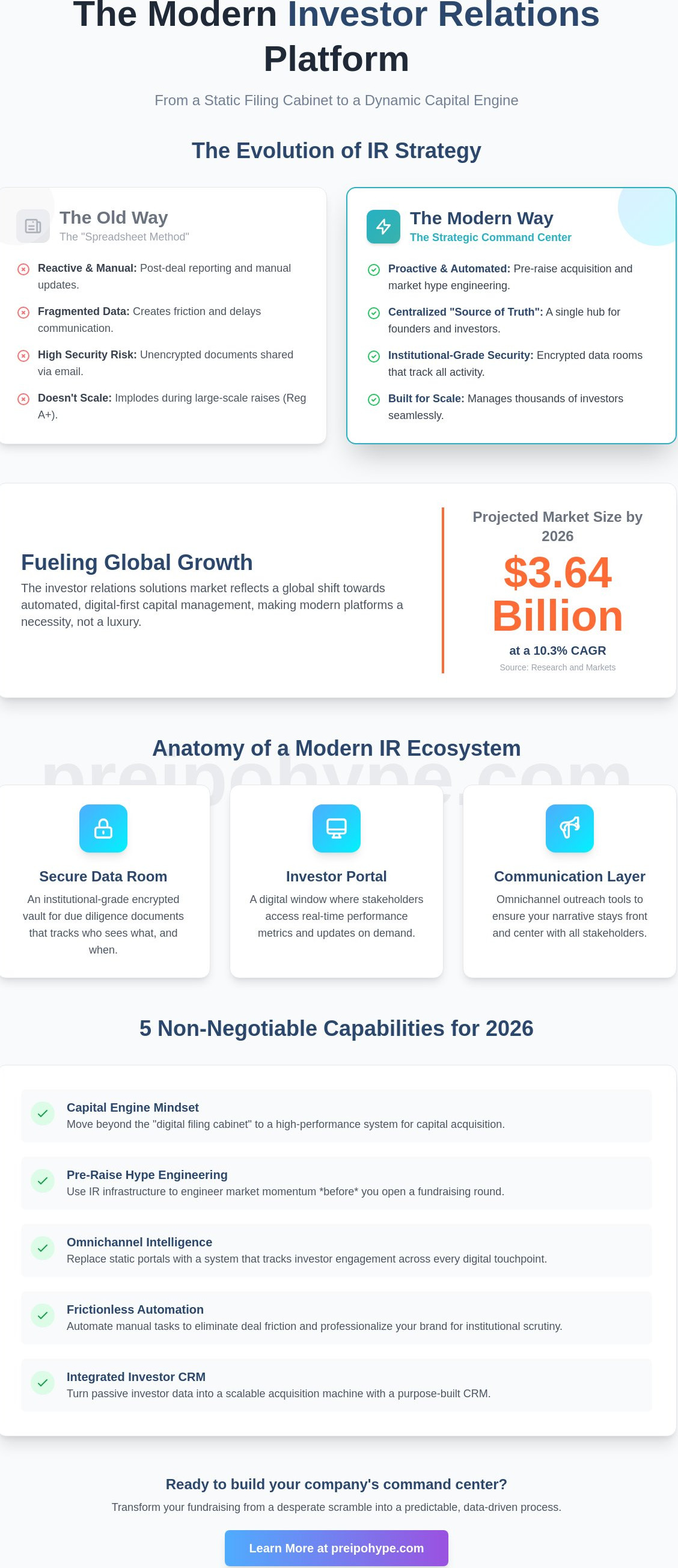
5 Non-Negotiable Features for Your 2026 IR Platform Strategy
By 2026, the gap between a standard raise and an elite capital acquisition event has widened into a canyon. Founders can no longer afford to guess which efforts are moving the needle. When evaluating what is an investor relations platform in this high-stakes environment, you must look for features that prioritize data-driven precision over simple storage. The market moves too fast for manual updates. You need a powerhouse that automates the friction and amplifies the hype.
The standard for institutional engagement has shifted. As of February 2026, 42% of investor relations teams have integrated AI into their daily workflows, a seven-fold increase from the previous year. This isn't just a trend; it's the new baseline for survival. If your platform isn't actively helping you engineer momentum, it's an anchor on your growth. To stay ahead, your infrastructure must include these five core pillars.
Custom Investor CRM with Attribution Tracking
You need to know exactly which ad, tweet, or newsletter blast generated which dollar. A custom CRM allows you to score leads, effectively separating retail "lookers" from high-value institutional "bookers." This level of intelligence ensures you spend your time on prospects with the highest intent. Integrating your CRM with Reg CF marketing services ensures your retail raise operates with the same surgical precision as a private placement. It turns your cap table into a map of your most successful marketing channels.
Seamless Onboarding and Document Automation
Friction is the silent killer of deals. If an investor has to jump through hoops to sign a subscription agreement, they'll drop off before the wire. Modern platforms automate the AML/KYC process, ensuring compliance with 2026 regulatory standards without slowing down the momentum. By integrating e-signature tools directly into the investor flow, you turn a multi-day administrative headache into a two-minute digital experience. This speed is essential for maintaining the "FOMO" that drives oversubscribed rounds.
Omnichannel Outreach Integration
Elite raises are built on a bedrock of integrated digital marketing and advertising. Your platform should allow you to push updates to SMS, email, and social channels from a single dashboard. This omnichannel approach ensures your narrative remains consistent across the entire digital landscape. Real-time analytics allow you to pivot your strategy instantly based on which segments are engaging with your content. You aren't just sending updates; you're managing a live campaign. To see these features in action, you can watch our video funnel and witness the architecture of a modern raise.
Regulatory Agility and Machine Readability
Beyond Software: Engineering the Hype Cycle with a Custom Investor CRM
Software alone won't close your round. To truly grasp what is an investor relations platform, you must look past the interface and into the execution. A platform is a service; it's a strategic partner that combines proprietary technology with the raw power of market momentum. Pre-IPO Hype doesn't just hand you a login. We deploy a Custom Investor CRM designed to be your ultimate competitive advantage. It's the difference between having a map and having a driver who knows every shortcut to the finish line.
The Pre-IPO Hype Advantage
Managing the Hype Cycle is a delicate art. It requires a Custom Investor CRM that doesn't just log calls but predicts behavior. By analyzing engagement patterns across our Foundation Infrastructure, we've helped facilitate over $100 million in funding by knowing exactly when to push the narrative and when to let the anticipation build. This level of control is what allows our clients to command higher valuations and attract the kind of institutional attention that stays for the long haul. Our consulting and advisory services are the secret sauce that turns a standard setup into a high-velocity capital engine. You gain a granular view of your momentum, allowing you to see which institutional clusters are moving toward a commitment. You're no longer just a founder; you're a market architect.
Taking the Next Step Toward Elite Funding
The window for early entry into the next generation of market leaders is closing. You've seen the architecture. You understand the necessity of omnichannel intelligence and automated onboarding. Now, it's time to execute. We invite you to view our video funnel to see the platform in its live environment. This isn't a demo; it's a blueprint for your future. If you're serious about scaling, book a strategy session to assess your current standing. The elite 1% are already using these tools to dominate the private markets. In 2026, you either lead with data or follow with regret. The keys to the gated financial world are within reach. Act decisively.
Seize the Momentum of the Next Capital Cycle
The era of the static data room is dead. You've seen how the elite 1% move beyond simple storage to engineer active hype and capture institutional interest. By integrating omnichannel intelligence and automated onboarding, you transform your company from a black box into a high-velocity capital engine. At this stage, asking what is an investor relations platform serves as your entry point into a gated financial world where data drives the narrative and momentum dictates the valuation.
We've already scaled over 230 companies and facilitated more than $100M in funding through our proprietary Foundation Infrastructure. The tools are ready, and the market is moving. You can either stay buried in manual spreadsheets or take command of your cap table with institutional-grade precision. It's time to stop chasing leads and start manufacturing a movement that backers can't ignore.
Engine your capital raise today with a Custom Investor CRM and claim your seat in the next generation of market leaders. Your future starts with a single, decisive move toward elite funding.
Frequently Asked Questions
How does an investor relations platform differ from a standard CRM?
Is an IR platform necessary for a Reg CF or Reg A+ raise?
Volume makes a dedicated system essential for public-facing raises. Managing thousands of retail backers through manual spreadsheets is a recipe for operational collapse. To understand what is an investor relations platform in this context, you must see it as an automation engine. It handles high-volume onboarding, automated updates, and distribution of tax documents without draining the CEO's time.
Can an investor relations platform help with SEC compliance?
Modern platforms provide the digital infrastructure needed to stay within regulatory guardrails. They automate critical processes like AML and KYC checks to ensure every backer is vetted instantly. With the May 2026 SEC proposals shifting the reporting framework, having a system that can adapt to new disclosure requirements is a massive advantage. It ensures your source of truth remains compliant as you scale.
What is the cost of a typical investor relations platform for a startup?
Pricing typically depends on the complexity of your raise and the size of your investor base. Most providers offer tiered structures that allow founders to start with basic infrastructure and add advanced modules like attribution tracking as they grow. You should evaluate the cost against the hours of manual labor saved and the increased professional image you present to institutional backers.
How does attribution tracking work within an IR platform?
Attribution tracking connects your marketing spend directly to the capital on your cap table. By using unique tracking pixels and links, the system identifies which specific ad or email campaign inspired an investor to commit. This data allows you to pivot your acquisition strategy in real-time. You'll know exactly which channels are driving the highest ROI for your capital acquisition campaigns.
Can institutional investors use the same portal as retail investors?
Elite platforms allow for tiered access within a single ecosystem. You can maintain a professional, unified brand while ensuring that institutional prospects see a different level of data than retail backers. This allows you to host deep-dive pro formas and sensitive legal documents in restricted folders. It's a strategic way to manage a diverse cap table without fragmenting your communication or your narrative. This versatility is key to understanding what is an investor relations platform for a multi-stage raise.
Disclaimer
Educational only. Not investment, tax, or legal advice. Pre-IPO Hype is investor relations infrastructure for Regulation CF and Regulation A+ raises. We are not a broker-dealer, funding portal, or investment adviser, and we do not offer or sell securities or make investment recommendations. Any securities offering is made only by the issuer, through its own offering documents and, where required, a registered intermediary.


