
What to Do When Fundraising Stalls: The Founder’s Playbook for Reviving a Stagnant Raise
For founders in any other sector, the reality is stark: the easy money has evaporated. If your campaign dashboard has gone cold, you are likely wondering what to do when fundraising stalls before your runway disappears. It is a high-stakes moment where your personal network has run dry and your digital ad spend is yielding nothing but high bounce rates.
Key Takeaways
- Identify the specific conversion leaks in your "Curiosity-to-Capital" funnel by auditing attribution data within your CRM.
- Learn what to do when fundraising stalls by transitioning from passive email lists to a high-impact omnichannel re-engagement system.
- Re-ignite investor interest with real social proof: verified milestones, press, and investor stories you can document.
- Replace manual, unscalable outreach with a permanent investor outreach system built on robust foundation infrastructure and automated CRM tools.
The Anatomy of a Stalled Capital Raise: Why Momentum Dies
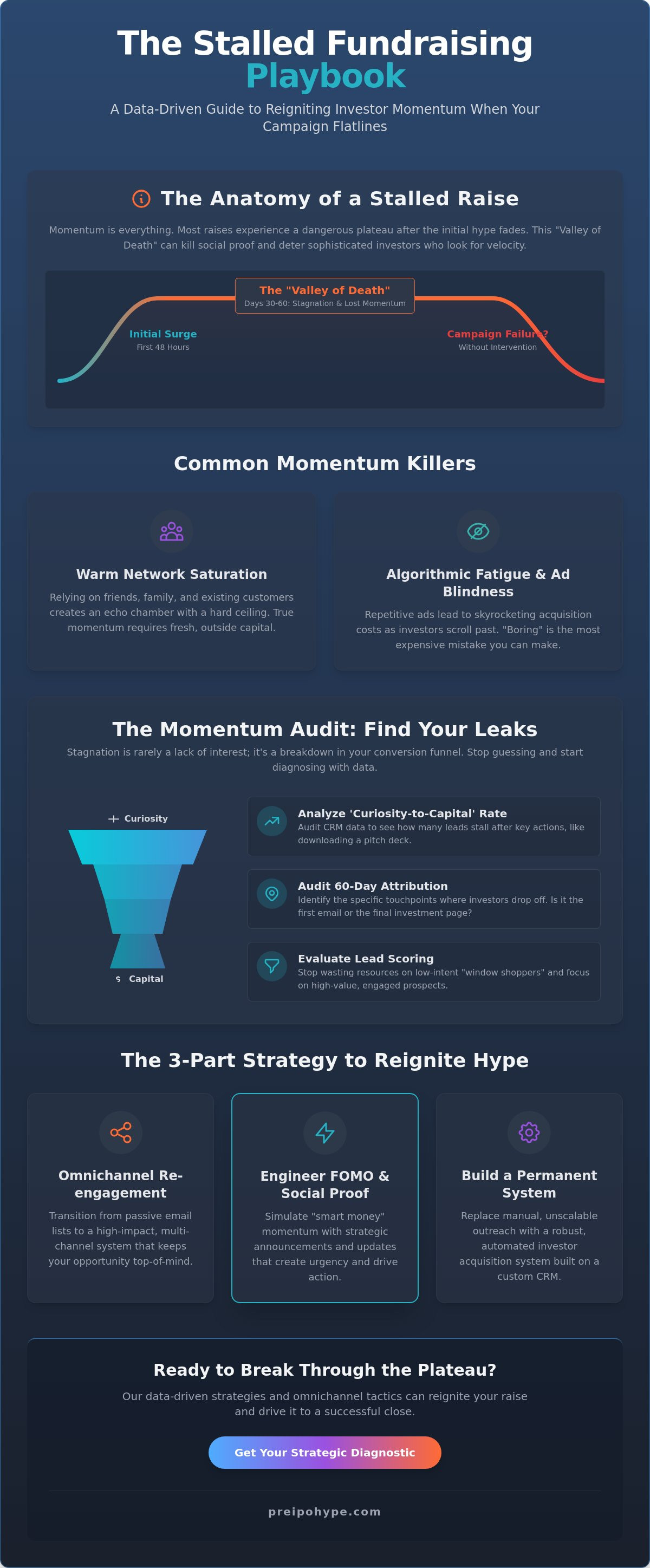
Momentum is the only currency that matters during a live raise. Most founders experience an initial surge of capital in the first 48 hours, fueled by early believers and internal lists. But by day 30, the adrenaline fades. This is the "Mid-Campaign Plateau," a dangerous phase where the daily investment volume drops to a trickle. In the world of equity crowdfunding, this is known as the "Valley of Death." Between days 30 and 60, the launch hype has evaporated, and the urgency of the closing deadline is too far away to trigger action. If you don't know what to do when fundraising stalls during this window, your campaign risks becoming a ghost town.
To better understand the psychology of donor and investor engagement during these critical phases, watch this helpful video:
A stagnant dashboard does more than just slow your progress; it destroys social proof. Sophisticated investors look for "velocity." They want to join a movement that is already winning. When they see a flat line on your funding chart, they assume the "smart money" has passed on the opportunity. While traditional Venture capital (VC) firms might take months to deliberate, the retail and angel markets move on sentiment. You must distinguish between a marketing problem, where your ads aren't reaching new eyes, and a storytelling problem, where your message is reaching people but failing to move the needle. If you're trapped in this cycle, it's time to ask our CEO for a strategic diagnostic of your current funnel.
The Saturation of the 'Warm' Network
Algorithmic Fatigue and Ad Blindness
Social media algorithms are ruthless. If your campaign creative hasn't changed in three weeks, your cost-per-acquisition will skyrocket. High-stakes capital markets demand fresh, authoritative content that cuts through the noise. Repetitive ads lead to "ad blindness," where potential investors scroll past your opportunity without a second thought. "Boring" is the most expensive mistake you can make. When the initial hype dies, you need a sophisticated Digital Marketing and Advertising strategy that evolves with the campaign's lifecycle to maintain a steady pulse of investment.
The Momentum Audit: Diagnosing Your Conversion Leaks
When the investment ticker stops moving, don't just dump more capital into the same underperforming ads. That is a tactical error. To understand what to do when fundraising stalls, you must perform a momentum audit. This is a clinical examination of your conversion funnel to find exactly where the capital flow is being restricted. Stagnation is rarely a lack of interest; it's usually a breakdown in the technical infrastructure that bridges curiosity and commitment. You need to assess the alignment between the tactic(s), the messaging and the audience at every stage of the funnel.
A comprehensive momentum audit follows four critical steps:
- Analyze the 'Curiosity-to-Capital' rate: Look at your CRM data to see how many leads are stalling after downloading the pitch deck.
- Audit attribution: Identify the specific touchpoints where potential investors drop off. Is it the first follow-up email or the final investment page?
- Evaluate lead scoring: Determine if your team is wasting resources chasing low-intent "window shoppers" instead of high-value prospects.
- Review Foundation Infrastructure: Ensure your landing page isn't suffering from technical friction, such as slow load times or a confusing checkout process that kills the "buy" impulse.
Lead Scoring and Investor Intent
Not all leads are created equal. You need to differentiate between casual observers and high-net-worth prospects who have the capacity to move the needle. Using The Custom Investor CRM allows you to prioritize follow-up based on engagement metrics. If a lead has opened your last three updates and spent significant time on the financials page, they are a "whale" potential. Identifying these patterns allows you to focus your energy where the ROI is highest. If you're struggling to segment your database, a quick consultation on lead scoring can provide the clarity you need.
Attribution and the 7-Touch Rule
Investors rarely commit on the first visit. Most require seven or more exposures to your brand before they feel comfortable signing a subscription agreement. You must map the entire journey from the first click to the final signature. If your tracking is broken, you won't see that a lead from day 10 finally converted on day 45. Mapping this journey reveals the "leaky buckets" in your process. High-growth raises aren't built on luck; they are built on a technical bedrock that ensures no lead is left behind.
Omnichannel Re-engagement: Reviving the Investor Interest
Most founders treat email as their only lifeline. When the open rates drop and the clicks dry up, they panic. If you want to know what to do when fundraising stalls, the answer lies in omnichannel dominance. You cannot rely on a single inbox to carry a multi-million dollar raise. Investors are distracted. They are bombarded with opportunities. To win, you must be everywhere they are, appearing as a constant, professional presence across their entire digital ecosystem.
This is where sophisticated Digital Marketing and Advertising comes into play. Retargeting ads on platforms like LinkedIn and Meta serve as gentle, high-authority reminders. They don't sell; they reinforce. For those high-intent leads sitting in your CRM, direct SMS outreach or a personal note can be the final nudge. High-frequency content isn't about noise. It's about providing continuous value that proves your company is moving toward its milestones regardless of the raise status. You are building a brand, not just a balance sheet.
The Power of the 'Investor Hype Cycle'
Every raise needs a second wind. You create this by engineering "milestone" updates. Did you hit a revenue target? Secure a new partnership? These aren't just news items; they are psychological triggers. Utilizing professional Regulation CF Marketing Services helps you structure these events to create a second peak in your funding chart. You want your audience to feel like they are getting internal access to a movement that is rapidly gaining ground. This sense of exclusivity turns a stagnant raise into a gated opportunity for those who act decisively.
Content as a Conversion Tool
The narrative must shift. Stop telling people you are raising money. Start showing them that you are winning. Investors don't want to "save" a struggling company; they want to ride a rocket ship. High-production content, specifically video, humanizes the founder and the mission. It builds the trust necessary for a five-figure check. You can check out our video funnel strategy to see how we use visual storytelling to drive commitment. This approach transforms passive observers into active participants in your growth story. By the time they reach your investment page, the decision is already made. They aren't just buying shares; they're buying into the future you've visualized for them.
Engineering FOMO: Using Social Proof to Break the Plateau
Investors are herd animals. They rarely want to be the first person through the door, but they absolutely refuse to be the last. If your dashboard has been quiet for a week, it sends a subconscious signal that the opportunity is cooling. When you are deciding what to do when fundraising stalls, your primary objective is to reverse this narrative. You must shift the conversation from "we are seeking capital" to "the window of opportunity is closing" when your deadline is real. This requires a strategic deployment of social proof to show the momentum you actually have.
Engineering this momentum involves more than just a progress bar. You need to leverage third-party validation. Press mentions, influencer endorsements, and lead investor testimonials serve as institutional stamps of approval. These signals tell the retail market that the "smart money" has already done the due diligence. Additionally, your current investors are your most underutilized asset. By providing them with the right tools, you can turn your cap table into a referral engine that brings fresh, high-trust leads into your funnel. This isn't just about finding more people; it's about making the people you've already reached feel the weight of the opportunity they are about to miss. Anyone paid to promote your raise has to disclose it.
The Psychology of Scarcity in Private Markets
Real scarcity moves fence-sitters. If your offering has a true deadline, is close to its maximum, or offers investor perks disclosed in your offering documents, say so plainly and on time. Never describe a raise as nearly full or oversubscribed unless your funding portal numbers show it. Overstating demand in a live securities offering can be a misleading statement under SEC rules, and investors check the progress bar. Investor spotlights and community testimonials help too, as long as anyone paid to promote the raise says so.
Leveraging Newsletter Exposure
Sometimes a plateau is a reach problem. This is where strategic newsletter exposure becomes a game changer. Paid newsletter placements, including the Invst Guru newsletter, put your raise in front of new readers. Any paid placement for a live offering must say it was paid for and how much. Results vary, and no placement guarantees investment.
Scaling the Hype: Building a Permanent Investor Outreach System
A plateau is more than a frustration. It's a diagnostic signal. If you've been manually emailing leads or chasing "warm" intros, you've hit the limit of human-scale effort. When founders ask what to do when fundraising stalls, the answer is rarely "work harder." It's "build better." You need to shift from a temporary campaign mindset to a permanent Foundation Infrastructure that captures, scores, and converts capital on autopilot. This is how the elite 1% of founders maintain momentum while others fade away.
Transitioning from manual outreach to a Custom Investor CRM changes the game. It allows you to track investor behavior with institutional precision. You aren't just raising $5 million; you're building a proprietary database of high-net-worth backers who will support your next three rounds. Working with a specialized equity crowdfunding campaign team ensures this system remains optimized. They handle the technical heavy lifting of Digital Marketing and Advertising, allowing you to focus on the vision while the machine handles the acquisition.
Automation and Lead Nurturing
The fortune is in the follow-up. Most capital is lost because a founder forgot to send the third, fifth, or seventh update. By setting up drip campaigns, you educate your audience on your milestones and convert "maybe" into "now." This is how you solve the problem of what to do when fundraising stalls permanently. You can also deploy the 'Ask the CEO' strategy, providing the high-touch feel of a personal relationship at a massive scale. If your current funnel is leaking, you can directly ask our CEO how we re-engineer stagnant campaigns for rapid recovery.
Don't view this raise as a one-off event. It's the first step in a multi-year liquidity journey. Successful founders build an investor outreach platform that works while they sleep, ensuring they never start from zero in the next round. This long-term capital strategy is what separates a startup from a market leader. Your current raise is the perfect time to audit your technical bedrock and prepare for future scaling events. You can schedule a 30-minute strategy session to analyze your current data and map out your path to a successful close and beyond.
Reclaiming Your Raise: From Stagnation to Scale
A stalled raise isn't a death sentence; it's a technical challenge that requires a clinical, data-driven response. By auditing your curiosity-to-capital conversion rate and deploying a high-velocity omnichannel strategy, you can bridge the mid-campaign "Valley of Death" and restore the social proof that elite investors demand. Success in the private markets is reserved for founders who understand exactly what to do when fundraising stalls and act with decisive authority rather than hope. You don't need a miracle; you need a system that works while you sleep.
This technical bedrock ensures that no lead is left behind and every dollar of ad spend is optimized for conversion. The elite investment circles are waiting for companies that can demonstrate true momentum. Stop the stagnation; schedule your 30-minute fundraising audit now. Your next milestone is closer than it looks. It's time to stop chasing leads and start engineering the successful close your vision deserves.
Frequently Asked Questions
How do I know if my fundraising campaign has actually stalled or is just in a natural lull?
A natural lull typically lasts 48 to 72 hours, often occurring mid-week. A stall is a flatline in investment volume that persists for seven days or more despite consistent traffic. Check your velocity metrics in your CRM. If your cost-per-acquisition is rising while your conversion rate drops, you've moved past a temporary dip and into a mid-campaign plateau that requires a tactical pivot.
Can I change my marketing strategy in the middle of a Regulation CF or Regulation A+ raise?
You can and should adapt your marketing tactics to maintain momentum. While your core offering terms are fixed by SEC filings, your Digital Marketing and Advertising approach is flexible. Use real-time analytics to shift budget toward high-performing channels. Just ensure all new creative remains compliant with your Form C or offering circular and includes the necessary risk disclosures to stay within regulatory bounds.
What is the most effective way to re-engage investors who opened my email but didn't invest?
Omnichannel retargeting is the most powerful tool for these high-intent leads. Don't just send another email. Use retargeting ads to show them a video funnel that highlights a recent milestone or partnership. This provides fresh social proof without being intrusive. Moving these "curious" leads into a specific drip campaign that addresses technical objections often converts them into committed capital.
Is it worth hiring an agency if my campaign is already 50% of the way through its timeline?
It's often the most critical time to bring in professional investor relations infrastructure for Regulation CF and Regulation A+ raises. If you are halfway through your timeline but under 50% of your funding goal, your current trajectory won't reach the finish line. An agency can rapidly implement Foundation Infrastructure to capture the massive surge of "closing window" interest that typically defines the final 30 days of a successful raise.
How do I use 'social proof' if my investment numbers haven't moved in a week?
Shift the narrative from capital raised to operational momentum. Highlight growth in your waitlist, new press features, or significant product updates. When deciding what to do when fundraising stalls, you must show that the company is winning regardless of the ticker. Investors follow the "smart money" and want to see a movement that is gaining ground every single day.
What are the legal restrictions on 'hype' marketing under SEC regulations?
SEC rules strictly prohibit misleading claims or any suggestion of guaranteed returns. You cannot use "hype" to mask financial reality. All communications must be fair and balanced. While you can highlight market opportunity and company growth, you must avoid promissory language. Professional Content Creation and Strategy ensures your message stays exciting and exclusive while remaining fully compliant with federal securities laws.
How often should I send campaign updates to my lead list without annoying them?
Consistency is better than frequency. Aim for one to two high-value updates per week for your general audience. High-intent leads in an automated nurturing sequence may receive more frequent touches. If your content provides genuine insight into your industry or traction, investors won't feel pestered. They want to feel like insiders who are getting a front-row seat to a high-growth opportunity.
What role does lead scoring play in reviving a stagnant capital raise?
Disclaimer
Educational only. Not investment, tax, or legal advice. Pre-IPO Hype is investor relations infrastructure for Regulation CF and Regulation A+ raises. We are not a broker-dealer, funding portal, or investment adviser, and we do not offer or sell securities or make investment recommendations. Any securities offering is made only by the issuer, through its own offering documents and, where required, a registered intermediary.


