
What to Do When Your Crowdfunding Campaign Stalls
A stalled campaign may be showing you where the message or outreach needs attention, not simply calling for more promotion. If you’re deciding what to do when fundraising stalls, start by identifying where engagement slowed and what supporters are responding to. A pause can have several causes, so base any restart on evidence rather than guesswork.
It’s understandable to want to restore momentum quickly. But changing the campaign message, outreach, or timing without understanding the cause can make it harder to learn what’s working. Professional campaign support can assess engagement patterns, plan a measured restart, and gather useful feedback from supporters.
This article covers common reasons fundraising campaigns stall, what to review before resuming activity, and when a change to the campaign message or plan may make sense. It also explains how investor relations infrastructure can support communications alongside the issuer’s registered intermediary and qualified securities counsel in a Regulation CF or Regulation A+ raise. Results vary. No marketing approach guarantees that a raise will close.
Key Takeaways
- Identify where engagement has slowed before deciding how to restart campaign activity.
- Use supporter responses and campaign performance patterns to shape the next outreach plan.
- Assess whether the campaign message clearly explains the issuer’s value to its intended audience.
- Professional campaign support can coordinate outreach alongside the issuer’s registered intermediary and qualified securities counsel.
- Keep campaign decisions grounded in evidence and consistent with the issuer’s current plans.
1. Common reasons fundraising campaigns stall
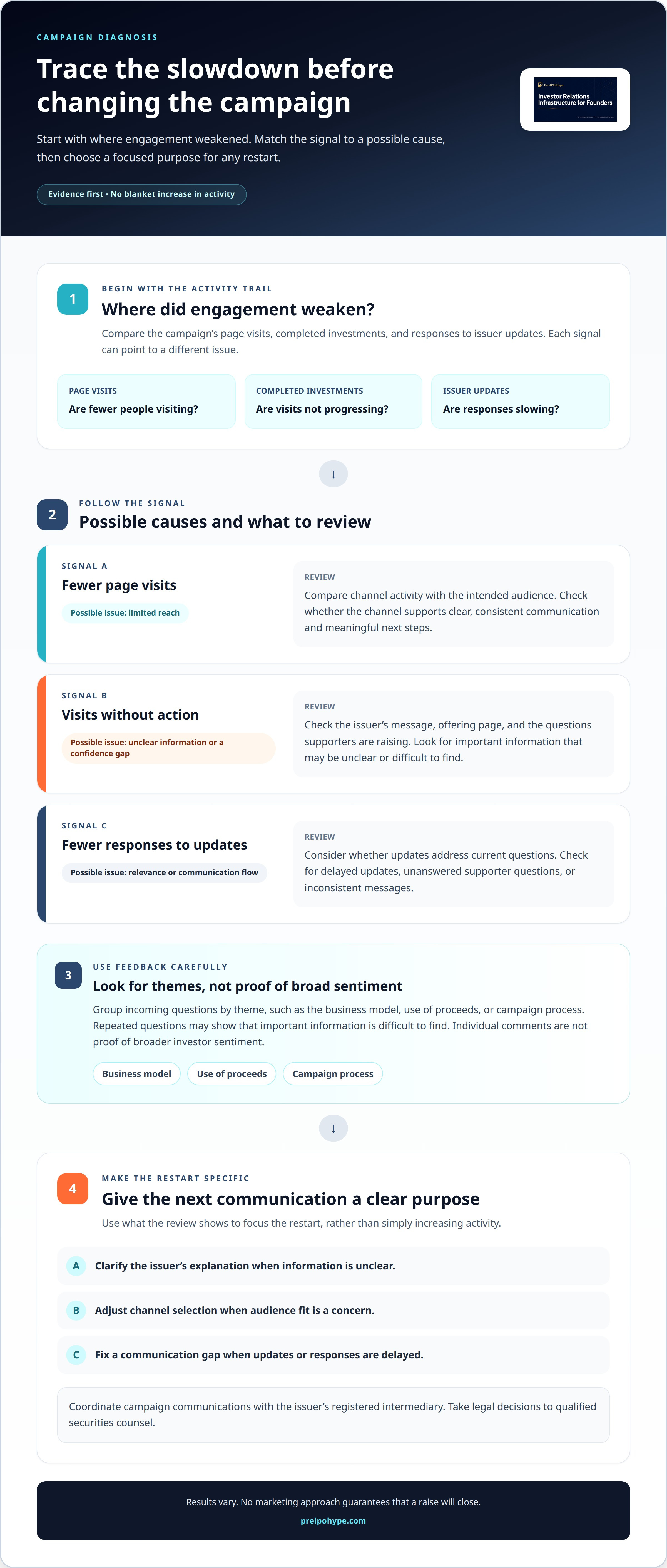
A stalled campaign rarely has just one possible cause. Pinpoint where activity weakened: page visits, completed investments, or responses to issuer updates. Each signal suggests a different issue. Fewer visits may indicate limited reach; visits without action may point to unclear information or a confidence gap. Comparing these stages helps you avoid treating every slowdown as an advertising problem.
The campaign message may also lose relevance as the raise progresses. An update that repeats the launch announcement, for example, may not answer supporters’ current questions about the company’s progress. Review the issuer’s message, offering page, and the questions supporters are actually raising. If the central explanation is unclear, more outreach may simply repeat the same problem across more channels.
A mismatch between the channel and the intended audience is another possible cause. A channel may attract attention without reaching people likely to engage with the issuer’s offering. Compare channel activity with the next meaningful action, such as visiting the offering page or asking a substantive question. Also consider whether the issuer can maintain accurate, consistent communications through that channel.
How do you assess which fundraising channels may fit a campaign? Compare the issuer’s intended audience, existing engagement patterns, message format, and capacity to respond. A channel is a stronger fit when it reaches relevant audiences and supports clear, consistent communication.
Campaign operations can contribute to a slowdown, too. A delayed update, unanswered supporter question, or inconsistent message can interrupt engagement. Review the issuer’s communication flow, including who approves updates and who responds to questions. If volunteers help with outreach, assigning clear roles can prevent duplicate messages and missed follow-up.
Supporter feedback can distinguish a reach problem from a message problem. A professional review can group incoming questions by theme, such as business model, use of proceeds, or campaign process. Repeated questions may show that important information is difficult to find. Individual comments can also reveal confusion, but they should not be treated as proof of broader investor sentiment.
If you’re considering what to do when fundraising stalls, start with diagnosis, not a blanket increase in activity. Map where engagement changed, review the content and channels around that point, and identify the evidence for each possible explanation. Then give the restart a defined purpose, such as clarifying the message, adjusting channel selection, or fixing a communication gap.
Momentum can fade even halfway through a five-year campaign, and campaigns generally stall because of a combination of factors. A fundraising letter expected to generate $7,000 but netting only $3,000 illustrates why professionals should compare expectations with actual results, then investigate how reach, message clarity, timing, and follow-up may be interacting rather than assuming one cause.
2. Planning a professional restart of campaign activity
A restart should address a defined part of the campaign, not simply increase activity. Use evidence from your review: which messages received responses, where interest dropped, and what supporters asked. Then set a clear purpose for renewed outreach, such as clarifying the company’s explanation or reconnecting with people who requested updates.
Next, organize a coordinated communications plan for the issuer. It can align the offering page, email updates, social posts, and responses to questions. If supporters repeatedly ask how the business model works, for example, the next update can address that directly. Keep the message consistent across channels while adapting each format to its audience.
Timing matters, but restarting a campaign should not imply that an outcome is imminent. Plan updates at a pace the issuer can maintain, leaving time to review content and respond to questions. Consider the campaign’s current information needs and the team’s capacity to communicate clearly. Each update should add useful information rather than repeat the same appeal across channels.
What are the risks of using urgency, matching gifts, or repeated appeals? Unsupported deadlines or matching claims can undermine trust, while repeated appeals without new information may cause supporters to disengage. Use deadlines, caps, and perks only when they are real and disclosed in your offering documents.
For a Regulation CF or Regulation A+ campaign, coordinate communications with the issuer’s registered intermediary. The issuer’s offering page remains the destination for investment information. If a planned update changes offering-related statements or terms, the issuer should take that decision to qualified securities counsel before publication. Marketing teams can prepare campaign materials, but they should not make legal decisions.
Paid promotion requires particular care. If the issuer pays someone to promote a Regulation Crowdfunding offering on the platform, that person must disclose the compensation each time under Rule 205. The restart plan should account for that requirement when coordinating paid messages. It should also distinguish paid promotion from ordinary issuer communications, so readers can understand who is speaking and whether compensation is involved.
Monitor the restart against its stated purpose. If the goal is to clarify the business model, review whether questions on that topic change. If the goal is to reach people who missed an update, assess engagement with the new message. This gives you a practical basis for shaping the next communication instead of assuming that more posts or repeated appeals will address the cause.
3. Gathering supporter advice with professional campaign support
Supporter feedback is most useful when it answers a defined campaign question. Prepare a short set of prompts for the issuer, then collect responses through suitable existing communication channels. For example, ask whether the company’s explanation is clear, what information seems missing, or which part of the offering page needs clarification. Specific prompts produce more actionable responses than a general request for thoughts.
Question wording matters. A leading prompt such as “Did you like our update?” invites approval rather than honest detail. A neutral alternative asks what was clear, confusing, or unanswered. You can also ask supporters what they expected to learn from a recent issuer update. This helps distinguish feedback about the message from feedback about the company or offering.
Choose a collection method that fits the audience and the feedback you need. A brief email prompt can capture quick reactions to an update, while a scheduled conversation can explore a complex point in more detail. Coordinate requests for the issuer and make their purpose clear. Avoid presenting feedback as a vote on the offering or a promise that the campaign will change.
Review responses consistently. Group comments by subject, such as product explanation, business model, use of proceeds, or offering-page navigation. Distinguish recurring questions from one person’s preference. One request for more technical detail, for instance, may not justify changing the main message, but repeated confusion about a core term may call for clearer language.
Turn relevant themes into communication options. If supporters find the company’s product difficult to understand, the issuer could consider a plain-language explanation or a focused update. If feedback concerns campaign mechanics, direct readers to the issuer’s registered intermediary or offering page. Questions about legal meaning or offering disclosures belong with qualified securities counsel, not a marketing interpretation.
Handle feedback carefully. Record the question, response theme, and any follow-up needed, while limiting access to people involved in campaign communications. Do not turn individual comments into broad claims about investor demand, or present a supporter’s positive reaction as evidence of likely investment activity. Clear distinctions protect the quality of your analysis.
Finally, compare feedback themes with the issuer’s next communication plan. If several supporters ask how a product works, an update can address that directly. If questions differ widely, clearer navigation to existing information may be more useful. This process gives the issuer a documented basis for deciding what to clarify, while keeping supporter input separate from legal advice or investment recommendations.
4. How can campaign professionals assess whether to change a fundraising goal, deadline, or campaign message?
Assess proposed changes against evidence, not frustration with a slow period. Review activity across the campaign and determine whether the issue concerns reach, engagement, or available information. A slowdown alone does not prove that the goal or message is wrong. Connect each proposed adjustment to a specific concern and explain what the issuer expects it to clarify.
To review a goal, compare the stated objective with the issuer’s current plans and the explanation given to supporters. Consider whether campaign materials still describe the project accurately and make its purpose understandable. If the business plan or use of proceeds has changed, the issue goes beyond marketing. The issuer should involve qualified securities counsel in decisions affecting offering disclosures or legal terms.
When reviewing a deadline, consider why the date exists and whether campaign communications describe it consistently. A date tied to an actual campaign or business constraint may serve a practical purpose. If the original reason no longer applies, flag the mismatch for the issuer to review. Do not recommend a date just to create pressure or suggest demand the campaign cannot support.
Message changes call for a different assessment. Compare the current explanation with supporters’ questions and the information on the offering page. Repeated questions about how a product works, for example, may indicate that its explanation needs to be clearer. If the explanation is clear but few people encounter it, the issue may be distribution instead.
Rather than changing several elements at once, identify one proposed adjustment and its purpose. You might revise a product explanation while leaving the goal and deadline unchanged. Then review whether the change addressed the intended information gap. This makes it easier to understand what the adjustment was designed to improve, without treating every shift in activity as proof of success.
Before updating campaign materials, coordinate the issuer’s communications with its registered intermediary and keep proposed messaging aligned with current offering information. If a change affects offering terms, disclosures, or legal statements, qualified securities counsel should guide that decision. Marketing review can identify communication needs and prepare options, but it does not replace legal advice.
A decision record can capture the concern, evidence considered, proposed change, and appropriate approval path. For example, it might explain why the issuer revised a product description while retaining its existing goal. This gives the team a clear reference for future communications and helps keep campaign decisions tied to information the issuer can support.
Pre-IPO Hype
Pre-IPO Hype provides investor relations infrastructure for Regulation CF and Regulation A+ raises. We are not a broker-dealer, funding portal, or investment adviser, and we do not offer or sell securities or make investment recommendations.
For stalled campaigns, Pre-IPO Hype’s Investor Relations OS provides a pipeline CRM, outreach automation, and analytics for running a raise. The system supports campaign activity, communications planning, and feedback organization alongside the issuer’s registered intermediary and qualified securities counsel. Our Custom Investor CRM includes lead scoring and attribution tracking.
Contact Pre-IPO Hype to discuss campaign support.
Make the Next Campaign Decision Deliberate
Deciding what to do when fundraising stalls is not about forcing activity back to its previous pace. It is about choosing a next step the issuer can explain and support. Keep a simple decision record: note the issue, the change under consideration, who approves it, and what response will inform the next review.
That discipline matters as a Regulation CF or Regulation A+ campaign continues. Keep communications consistent with the issuer’s offering information, and bring qualified securities counsel into legal decisions. A measured plan gives the team a clear basis for moving forward, even when the right adjustment is to hold steady rather than change course.
With a clear decision process, your next campaign step can be thoughtful, focused, and aligned with the company’s plans.
Frequently Asked Questions
Understanding the problem: Why fundraisers stall?
Fundraising slows when the connection between the issuer’s story and supporter action weakens. In a Regulation CF or Regulation A+ campaign, someone may understand the company but still need clearer information before engaging with the offering. External changes can also affect attention. Separate shifts in audience interest from gaps in the campaign experience, such as an outdated update or a difficult path from campaign message to offering information.
What are the common reasons a fundraising campaign stalls?
Common causes include unclear messaging, limited exposure to relevant audiences, and friction in the supporter experience. A campaign post may describe a product but leave out the problem it solves, for example, leaving readers unsure why the company matters. Another campaign may receive questions across several channels without a consistent response process. Reviewing supporter questions and the path to the issuer’s offering page can help pinpoint where interest is lost.
How can campaign professionals diagnose why fundraising donations have slowed?
Compare campaign activity by source and stage instead of relying on one overall total. For example, review whether an email prompted visits, whether social posts led to offering-page views, and where activity declined. Check timing and content changes to understand what was happening when engagement shifted. For an investment offering, the relevant signals are campaign and investor engagement, not charitable donations.
Disclaimer
Educational only. Not investment, tax, or legal advice. Pre-IPO Hype is investor relations infrastructure for Regulation CF and Regulation A+ raises. We are not a broker-dealer, funding portal, or investment adviser, and we do not offer or sell securities or make investment recommendations. Any securities offering is made only by the issuer, through its own offering documents and, where required, a registered intermediary.