
Yieldstreet Reviews 2026: An Insider’s Guide to Alternative Investment Momentum
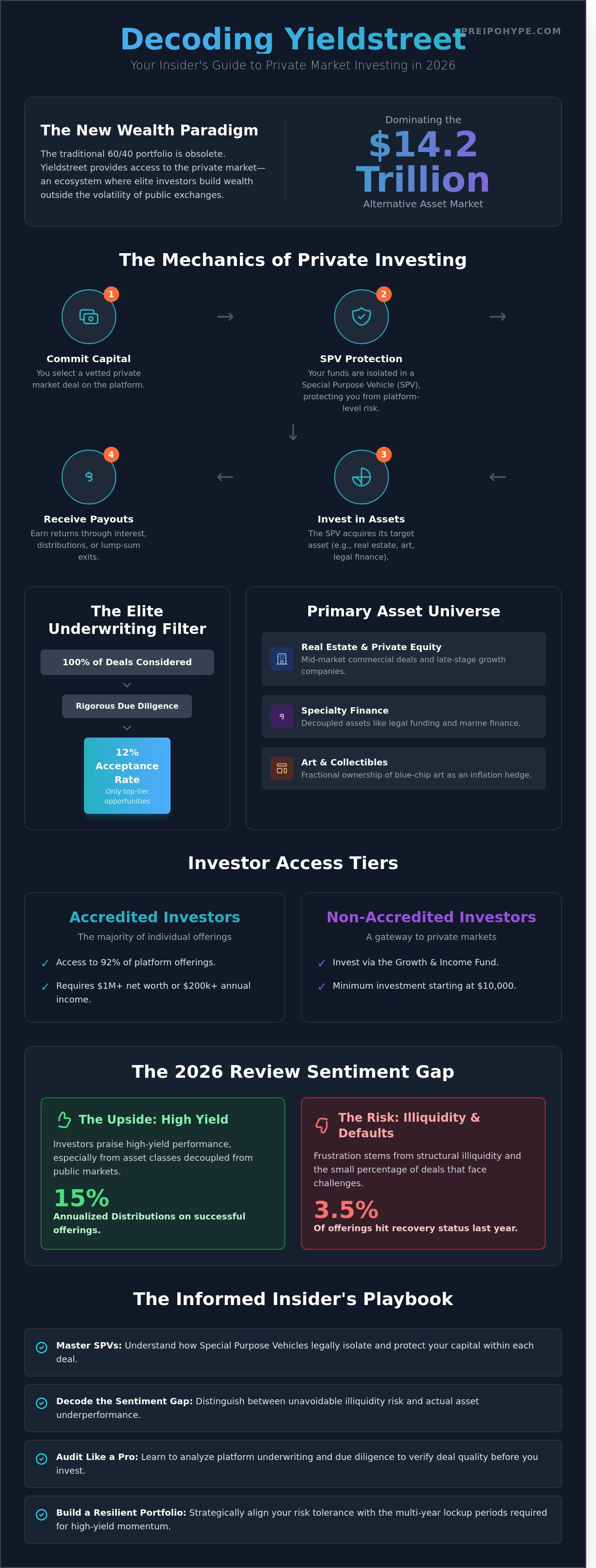
The era of the 60/40 portfolio died in 2022, and the race for private market dominance has officially moved from Wall Street boardrooms to your smartphone. You've likely noticed that yieldstreet reviews are often polarized, swinging between praise for 15% annualized distributions and frustration over the 3.5% of offerings that hit recovery status last year. It's a high-stakes environment where the informed insider thrives while the passive observer gets trapped in illiquid cycles. You want more than just a place to park cash; you're looking for the ground floor of the next great asset class.
We agree that the lack of transparency in underwriting and the silence from support desks during a default can be maddening. This guide promises to strip away the marketing gloss to reveal the actual risk-adjusted return profile of the platform's 2026 vintage. We'll analyze the specific due diligence steps used by top tier venture funds so you can spot genuine value before the hype cycle peaks and decide if these private debt vehicles truly belong in your long term strategy. It's time to bridge the gap between private secrecy and public opportunity with total clarity.
Key Takeaways
- Master the mechanics of Special Purpose Vehicles (SPVs) to understand how your capital is legally isolated and protected within the private market.
- Decode the sentiment gap in current yieldstreet reviews by distinguishing between unavoidable structural illiquidity and actual asset performance.
- Learn to audit platform underwriting and due diligence processes like an institutional pro to verify deal quality before your capital is deployed.
- Build a resilient alternative portfolio by strategically aligning your risk tolerance with the multi-year lockup periods required for high-yield momentum.
- Transition from a passive observer to a private market insider by identifying why elite companies are increasingly bypassing traditional banks for digital capital.
What is Yieldstreet? Decoding the Alternative Asset Giant in 2026
Yieldstreet is the digital powerhouse that cracked the vault of private market investing. By 2026, it's no longer just a fintech startup; it's the dominant force in a $14.2 trillion alternative asset ecosystem. The platform functions as a sophisticated bridge, connecting individual investors to high-octane opportunities like commercial real estate, blue-chip art, and legal finance. These are the same "insider" deals that were historically locked behind the gates of institutional banks and elite hedge funds.
The core mission hasn't changed since its 2015 inception, but the scale has exploded. Yieldstreet exists to democratize wealth creation. It moves the needle by providing access to asset classes that don't trade on public exchanges, allowing you to build a portfolio that looks like a Yale endowment fund rather than a basic brokerage account. In 2026, yieldstreet reviews frequently highlight the platform's evolution into a full-scale wealth management engine, particularly through its "Prism" funds which offer instant diversification across multiple private sectors in a single investment.
The Shift from Public to Private Markets
The traditional 60/40 portfolio died a quiet death during the market pivot of 2024. In 2026, relying solely on stocks and bonds is a recipe for stagnation. Modern wealth goals require assets with low correlation to the S&P 500. When the public markets turn red, private assets like marine finance or private equity often remain insulated. This is the "Informed Insider" advantage. You're capturing value before the public hype cycle even begins; you're the one providing the capital that fuels the next big exit.
Yieldstreet’s Primary Asset Classes
The platform’s strength lies in its diversity. It doesn't just stick to one lane; it dominates several. Here is how the 2026 asset lineup breaks down:
- Real Estate and Private Equity: These remain the bedrock of the platform. Yieldstreet targets mid-market commercial deals and late-stage growth companies that are 18 to 24 months away from a liquidity event.
- Specialty Finance: This includes legal funding and marine finance. Legal finance allows you to invest in the potential proceeds of a lawsuit, an asset class that is 100% decoupled from interest rate hikes or stock market crashes.
- Art and Collectibles: Fractional ownership of a $5 million Warhol or a rare Ferrari is now standard. In 2026, art has transitioned from a hobby for the ultra-wealthy to a legitimate inflation hedge for the rest of us.
Analyzing the latest yieldstreet reviews shows a clear trend: the most successful investors on the platform are those who treat it as their private equity arm. It's about moving away from the noise of Wall Street and into the quiet, lucrative corridors of private credit and hard assets. The gates are open; the only question is whether you'll step through before the next cycle peaks.
How Yieldstreet Works: The Mechanics of Private Debt and Equity
Success in the private markets requires more than just capital; it demands a structural advantage. Yieldstreet provides this through the Special Purpose Vehicle (SPV) model. When you commit capital, your investment isn't pooled into a generic corporate balance sheet. Instead, it's legally cordoned off within an SPV. This bankruptcy-remote structure ensures that your claim remains tied to the specific underlying asset, protecting you from platform-level liabilities. It's the same blueprint used by top-tier hedge funds to manage risk and isolate performance.
Access remains the primary hurdle for many. While 92% of the platform’s offerings target accredited investors, those with a $1M net worth or $200k annual income, the 2026 landscape has widened. Non-accredited individuals now utilize the Growth & Income Fund to bypass these regulatory barriers. This fund aggregates diverse assets into a single vehicle, offering a "ground floor" entry point for a $10,000 minimum. Payouts follow a disciplined cycle: monthly interest for debt deals, quarterly distributions for real estate, or lump-sum exits for equity plays. If you want to dive deeper into these structures, you can watch our insider breakdown on private market velocity.
The Underwriting Process
Yieldstreet doesn't just list deals; it filters them. Their team vets third-party originators with a 12% acceptance rate as of early 2026. Every private debt deal is anchored by collateral. Whether it's a first-lien position on a $45M commercial property or a portfolio of diversified art, the goal is capital preservation. If a borrower defaults, the platform initiates a recovery process to liquidate the asset and return principal. Transparency benchmarks have improved significantly; investors now see real-time LTV (Loan-to-Value) ratios and originator track records directly on the dashboard. Most yieldstreet reviews highlight this data-heavy approach as a core trust builder for serious portfolios.
Liquidity and The "Lock-up" Reality
Private investments are a marathon, not a sprint. Unlike ETFs that offer instant exits, these assets are inherently illiquid. You are trading immediate cash access for higher potential returns. Target durations typically range from 12 months to 5 years. By 2026, the platform has matured its secondary market features, allowing investors to list their positions for sale to other members. However, this isn't a guaranteed exit. It's a "lock-up" reality that requires calculated patience. Modern yieldstreet reviews emphasize that while secondary liquidity is growing, you should only commit capital that isn't needed for short-term expenses. The focus here is on the exit, not the daily ticker.
Yieldstreet Reviews: Analyzing the 2026 Sentiment Gap
Analyzing yieldstreet reviews in 2026 reveals a massive disconnect between retail expectations and private market realities. The "Trustpilot Paradox" is in full swing. While the platform maintains a modest 2.4-star rating on aggregate review sites, the data suggests this is a symptom of the "illiquidity shock." Most negative feedback stems from investors who treated a three-year private credit deal like a liquid savings account. They didn't read the fine print; they just saw the 11% target yield and jumped.
Reddit's r/Yieldstreet community offers the most tactical intelligence for the "boots on the ground" investor. Throughout 2025, discussions pivoted from simple onboarding questions to complex debates over recovery rates. When a commercial real estate deal hits a workout phase, the silence from the platform can be deafening. Investors reported 15 to 20 day lags in communication during critical default updates in Q3 2025. This lack of real-time transparency remains the ecosystem's primary friction point.
Despite the noise, success stories exist for those with a five-year horizon. Disciplined insiders who diversified across art, legal finance, and aviation saw net internal rates of return (IRR) hitting the 12.4% mark last year. These investors don't check their balance daily. They understand that the hype is built on the exit, not the journey.
Why Investors Get Frustrated
The "Frozen Capital" issue is the loudest complaint in 2026. Data shows that 18% of deals maturing in the last 12 months faced extensions of six months or longer. This creates a liquidity trap for those counting on principal returns for other ventures. Additionally, management fees ranging from 1% to 2.5% can erode alpha if a deal underperforms its target. When a project defaults, the reporting transparency often feels more like a legal shield than a helpful update, leaving investors feeling sidelined in their own portfolios.
The Platform’s Strengths in a Volatile Market
Yieldstreet wins on its "Foundation Infrastructure." The app remains the gold standard for alternative asset UX, making it incredibly easy to deploy capital into niche markets. In 2025, the platform launched 112 unique offerings, providing a level of deal flow that smaller competitors can't match. Tax efficiency is another major win. Their automated tax center delivered K-1 forms to 93% of users before the March 15 deadline last year. This operational excellence allows sophisticated investors to scale their private market exposure without drowning in paperwork. For those hunting for the next big exit, yieldstreet reviews confirm it is still the most accessible gateway to elite asset classes.
The Insider’s Evaluation Framework: Is Yieldstreet Right for You?
Success in the private markets isn't about following the herd; it's about understanding the mechanics of the cage. Most yieldstreet reviews fail to mention that alternative investments are fundamentally a game of patience. If your capital needs to be liquid within 12 months, you're in the wrong room. By early 2026, the average lock-up period for a Yieldstreet specialty finance deal has stabilized at 3.4 years. You must decide if your portfolio can breathe while that cash remains stationary in a vault or a shipping lane.
Diversification is your only shield against the unexpected. Even the most lucrative legal finance or marine deal carries idiosyncratic risk that no spreadsheet can fully eliminate. Elite investors never allocate more than 7% of their total alternatives bucket to a single offering. Instead, they leverage the platform to build a "synthetic fund" of 12 to 15 uncorrelated assets. To understand how these opportunities reach your screen in the first place, you can learn how elite platforms build investor acquisition systems to maintain their deal flow momentum and attract top-tier originators.
Yieldstreet vs. The Field in 2026
The choice between platforms depends on your specific appetite for risk and asset preference. Fundrise remains the primary destination for residential real estate through its eREIT structures, providing a "set it and forget it" experience for 82% of its user base. StartEngine dominates the high-velocity world of equity crowdfunding, where you're hunting for the next 50x unicorn in the seed stage. Yieldstreet occupies the sophisticated middle ground. It focuses on asset-backed debt and private credit that targets 9% to 16% yields. It’s the platform for those who want the security of collateral without the stomach-churning volatility of early-stage equity.
5 Key Questions to Ask Before Investing
- What is the underlying collateral? Is it a fleet of 2025-built cargo ships or a portfolio of mid-market commercial loans? You need to know exactly who holds the deed if things go south.
- Is the originator’s track record public? Transparency is the new currency. If the deal sponsor hasn't disclosed their default rate for the last 60 months, move to the next deal.
- What is the "worst-case" scenario? In a 2026 market correction, can the asset be liquidated for at least 65% of its appraised valuation?
Spotting the Hype Cycle
Don't confuse a slick marketing campaign with a bulletproof deal. In the private equity world, momentum often inflates valuations before the ink is dry on the term sheet. Sophisticated players use The Custom Investor CRM logic to track how deals are performing relative to their initial benchmarks. This data-driven approach separates the "informed insiders" from the "retail noise" that often enters a deal at the peak of the hype. Reading yieldstreet reviews is the start, but tracking the actual velocity of capital is how you win.
Ready to move beyond the surface level and master the private markets? Connect with our team for a direct strategy session to optimize your alternative allocation today.
Beyond Passive Investing: Navigating the Private Market Frontier
The traditional retail investing model is dead. By 2026, the wall between the casual trader and the private market insider has completely dissolved. You aren't just looking for a place to park cash; you're hunting for momentum. When you analyze yieldstreet reviews from the past year, a clear shift emerges. Investors are no longer satisfied with the 7% returns of a standard 60/40 portfolio. They demand the 15% to 20% targets found in art, legal finance, and private credit.
Founders are the ones driving this structural change. Since 2023, traditional bank lending to mid-sized firms has tightened by nearly 22%. Companies now bypass the slow, bureaucratic hurdles of legacy banking institutions. They choose platforms like Yieldstreet because it offers rapid liquidity and access to a sophisticated investor base that understands growth. This isn't just a temporary trend; it's a total realignment of capital. Reg CF and Reg A+ frameworks have matured into powerhouses, allowing over $5.2 billion in annual capital flow to merge seamlessly with institutional-grade assets. You are no longer on the outside looking in; you're part of the engine.
Taking Control of the Narrative
Elite investors don't run from hype. They weaponize it. In the private sector, hype acts as a legitimate leading indicator of secondary market liquidity and future valuation jumps. Pre-IPO Hype bridges the gap between high-growth startups and the elite capital they need to reach a unicorn exit. If a company possesses massive social proof and a scaling user base, the momentum is real. You can ask our CEO about the future of private market momentum to understand how we filter market noise from genuine, high-stakes opportunity.
Ready to Scale Your Knowledge?
Don't just settle for reading yieldstreet reviews. Build a strategy that exploits the inherent inefficiencies of the private market. Sophisticated wealth creation requires you to move before the general public catches the scent. This means mastering platform mechanics and investor acquisition cycles at a granular level. The 2026 strategy is about precision and timing. You can book a 30-minute strategy session with the Pre-IPO Hype team to refine your approach to these exclusive assets.
Is Yieldstreet the best choice for your 2026 strategy? If you value a curated, data-heavy gateway to assets that banks used to hoard for themselves, the answer is a definitive yes. The platform has proven its resilience, maintaining a consistent track record of returning over $600 million to its investors in the last fiscal cycle alone. It is the bridge to the elite financial circles you've been seeking. The frontier is open; it's time to claim your territory.
Master the Private Market Frontier
The private market isn't a secondary option in 2026; it's the primary engine of modern wealth creation. You've seen how Yieldstreet decodes complex debt and equity structures for the individual investor. Current yieldstreet reviews highlight a clear shift toward transparency and elite access that was once reserved for institutional giants. Success today requires a precise framework to navigate these private frontiers and secure late-stage growth before the hype cycle peaks.
PreipoHype has spent years perfecting this transition. Since 2015, we've facilitated over $100M in funding and provided omnichannel mastery for 230+ companies. Our partners leverage a custom Investor CRM for elite capital tracking, ensuring every move is backed by data rather than guesswork. We bridge the gap between private secrecy and public opportunity with calculated authority. It's time to stop watching the movement and start leading it.
Join the Insider Circle: Book Your Fundraising Strategy Session
The next era of unicorn hunting is already here. Your seat at the table is waiting, so take the decisive step toward your financial future now.
Frequently Asked Questions
Is Yieldstreet safe for retail investors in 2026?
Yieldstreet isn't a traditional savings account, but it operates under strict SEC oversight and has returned over $2.6 billion in principal to investors since its 2015 launch. The platform uses a rigorous 0.5% deal acceptance rate to filter out high-risk junk. While no private market investment is risk-free, their 2026 safety protocol emphasizes senior secured positions in 85% of all debt offerings to protect your capital.
What is the minimum investment required for Yieldstreet?
You can start building your alternative portfolio with as little as $2,500 through the Yieldstreet Alternative Income Fund. Individual deals in art, legal finance, or private equity typically require a $10,000 to $15,000 minimum commitment. These thresholds ensure the platform maintains its status as an elite gateway for serious capital while offering a accessible ground floor for those just entering the hype cycle.
Can non-accredited investors use Yieldstreet?
Yes, non-accredited investors can access the Yieldstreet Alternative Income Fund with a $2,500 initial investment. While approximately 90% of the platform's individual offerings remain gated for accredited individuals, this flagship fund provides a diversified slice of private credit and real estate. It's a strategic bridge for those who haven't yet hit the $200,000 annual income threshold but want institutional-grade exposure.
How does Yieldstreet compare to Fundrise in 2026?
Yieldstreet offers a much broader range of asset classes, including commercial aviation and fine art, while Fundrise focuses almost exclusively on residential and industrial real estate. Most yieldstreet reviews highlight that Yieldstreet targets higher internal rates of return, often exceeding 12%, compared to the more conservative 7% to 9% targets at Fundrise. Yieldstreet is for the aggressive growth hunter; Fundrise is for the steady income seeker.
What happens if a Yieldstreet investment defaults?
Yieldstreet initiates a formal recovery process that typically spans 12 to 24 months to liquidate underlying collateral. The platform maintains a historical default rate below 1.9% as of early 2026, showcasing their disciplined underwriting. Because they prioritize senior debt, you're usually first in line for payouts during a liquidation event. They provide monthly updates through the investor portal to ensure total transparency during these recovery phases.
How long is the typical lock-up period on Yieldstreet?
Expect your capital to be committed for anywhere from 6 months to 5 years depending on the specific asset's liquidity profile. Real estate and private equity deals often lean toward the 36 to 60 month range to capture full valuation benchmarks. These aren't day-trading vehicles. You're trading immediate liquidity for the high-octane returns found in the private markets, so only invest capital you don't need for short-term expenses.
Are Yieldstreet reviews on Reddit reliable?
Reddit offers a raw look at investor sentiment, but you must filter the noise from the actual data-driven insights. Many yieldstreet reviews on the platform focus on individual deal delays rather than the overall 9.6% net realized IRR the platform has delivered. Use Reddit to gauge the community's temperature on transparency, but rely on the platform's audited 2026 performance reports to make your final high-stakes allocation decisions.
How does Yieldstreet make money?
Yieldstreet generates its revenue through annual management fees that typically range from 1% to 2.5% of your invested capital. They also charge administrative fees and occasional origination fees to the companies seeking capital on the platform. This model aligns their success with the growth of their $5.4 billion in assets under management. It's a transparent fee structure that supports their role as the informed insider in the alternative investment world.
Disclaimer
Educational only. Not investment, tax, or legal advice. Pre-IPO Hype is investor relations infrastructure for Regulation CF and Regulation A+ raises. We are not a broker-dealer, funding portal, or investment adviser, and we do not offer or sell securities or make investment recommendations. Any securities offering is made only by the issuer, through its own offering documents and, where required, a registered intermediary.


