
Best Reg CF Portals 2026: Wefunder vs StartEngine (Fees & Fit)
Most founders treat their choice of platform like a silver bullet; in reality, it's just a high-stakes checkout counter. Whether you're eyeing Wefunder's 33% market share or StartEngine's large registered user base, the platform alone won't close your round. When founders ask which are the best Reg CF portals for startups, the Wefunder vs StartEngine debate often misses the point that a successful raise requires a proprietary marketing engine that operates outside of any platform's algorithm. You're likely feeling the pressure of the $5 million Reg CF cap and the fear of a public failure, but the real risk is entering the market without a scalable infrastructure to own your investor relationships.
You understand that capital is the fuel for your next milestone, yet complex fee structures and a lack of lead data ownership can stall your momentum before you even launch. This 2026 insider guide promises to strip away the platform hype, revealing the critical differences in fee structures and investor demographics that will dictate your ROI. We'll examine why StartEngine's 2% equity kicker might be your biggest expense and how to build a foundation that improves your odds of a controlled close.
Key Takeaways
- Identify whether your startup aligns better with Wefunder’s community-driven narrative or StartEngine’s aggressive internal marketplace to maximize your reach.
- Decode the economic reality of the Wefunder vs StartEngine choice by calculating the long-term impact of success fees and equity kickers on your cap table.
- Master the "Platform Fallacy" by implementing a Custom Investor CRM to ensure you own your lead data rather than relying on platform-controlled algorithms.
- Build a Foundation Infrastructure that prepares your company for institutional-grade scrutiny while maintaining the infectious energy of a high-growth retail raise.
- Leverage omnichannel outreach and strategic newsletter exposure to ignite the hype cycle and secure critical capital momentum before your public launch.
Reg CF Portal Landscape in 2026
By 2026, equity crowdfunding has shed its reputation as a "last resort" for cash-strapped founders. It is now a calculated offensive move for elite startups. The current Equity Crowdfunding Landscape is a high-velocity environment where retail sentiment and institutional interest have finally converged. Choosing between the major players is no longer a matter of convenience; it is a decision that dictates your brand's trajectory for the next decade. The Wefunder vs StartEngine debate is fundamentally a choice of ecosystem, and the wrong move can leave millions in potential capital on the table.
The "Hype Cycle" in 2026 moves faster than ever. Retail investors now act with the precision of venture capitalists, looking for signals of momentum before they commit. This is where Reg CF marketing services become the essential strategic layer. They turn a static platform listing into a living, breathing movement. Founders who treat their raise as a "set it and forget it" project are finding themselves ignored, while those who leverage a sophisticated marketing stack are closing rounds in record time. Your platform is the venue, but your marketing infrastructure is the promoter that fills the seats.
The 2026 Regulatory Environment: Reg CF vs. Reg A+
The $5M Reg CF annual limit has fundamentally changed the math for Series A-stage companies. In the 2026 fiscal year, this cap allows founders to bypass traditional gatekeepers while maintaining lean disclosure requirements. While Reg A+ offers higher ceilings, the speed and efficiency of a $5M Reg CF raise often provide a better ROI on marketing spend. Matching your regulatory exemption to your specific growth trajectory is critical. If your goal is rapid market penetration with a broad investor base, the streamlined nature of Reg CF on these titans is often the superior path.
Investor Psychology: The Shift to Sophisticated Retail
Investors in 2026 are data-hungry. They have moved beyond the emotional appeal of the pitch deck to demand real-time traction and data-backed projections. Social proof is the primary currency. If your campaign doesn't show significant movement in the first 48 hours, the algorithm will bury you. Transparency is no longer optional; it's the new standard for trust. Founders must provide frequent, high-impact updates to keep the momentum alive. In this environment, the ability to demonstrate immediate, verifiable interest is what separates a successful close from a public failure.
Wefunder vs StartEngine: Platform DNA
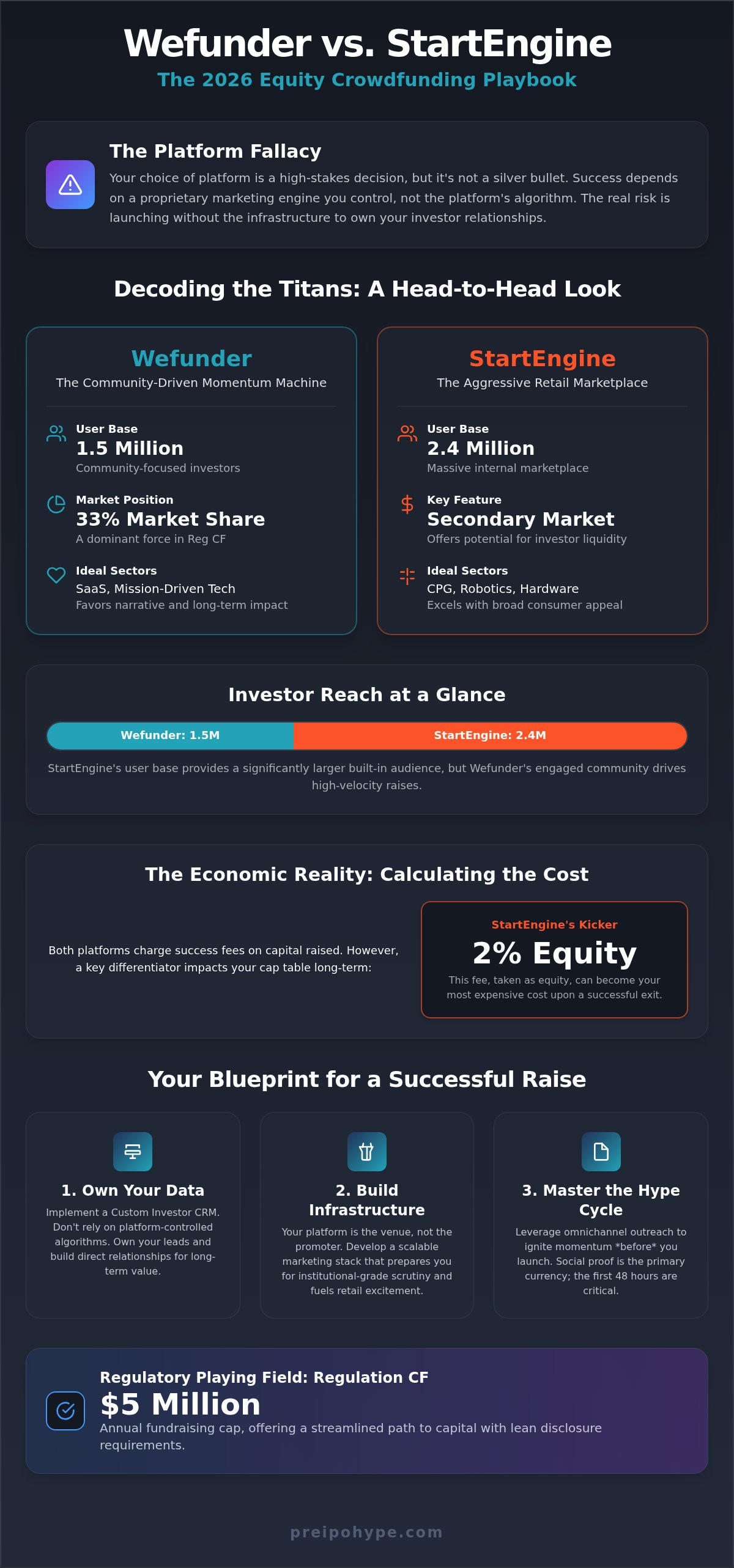
Choosing between Wefunder and StartEngine is like deciding between a high-growth community and a sophisticated retail stock exchange. While both platforms strictly adhere to the SEC's Regulation Crowdfunding rules, they interpret the "crowd" very differently. Wefunder operates as a community-driven engine where narrative and mission-driven momentum are the primary drivers of success. In contrast, StartEngine functions as a marketing powerhouse, leveraging a massive internal marketplace with a large registered user base to accelerate raises through aggressive internal promotion and secondary market liquidity.
The algorithms that power these platforms are fundamentally distinct. Wefunder’s trending logic rewards organic engagement and velocity; if your round is moving, the platform amplifies that signal to its large registered user base. StartEngine utilizes a more institutional approach, offering internal promotion features that act as a multiplier for brands with broad consumer appeal. Understanding which platform "owns" your sector is the first step toward dominance. Wefunder has traditionally been the stronghold for SaaS and mission-driven tech, while StartEngine has carved out a massive lead in CPG, Robotics, and hardware-heavy sectors.
Wefunder: The Founder-Friendly Momentum Machine
Wefunder’s status as a Public Benefit Corp (PBC) isn't just a label. It's a signal that attracts investors who prioritize long-term impact alongside financial returns. Their Lead Investor model is a strategic masterstroke, allowing founders to aggregate thousands of small checks into a single line item on the cap table via an SPV. This simplifies future VC rounds and keeps your corporate structure lean. However, winning the Wefunder leaderboard requires a disciplined pre-launch. You typically need 30% of your goal committed from your own network before going live to trigger the platform's internal discovery engine.
StartEngine: The Institutional Marketplace for Consumer Brands
StartEngine has built an ecosystem that mirrors a public exchange. Their secondary market (ATS) provides a rare commodity in the private world: liquidity. This feature alone often attracts more sophisticated retail investors who are wary of ten-year holding periods. The "Owner’s Bonus" program further incentivizes their large registered user base to reinvest, creating a loyal base of repeat backers. For consumer-facing brands, this marketplace is often associated with higher platform-reported close rates than the broader industry average. If you're unsure which DNA matches your cap table goals, it's worth scheduling a strategy session to map your marketing stack to the right platform.
Fee Comparison: What Each Portal Takes
Calculating the true cost of capital requires looking far beyond the headline percentage. While both platforms offer a gateway to millions in funding, their economic models impact your long-term valuation and cap table health in drastically different ways. The Wefunder vs StartEngine debate often centers on a half-point difference in cash fees, but the real divergence lies in equity dilution and the "investor tax" that can alienate your most sophisticated backers. In a market where you're aiming for a $5 million Reg CF close, these nuances represent hundreds of thousands of dollars in realized value.
StartEngine typically charges a 7% cash fee on the total capital raised, but the sting comes from the mandatory 2% equity stake they take in your company. For a founder raising $1 million, that's $70,000 in immediate cash plus a slice of your future that could be worth millions at exit. Wefunder takes a different approach with a 7.5% flat fee on the total raise. While the upfront cash cost is slightly higher, it keeps your equity intact. Wefunder also offers a strategic waiver for investors contributing $25,000 or more, which is a powerful tool for founders who can attract larger, "anchor" checks to their round.
Hidden Costs and Compliance Fees
Your raise is only as secure as your legal and accounting paperwork. Beyond platform fees, founders must budget for the mandatory Form C filing and the varying levels of financial scrutiny required by the SEC. If you're raising over $1.24 million, you'll likely need a full financial audit rather than a simple review; a jump in cost that can catch unprepared founders off guard. Implementing a robust foundation infrastructure early on isn't just about compliance. It is about ensuring your data is institutional-grade so you don't get stalled in escrow or flagged during annual reporting obligations.
Platform-Specific Value-Adds: What Do You Get for the Fee?
The Wefunder vs StartEngine choice also dictates the level of human support you receive. StartEngine’s "Select" and "A+" tiers offer premium, high-touch services for companies with massive growth potential, though these come with additional costs. Wefunder’s "Work with us" program focuses heavily on the story framework, helping founders distill complex tech into a narrative that resonates with retail investors. You aren't just paying for a listing; you're paying for an ecosystem. You need to decide if you want StartEngine’s massive, repeat-investor marketplace or Wefunder’s community-driven, narrative-heavy engine.
What Neither Portal Provides: Investor Infrastructure
Most founders fall victim to the "Platform Fallacy." They assume that listing on a major site means the investors will simply appear. In reality, a platform is a sophisticated checkout counter, not a marketing engine. While StartEngine claims a large registered user base, industry data suggests that 70% to 80% of capital in a successful raise often originates from the founder’s own strategic outreach. Whether you are navigating the Wefunder vs StartEngine choice, your success depends on a proprietary marketing stack that functions independently of platform algorithms. If you wait for the platform to bring you the money, you've already lost.
You need a system that tracks the journey from curiosity to capital. This is where a custom investor CRM becomes non-negotiable. Without it, you are blind to who is visiting your page and who is truly ready to commit. By implementing lead scoring and 60-day attribution, you can identify high-intent prospects before they even click "Invest." This allows for the surgical follow-up required to close the gap between initial interest and an executed check. Momentum in equity crowdfunding is a calculated result, not a stroke of luck.
Building Your Own Investor Data Moat
Relying solely on platform discovery is a dangerous game of platform lock-in. You must own your investor data from day one. By using lead magnets and dedicated landing pages to capture interest before your official launch, you build a "data moat" that protects your raise. Integrating your CRM with platform APIs allows for real-time engagement tracking, ensuring that your omnichannel outreach is synchronized and impactful. This foundation allows you to maintain control of the relationship. Even if a platform’s internal traffic fluctuates, your internal engine keeps the capital flowing.
Omnichannel Outreach: Engineering the Hype
Momentum isn't an accident; it's engineered. Elite raises leverage digital marketing and advertising to drive targeted traffic that actually converts. Retargeting strategies keep your opportunity top-of-mind for those who have visited your page but haven't yet pulled the trigger. To ignite immediate credibility, savvy founders tap into elite networks like the Invst Guru newsletter, creating a steady pulse of opportunity. If you're ready to bridge the infrastructure gap and dominate your raise, book a technical stack audit today to see how we power elite capital closes.
Where Pre-IPO Hype Fits
Your choice in the Wefunder vs StartEngine debate is the final mile of a journey that begins months before you ever go live. In the high-stakes environment of 2026, the platform is simply the venue where the transaction occurs. Pre-IPO Hype serves as the strategic layer and promoter that turns these platforms into capital-raising machines. We support Reg CF raises with data-driven systems rather than treating crowdfunding as a game of chance. By the time you launch, your raise should already be structured for a controlled close.
Our Foundation Infrastructure turns a chaotic public raise into an institutional-grade event. We prepare founders for the intense scrutiny of 2026 investors by ensuring every piece of the marketing engine is calibrated for maximum conversion. This isn't just about getting eyes on a page; it is about engineering a hype cycle that compels action. When you have questions about how these systems integrate with your specific goals, you can ask our CEO for a direct perspective on your fundraising roadmap.
The Pre-IPO Hype Advantage
Elite raises are built on proprietary intelligence. We provide access to our internal investor data systems, allowing you to target high-intent backers who have already demonstrated an appetite for your specific sector. This is paired with a customized fundraising tech stack designed to handle the velocity of a $5 million Reg CF round. Our strategic advisory doesn't stop at the platform close. We build the infrastructure that carries your momentum through to Series A and beyond, ensuring your cap table remains a strategic asset rather than a liability.
Ready to Scale? Schedule Your Strategy Session
The difference between a stalled campaign and a record-breaking close often comes down to market positioning. You can gain direct access to Jeff "Fuzzy" Wenzel for a deep-dive analysis of your current valuation and story framework. We evaluate your readiness for a 2026 launch and identify the gaps in your current marketing stack before they cost you capital. If you are serious about dominating the market and owning your investor relationships, book a 30-minute strategy session today to engineer your raise with the precision it deserves.
Mastering Your Capital Destiny in 2026
The Wefunder vs StartEngine decision is merely the first move in a high-stakes chess match. Your success depends on whether you treat the platform as a magic wand or a strategic checkout counter. To dominate the 2026 landscape, you must bridge the infrastructure gap by owning your investor data and deploying a marketing stack that operates independently of any platform's shifting algorithm.
Since 2015, we've been redefining Reg CF marketing by providing the technical bedrock for elite raises. We support Reg CF raises with our proprietary Custom Investor CRM to turn curiosity into committed capital. You don't have to navigate this complex financial world alone. Access the same systems that power the market's most successful closes and secure your company's future.
Engineer your elite capital raise with Pre-IPO Hype and take control of your growth trajectory today. The opportunities are rare, but for those who act with precision, the capital is waiting.
Best Reg CF Portals for Startups: Decision Matrix
Beyond the Wefunder vs StartEngine head-to-head, founders ranking the best Reg CF portals for startups should match portal DNA to raise profile—not chase a fake #1. Republic is often a third option for brand/community raises; niche portals (for example sector or community-debt focused) can fit when your investor base is highly specialized. You still run one Reg CF offering on one funding portal at a time.
- Mission / community / SaaS narrative: Wefunder often fits—Lead Investor SPV keeps the cap table clean.
- CPG / retail / hardware marketplace: StartEngine often fits—internal promotion plus secondary/ATS matters for some investor personas.
- Brand storytelling + third marketplace: Consider Republic as an alternate fit check before you lock fees.
- What neither portal provides: owned investor CRM, pre-launch waitlist, and post-close investor relations—you build that stack yourself.
Related reading: equity crowdfunding vs VC.
Frequently Asked Questions
Which is one of the best Reg CF portals for startups in 2026?
There is no universal #1. The best Reg CF portals for startups are the ones that match your sector, fee tolerance, and investor persona. Use fit criteria: community vs marketplace DNA, cash fee vs equity kicker, SPV vs direct holders, and whether secondary liquidity matters to your backers.
What happens to my investor list after the raise closes?
Portal discovery traffic is not the same as an owned investor list. Unless you capture leads before and during the campaign in your own CRM, you may lose remessaging control after close. Build the data moat before launch.
What is the main difference between Wefunder and StartEngine in 2026?
Wefunder thrives on community narrative and early-stage momentum, while StartEngine operates as a high-volume marketplace with institutional-grade tools. The Wefunder vs StartEngine choice often comes down to your cap table goals. Wefunder’s SPV model keeps your cap table clean with a single line item. StartEngine offers an Alternative Trading System (ATS) for secondary liquidity, appealing to investors who want an exit path before an IPO or acquisition.
Which platform is cheaper for a $1M Reg CF raise?
Wefunder is generally more cost-effective for founders who prioritize equity preservation. While StartEngine charges a 7% cash fee, they also take a mandatory 2% equity stake in your company. Wefunder’s flat 7.5% fee might seem higher upfront, but it doesn't dilute your ownership. For a $1 million raise, that 2% equity kicker on StartEngine could eventually represent millions in lost value for the founding team at exit.
Can I raise capital on Wefunder and StartEngine at the same time?
You can, but you shouldn't. Splitting your traffic between two platforms is a recipe for a stagnant raise. Most platform algorithms, especially in the Wefunder vs StartEngine rivalry, rely on velocity and momentum to feature your deal. By concentrating your marketing spend on a single platform, you're more likely to hit the trending leaderboard and unlock the "platform effect" that brings in passive retail investors.
Do Wefunder and StartEngine provide marketing for my campaign?
No, they provide the venue, not the promoter. While both platforms have internal discovery tools, they only promote campaigns that already show significant traction. You are responsible for driving the first 30% of your capital. Without a proprietary marketing stack and a custom investor CRM to manage your leads, you're essentially shouting into a void and hoping the platform's 2026 algorithm notices you.
How long does it take to launch a campaign on these platforms?
A successful launch typically requires 60 to 90 days of preparation. You'll need time for financial reviews, legal Form C filings, and the creation of high-impact content. This window is when you build your "data moat" by capturing investor leads before the campaign goes live. Rushing the technical setup or compliance requirements is the fastest way to ensure your raise stalls out in the first week.
What is a Lead Investor on Wefunder, and do I need one?
A Lead Investor is a person who directs the voting of the shares held by the Wefunder SPV. This model is essential for founders who want to keep their cap table manageable for future VC rounds. You do need one to utilize the SPV structure. It allows you to aggregate thousands of small checks into one single line item, preserving your corporate governance and making Series A due diligence much smoother.
What happens if my campaign does not reach its minimum goal?
It's an "all-or-nothing" model. If you don't hit your minimum funding goal by the deadline, all investor funds are returned. This is the ultimate risk of a public raise. To mitigate this, elite founders use omnichannel outreach and lead scoring to ensure they have enough soft-circled interest to blow past the minimum in the first 48 hours. A failed raise is a public signal you don't want on your record.
How does StartEngine Secondary work for my investors?
StartEngine Secondary is an Alternative Trading System (ATS) that provides a marketplace for trading private shares. It offers investors a path to liquidity without waiting for a traditional exit event. This is a significant advantage for attracting sophisticated retail participants who are wary of long holding periods. However, your company must meet specific regulatory and platform requirements to be eligible for trading on this secondary exchange.
Disclaimer
Educational only. Not investment, tax, or legal advice. Pre-IPO Hype is investor relations infrastructure for Regulation CF and Regulation A+ raises. We are not a broker-dealer, funding portal, or investment adviser, and we do not offer or sell securities or make investment recommendations. Any securities offering is made only by the issuer, through its own offering documents and, where required, a registered intermediary.