
Equity Crowdfunding vs VC: How to Raise Without Venture Capital
Most founders believe they must choose between the iron grip of a board seat or the marketing intensity of a public raise, but they're asking the wrong question. In a market where Q1 2026 venture deal value was widely reported near $267.2 billion while remaining concentrated in just five firms, the real play is using one to leverage the other. You're likely feeling the tension of the equity crowdfunding vs venture capital debate, weighing the fear of losing company control against the anxiety of a public campaign failure. It's a high-stakes calculation that determines your ultimate path to a larger raise.
We'll help you master the tactical differences between institutional VC and digital equity crowdfunding to engineer your most successful capital raise yet. You'll learn how to navigate the $5 million Reg CF limits and the current "flight to quality" to maintain maximum equity. We're diving into the specific mechanics of building a strategic brand moat that forces institutional investors to accept your terms. This is your roadmap to the gated world of elite financing, where you don't just ask for capital, you command it by acting decisively in an evolving market.
Key Takeaways
- Navigate the 2026 convergence of retail and institutional markets to strategically choose between equity crowdfunding vs venture capital based on your control and liquidity goals.
- Leverage the "Institutional Authority" of top-tier venture capital to secure the social proof and elite network access required for rapid scaling.
- Transform your capital raise into a high-impact marketing event that builds an "Army of Advocates" to drive both funding and long-term customer acquisition.
- Master the Hybrid Model by using a Regulation Crowdfunding campaign to engineer the market momentum and FOMO necessary to dictate founder-friendly terms to VCs.
- Prioritize high-growth infrastructure, such as a custom Investor CRM, to ensure the source of your capital is backed by a system capable of managing larger liquidity goals.
Equity Crowdfunding vs Venture Capital: The 2026 Power Shift
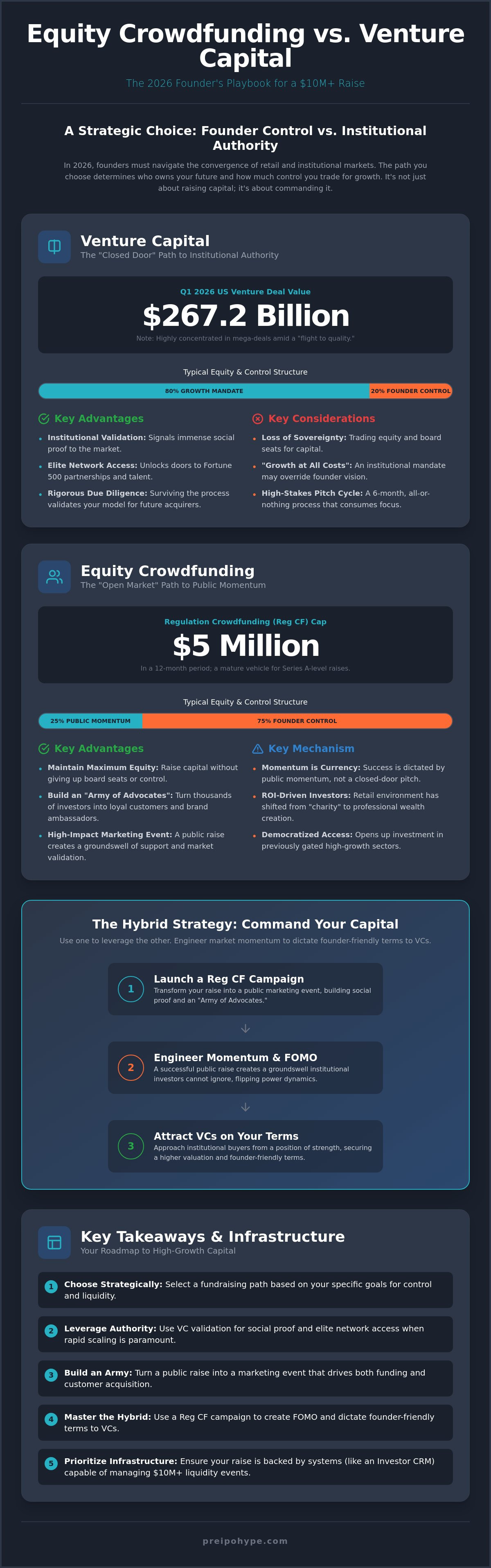
The capital markets of 2026 have witnessed a massive convergence. The traditional "Closed Door" model of venture capital is no longer the only game in town for high-growth startups. While US venture deal value was widely reported near $267.2 billion in Q1 2026, the market is heavily skewed toward a few mega-deals. This concentration has forced founders to look toward the "Open Market" where momentum, not just a pitch deck, dictates success. Today, the choice between equity crowdfunding vs venture capital is a strategic decision about who owns your future and how much control you're willing to trade for growth.
To understand the foundational shift in this space, check out this Equity Crowdfunding Overview which details how these regulations have evolved globally to democratize access to elite investment circles. In this new landscape, momentum is the primary currency. A successful digital raise creates a groundswell of public support that institutional buyers can't ignore, effectively flipping the script on traditional power dynamics.
To better understand this concept, watch this helpful video:
The Evolution of Reg CF and Reg A+
Regulation Crowdfunding has matured into a Tier-1 funding vehicle. 2026 regulations have solidified these digital paths as legitimate alternatives to Series A rounds. Reg CF currently serves as the primary entry point for digital fundraising with a $5 million cap in a 12-month period. We've seen a total shift from a "charity" mindset to a professional, ROI-driven retail environment. Investors aren't just backing a product; they're hunting for significant wealth creation in sectors that were previously gated by institutional barriers.
The VC Reality Check
Venture capital is currently experiencing a "flight to quality," concentrating capital in a small number of top-tier companies, particularly in AI. If you don't fit the specific profile of a mega-deal candidate, the institutional appetite is selectively cold. It's vital to frame VC not as a benevolent partner, but as a high-cost institutional buyer of your equity. The hidden costs of the equity crowdfunding vs venture capital debate often include board seats, complex liquidation preferences, and a total loss of operational agility. In 2026, taking VC money means you're no longer just running a company; you're servicing an institutional mandate.
Venture Capital: The Price of Institutional Authority
Venture capital remains the gold standard for institutional validation. When a top-tier firm leads your round, they aren't just providing liquidity; they're granting you a passport into an elite ecosystem. This "Social Proof" is the primary advantage in the equity crowdfunding vs venture capital debate. It signals to future acquirers and late-stage investors that your model has survived the most rigorous due diligence imaginable. However, this validation is rarely free. It's an institutional purchase of your company's sovereignty. You're trading agility for an elite network that can open doors to Fortune 500 partnerships and global distribution channels.
The "All-or-Nothing" nature of the VC pitch cycle is a high-stakes gamble. Founders often spend six months in a "Closed Door" loop, pitching dozens of firms only to face a binary outcome. This process consumes your most valuable resource: focus. While you're chasing a single lead investor, your competitors might be building a brand moat. The equity burn is also concentrated. Giving up 20% to one firm creates a single point of failure in your governance. If that relationship sours, your path to a larger raise becomes significantly more complex.
The Governance Moat
The governance moat is where founders often feel the most friction. Accepting VC money usually means handing over a board seat. This shift changes your exit strategy from a founder-led vision to an institutional mandate. VCs operate on a "Growth at All Costs" timeline. They need a 10x return to return their fund, which often forces companies into aggressive scaling that might not be sustainable. While SEC Regulation Crowdfunding allows for a more distributed, less intrusive cap table, a single VC firm holding 20% of your equity has significantly more leverage over your daily operations than 5,000 retail investors combined. This concentration of power can lead to founder replacement or forced pivots that prioritize investor IRR over long-term brand health.
When VC is the Right Move
There are sectors where institutional capital isn't just a choice; it's a requirement. If you're building in deep tech, biotech, or heavy infrastructure, the capital intensity often exceeds what a digital raise can provide. In these cases, the lead VC acts as a "Validation Event." Their presence simplifies future capital acquisition by de-risking the venture for secondary institutional players. If you're unsure where your company fits on this spectrum, Pre-IPO Hype Consulting offers a deep dive into strategic positioning to ensure you aren't overpaying for authority. You shouldn't walk into a VC boardroom without a clear understanding of your leverage. If you want to map out your specific dilution path before signed term sheets arrive, you can schedule a strategy session to analyze your optimal cap table structure.
Equity Crowdfunding: Engineering Public Momentum
If venture capital is a private auction, equity crowdfunding is a public premiere. In the tactical debate of equity crowdfunding vs venture capital, many founders overlook the most potent benefit: the marketing event. You aren't just raising capital; you're engineering a massive customer acquisition campaign. While VCs might take six months for due diligence, a well-oiled digital raise can hit its target in weeks. This speed allows you to capitalize on market momentum while it's hot, rather than waiting for an institutional committee to decide your fate. You're trading the "Closed Door" pitch for an open market that rewards transparency and energy.
The "Army of Advocates" effect is your secret weapon. When you turn 1,000 retail investors into stakeholders, you've essentially recruited 1,000 sales reps who are financially incentivized to promote your brand. They don't just provide capital; they drive product adoption and defend your market share. This creates a brand moat that is nearly impossible for competitors to breach. Crucially, you retain total governance. You can raise $5M+ via Reg CF without shifting a single board seat or losing your ability to pivot. In the ongoing landscape of equity crowdfunding vs venture capital, the value of keeping your hands on the steering wheel while building a loyal fan base is a massive competitive advantage.
The Hype Cycle as a Financial Tool
The "Investor Hype Cycle" is the primary driver of valuation in 2026. It's about synchronizing your narrative across every channel to create a sense of inevitability. Mastering omnichannel outreach is essential here, as it converts passive curiosity into committed capital. The Digital Fundraising Roadmap serves as your blueprint, ensuring every ad, email, and social post pushes the needle toward your funding goal. This systematic approach turns market excitement into a measurable financial asset.
The Cost of the Crowd
Don't mistake crowdfunding for "cheap" money. While it's cheaper in terms of equity retention, the upfront costs are real. You'll face marketing spend, platform fees, and the legal rigors of Form C compliance. Some founders fear that managing thousands of investors is a logistical nightmare. It isn't. With a Custom Investor CRM, you can automate communication and maintain the transparency that this model demands. High-growth infrastructure is the key to managing a large cap table without sacrificing your focus. Transparency is your non-negotiable requirement; in the open market, your reputation is your most valuable asset.
The Tactical Choice: Complements, Not Just Substitutes
The most sophisticated raises in 2026 don't treat this as a binary choice. They deploy a hybrid model where equity crowdfunding serves as the technical and psychological precursor to a Series A. By leveraging the equity crowdfunding vs venture capital dynamic as a sequence rather than a fork in the road, you create a "Valuation Anchor." When 2,000 retail investors have already validated your price per share in a public forum, it becomes significantly harder for a VC to demand a lower valuation or aggressive liquidation preferences. You aren't just raising cash; you're setting the market price for your equity before the institutional sharks even enter the room.
This strategy creates an immediate sense of FOMO. Nothing motivates a venture partner faster than seeing a ticking clock on a public portal where capital is flowing in from the crowd. It signals that your brand has reached a level of viral momentum that doesn't require their permission to exist. This psychological leverage is the fastest path toward a larger raise because it forces VCs to compete for your allocation, rather than you begging for theirs. You're effectively using the crowd to de-risk the investment for the institutions, which allows you to demand founder-friendly terms.
Using Crowdfunding to Dictate VC Terms
The ultimate play is raising enough from the crowd to hit a specific milestone, such as a key product launch or revenue target, that fundamentally re-rates your company's value. If $2M from a Reg CF raise allows you to double your ARR, your subsequent VC valuation could jump by 5x. To address the common "Cap Table" objection, smart founders use Special Purpose Vehicles (SPVs). This bundles thousands of retail investors into a single line item, keeping your cap table clean for institutional due diligence. Walking into a Series A meeting with $1M already committed by the public changes the entire energy of the negotiation. It proves that the market wants what you're building, regardless of what an analyst's spreadsheet says.
VC vs. Crowdfunding Comparison Framework
Choosing your path requires a cold analysis of your long-term goals. While VCs offer institutional social proof, they demand a high price in board control. Crowdfunding offers viral brand impact with zero governance interference. In the equity crowdfunding vs venture capital landscape, you must weigh these trade-offs with precision:
- Board Control: VC is high and often restrictive; Crowdfunding is non-existent.
- Brand Impact: VC is limited to industry circles; Crowdfunding creates a viral "Army of Advocates."
- Due Diligence: VC is deep, private, and slow; Crowdfunding is broad, public, and momentum-driven.
To execute either path successfully, you must first secure your Foundation Infrastructure to ensure your legal and technical bedrock is ready for high-growth scrutiny. If you're ready to engineer this type of leverage for your next round, book a strategic raise analysis today to map out your optimal hybrid sequence.
Engineering Your Raise: The Infrastructure of High-Growth Capital
The source of your capital matters significantly less than the system you use to acquire it. Whether you're leaning into the institutional weight of venture capital or the viral energy of the crowd, your success depends on technical infrastructure. In the tactical comparison of equity crowdfunding vs venture capital, many founders fail because they treat fundraising as a series of meetings rather than a data-driven acquisition funnel. To pursue a larger raise, you need a system that tracks every touchpoint and scores every lead with surgical precision. This is where the elite separate themselves from the amateurs.
Pre-IPO Hype bridges the gap between institutional authority and retail energy by providing the foundation infrastructure required for modern raises. We don't just help you choose a path; we build the technical bedrock that makes either path more efficient. By utilizing 60-day attribution and advanced lead scoring, you can identify high-intent investors before they even commit a single dollar. This level of insight turns a chaotic public campaign into a controlled, high-stakes financial event that commands respect from both retail participants and institutional observers.
The Custom Investor CRM: Your Data Command Center
A generic CRM will fail you in a high-growth capital raise. You need a Custom Investor CRM designed specifically for the private markets. This isn't just about storing contact information; it's about identifying the "Whales" in your crowdfunding pool who have the capacity for future private rounds. Lead scoring allows your team to prioritize outreach to high-net-worth individuals while automating the nurturing of smaller retail backers. By tracking omnichannel engagement in real-time, you can optimize your marketing spend toward the channels that actually convert curiosity into capital, ensuring every dollar of your budget is working toward your liquidity goals.
Omnichannel Mastery and Investor Acquisition
Powering a successful hype cycle requires more than just a few social media posts. It requires a relentless, data-driven approach to investor acquisition. We use Newsletter Exposure to prime the market well before your official launch, creating a sense of exclusivity and early access. This pre-launch priming ensures that when your campaign goes live, you aren't starting from zero; you're starting with a warm audience of investors ready to act decisively. This omnichannel mastery is the only way to navigate the equity crowdfunding vs venture capital landscape successfully in 2026. The best-funded companies aren't necessarily the ones with the best ideas; they're the ones with the best data systems and the most sophisticated acquisition infrastructure.
Master Your Path to a Larger Raise
The transition toward a hybrid fundraising model isn't just a trend; it's the new standard for 2026. You've seen how the strategic interplay between retail momentum and institutional authority creates the leverage necessary to dictate founder-friendly terms. Whether you lean into the viral power of the crowd or the gated access of venture capital, your ultimate success depends on the technical bedrock of your raise. Advanced data systems and lead scoring are the true engines of growth in the equity crowdfunding vs venture capital landscape.
Jeff "Fuzzy" Wenzel has supported many Reg CF and hybrid raises for companies scaling through these complex markets. By utilizing our proprietary Custom Investor CRM technology, you can transform a chaotic campaign into a precision-engineered liquidity event. Don't leave your equity to chance in a market that rewards preparation over luck. Book a Strategic Fundraising Session with Jeff "Fuzzy" Wenzel to architect your most successful capital raise yet. The future of your company is yours to command.
How to Raise Capital Without Venture Capital: Four Paths
If your question is how to raise capital for a startup without venture capital, treat it as a sequence—not a single silver bullet:
- Reg CF equity crowdfunding: Raise up to the SEC $5M rolling 12-month cap with a broad retail base while keeping board control.
- Reg A+ (when ready): Higher ceilings and different disclosure burden—use when Reg CF can no longer fund the next milestone.
- Revenue / bootstrapping: Customer cash and disciplined burn reduce dilution before any public raise.
- RBF / venture debt (high-level): Non-or less-dilutive tools for companies with predictable revenue—evaluate with counsel, not as a default.
Related: Wefunder vs StartEngine / best Reg CF portals for portal fit once you choose crowdfunding.
Dilution and Control: Side by Side
Illustrative only: a typical early VC check may trade ~15–25% equity plus governance (board seat, preferences). A Reg CF round can raise meaningful capital with distributed holders and no automatic board seat—platform fees and marketing spend are the cash cost instead. Label any cap-table math you share with investors as illustrative, not a promise of outcomes.
Frequently Asked Questions
How to raise capital for a startup without venture capital in 2026?
Combine revenue discipline with the right exemption: many founders use Reg CF first for up to $5M, keep an owned investor CRM, then decide whether Reg A+, angels, or a later VC round still makes sense. Crowdfunding is one path to raise without VC—not the only path.
Can you raise money without VCs?
Yes. Equity crowdfunding, revenue growth, selective debt, and strategic angels all fund startups without a traditional venture round. VC still uniquely helps in deep tech, biotech, and check sizes that exceed retail capacity.
Is equity crowdfunding better than venture capital for early-stage startups?
It depends on your primary objective: brand building or institutional validation. Equity crowdfunding is often superior for consumer-facing startups that want to leverage their user base as a viral marketing engine. Venture capital is better suited for capital-intensive sectors like biotech where institutional social proof and elite, deep-pocketed networks are mandatory for survival and long-term scaling. You must weigh the "Army of Advocates" against institutional authority.
Can a company have both venture capital and equity crowdfunding?
Absolutely, and the "Hybrid Model" is becoming the gold standard for high-growth raises in 2026. Many founders use a Reg CF campaign to prove market traction and set a valuation anchor before approaching institutional firms for a Series A. This sequence creates a competitive environment where VCs are forced to bid against the momentum already established by the crowd, often leading to better terms.
What are the main risks of equity crowdfunding vs venture capital?
The primary risk of equity crowdfunding is public failure; a campaign that doesn't hit its target is visible to the entire market. In the equity crowdfunding vs venture capital debate, the risk of VC is institutional interference. You risk losing company sovereignty through board seats and "Growth at All Costs" mandates that might not align with your specific long-term vision for the brand.
How does equity crowdfunding affect future VC funding rounds?
If managed correctly with an SPV, crowdfunding creates the FOMO required to drive up your Series A valuation. It proves that the public is already willing to pay your asking price, which acts as a powerful psychological leverage point in VC negotiations. However, a messy cap table without a single-line SPV can complicate institutional due diligence if you don't have the proper foundation infrastructure in place.
What is the cost difference between a VC raise and a Reg CF campaign?
Venture capital is cheaper in terms of upfront cash but significantly more expensive in terms of equity burn. A Reg CF campaign requires upfront marketing spend and platform fees, but you retain a much larger portion of your company. You're essentially trading cash today for the ability to keep your hands on the steering wheel tomorrow, which is a vital calculation for long-term equity value.
Do VCs hate crowdfunding on a cap table?
The stigma has largely vanished in 2026, provided the raise was executed through a Special Purpose Vehicle (SPV). VCs actually appreciate the "Army of Advocates" that a crowd raise creates, as it de-risks the brand's market adoption before they commit capital. As long as your cap table remains a single line item for the crowd, most institutional partners view it as a competitive advantage rather than a liability.
Which funding method allows the founder to keep more control?
Equity crowdfunding is the clear winner for founders who prioritize total operational sovereignty and long-term brand control. Unlike venture capital, which typically demands board seats, liquidation preferences, and veto rights, retail investors act as passive stakeholders. This allows you to raise millions without sacrificing your ability to pivot or dictate your own exit strategy on your own timeline without institutional pressure.
How long does it take to raise capital through crowdfunding vs VC?
A venture capital raise typically consumes four to six months of a founder's focus during the "Closed Door" pitch cycle. In contrast, once your digital infrastructure is live, a crowdfunding campaign can hit its target in just a few weeks. While the preparation for the equity crowdfunding vs venture capital path takes time, the speed of capital delivery in the open market is often much faster.
Disclaimer
Educational only. Not investment, tax, or legal advice. Pre-IPO Hype is investor relations infrastructure for Regulation CF and Regulation A+ raises. We are not a broker-dealer, funding portal, or investment adviser, and we do not offer or sell securities or make investment recommendations. Any securities offering is made only by the issuer, through its own offering documents and, where required, a registered intermediary.