
Investor Relations Strategy for Startups Raising Under Regulation CF
What if investor relations for high-growth companies is less about a last-minute campaign and more about a repeatable communication system? Founders preparing for a Regulation CF or Regulation A+ raise often know they need to keep investors informed. The challenge is assigning each task and keeping information consistent across channels.
A clear workflow helps your team coordinate planning, investor communications, and follow-up while keeping responsibilities visible. This guide explains how to organize those tasks before and during a raise, compare internal roles and campaign support, and coordinate with the issuer’s registered intermediary. It also explains where qualified securities counsel should guide legal decisions.
You’ll come away with a practical framework for building a process that fits your team, whether you manage the work internally or use investor relations infrastructure for campaign support. Results vary. No marketing approach guarantees that a raise will close.
Key Takeaways
- Build investor relations for high-growth companies as a repeatable workflow, with clear ownership for each communication task.
- Separate routine company updates from offering communications, and route legal decisions to qualified securities counsel.
- Compare founder-led coordination, an internal IR owner, and structured campaign support by ownership, continuity, and coordination needs.
- Document key messages and review how your team’s processes and tools support consistent communication during a Regulation CF or Regulation A+ raise.
What investor relations means for high-growth companies preparing to raise
Investor relations is the disciplined process of communicating accurate, consistent information to a company’s stakeholders. For a high-growth business preparing for a raise, that means deciding who owns each communication, which facts can be shared, and how the team keeps messages aligned as the company changes. A clear process reduces confusion, but it does not promise a particular fundraising outcome.
The function extends beyond campaign messaging. This overview of investor relations describes it as a strategic management responsibility that brings together communication and other company functions. That provides useful context, but a private company’s fundraising communications aren’t identical to a public company’s ongoing investor relations program.
How investor relations differs across company stages
In a founder-led private raise, the CEO may own the company narrative while finance, operations, and other team members contribute facts or respond to questions. The process can be lean, but ownership still needs to be explicit. A public company may have a dedicated IR function coordinating regular stakeholder communications across departments. Its practices can offer useful organizational ideas, but shouldn’t be copied wholesale into an offering workflow.
Regulation CF and Regulation A+ call for stage-appropriate coordination among the issuer’s team, its registered intermediary, and qualified securities counsel. The requirements and communication context depend on the offering. Have qualified securities counsel guide legal decisions rather than assuming a public-company template or general marketing process fits.
What founders need from an IR workflow
Start with three foundations: a named communication owner, a shared source for approved company facts, and a reliable record of outreach completed for the issuer. Define who drafts updates, who checks factual details, and who routes offering-related questions to the right people. Qualified securities counsel should guide legal decisions about offering content.
Repeatable steps become more important as responsibilities grow. A documented process helps new team members use current messages instead of outdated drafts, and lets founders see what has been sent and where follow-up belongs. Keep routine company updates distinct from offering communications, while coordinating both to avoid conflicting information. Just as growing businesses streamline recurring operations by partnering with specialized providers like Integrity Statements for statement and billing distribution, an IR workflow brings structure and accountability to investor touchpoints.
Investor relations is the operating discipline; infrastructure can help organize communication work. For a closer look at that distinction, see this guide to investor acquisition platforms. The right workflow for investor relations for high-growth companies should fit the issuer’s team and offering, with responsibilities clear before communication expands.
How to build an investor relations workflow for a high-growth raise
A workable raise communication process gives each task an owner, keeps company facts consistent, and shows when a question needs counsel’s input. The goal is not to add layers of approval for their own sake. It’s to create a repeatable path from preparing information to reviewing communications and recording follow-up.
Set ownership, audience, and message boundaries
Name the person responsible for gathering company updates and maintaining the current messaging source. Identify who checks business facts, who coordinates communications for the issuer, and who handles incoming questions. Keep routine stakeholder updates distinct from offering communications. Send legal questions and decisions about offering content to qualified securities counsel.
Then build the workflow in sequence:
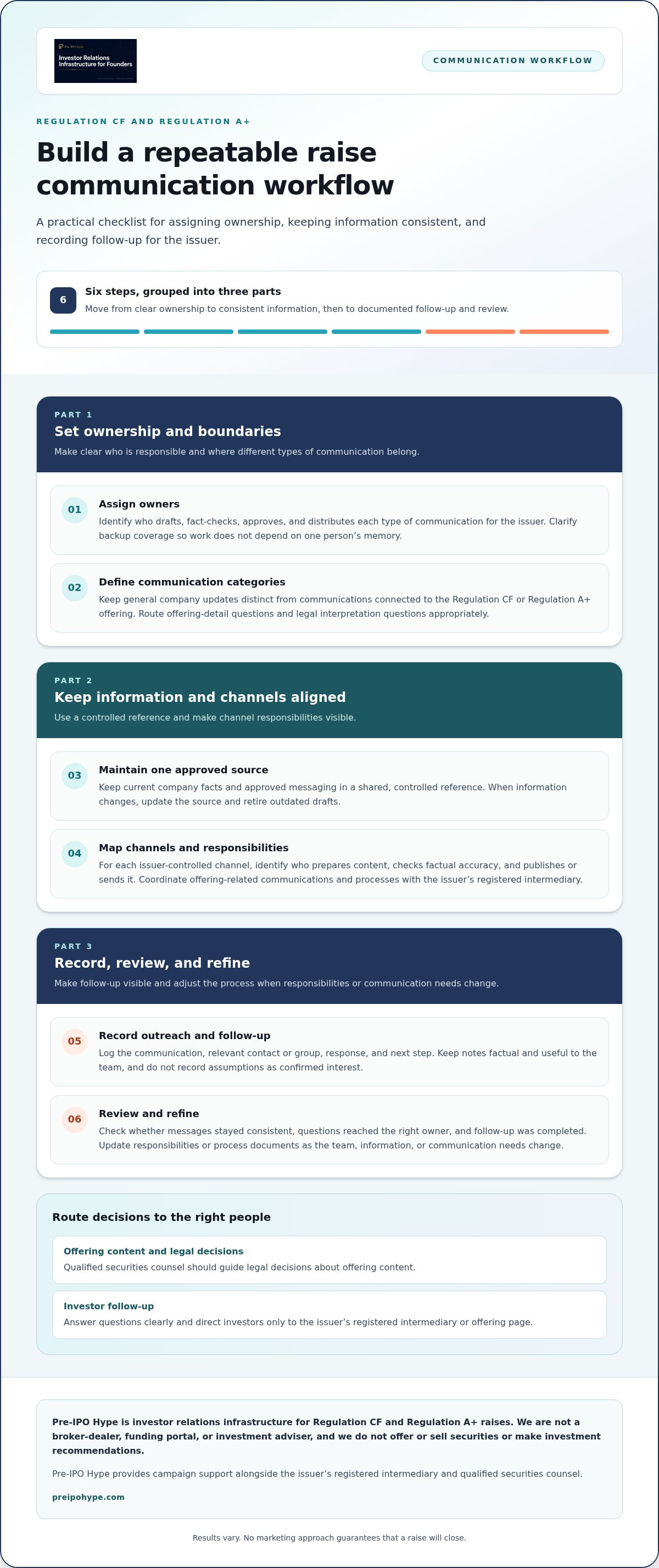
- Assign owners. Identify who drafts, fact-checks, approves, and distributes each type of communication for the issuer. Make backup coverage clear so work doesn’t depend on one person’s memory.
- Define communication categories. Separate general company updates from communications connected to the Regulation CF or Regulation A+ offering. Set a clear route for questions about offering details or legal interpretation.
- Maintain one approved source. Keep current company facts and approved messaging in a shared, controlled reference. When information changes, update the source and retire outdated drafts so people don’t reuse language that is no longer current.
- Map channels and responsibilities. For each issuer-controlled channel, identify who prepares content, who reviews factual accuracy, and who publishes or sends it. Coordinate with the issuer’s registered intermediary on offering-related communications and processes.
- Record outreach and follow-up. Log the communication, the relevant contact or group, the response, and the next step. Keep notes factual and useful to the team, and don’t record assumptions as confirmed interest.
- Review and refine. Check whether messages remained consistent, questions reached the right owner, and follow-up was completed. Update responsibilities or process documents when the team, information, or communication needs change.
Coordinate outreach and follow-up for the issuer
Follow-up should answer the person’s question clearly and direct investors only to the issuer’s registered intermediary or offering page. Set an owner and an appropriate next step, without using pressure or implying urgency that isn’t real. The National Investor Relations Institute (NIRI) offers professional resources for IR teams; its investor relations resources provide broader context for developing a disciplined function.
Tools should support agreed responsibilities, not determine who owns them. This fundraising technology stack overview provides context for considering how systems fit into a defined workflow. Start with the process, then select tools that support the issuer’s records and coordination needs. A workflow conversation is another way to think through the operating model.
How to compare investor relations operating models and tools
There’s no single operating model that fits every raise. Compare options by asking who owns the work, how continuity is maintained, how the issuer controls messaging, and how much coordination is needed with the issuer’s registered intermediary and qualified securities counsel. A useful model makes responsibilities clear without treating software or campaign support as a replacement for the issuer’s judgment.
| Operating model | Ownership | Continuity | Communication control | Coordination requirements |
|---|---|---|---|---|
| Founder-led coordination | Founder or a small team owns tasks directly. | Can depend on the availability and memory of key people. | Direct control, with consistency reliant on agreed processes. | Founder coordinates internal contributors and relevant external parties. |
| Internal IR owner | A designated employee coordinates the function. | Responsibilities can be documented and handed over internally. | Issuer retains direct oversight through its internal owner. | Requires clear input and review paths across the team. |
| Structured external campaign support | External support helps with defined campaign tasks for the issuer. | Continuity depends on documented roles, messages, and handoffs. | The issuer retains control of its communications and decisions. | Must operate alongside the issuer’s registered intermediary and qualified securities counsel. |
When founder-led coordination may be workable
Direct founder ownership may be manageable when communication volume is limited, facts are easy to keep current, and the founder can reliably coordinate drafting, review, and follow-up. Reassess the process if handoffs get missed, channels carry inconsistent messages, or questions have no clear follow-up owner. These are signs of a process gap, not automatic reasons to adopt a particular team structure.
What infrastructure can and cannot do
Tools can help organize a workflow, but they don’t determine whether offering content is legally appropriate. They aren’t a substitute for qualified securities counsel’s legal review, the registered intermediary’s role, or the issuer’s decisions. Campaign support can assist with work done for the issuer alongside the intermediary and counsel, without taking over those responsibilities or making investment recommendations.
Assess infrastructure against the work you need to coordinate. A tool should fit an agreed process for handling messages, records, and follow-up rather than create a parallel workflow. This fundraising technology stack overview can help frame how tools relate to the wider operating model. When reviewing a CRM, identify what information the team needs to organize and how it will use that information. Keep legal decisions with qualified securities counsel.
Choose the simplest model that gives each task an owner and preserves issuer control. Revisit it if responsibility becomes unclear or continuity suffers. The useful comparison is not “internal or external” in the abstract, but which allocation of work best fits the issuer’s team, communication needs, and coordination responsibilities.
How to keep fundraising communications coordinated and compliant
Clear coordination starts with separating operational planning from legal decisions. Operational planning covers who prepares company information, how messages move through the issuer’s channels, and where questions are recorded. Founders should route legal judgments about offering content to qualified securities counsel, rather than relying on a communications workflow or campaign tool to determine what is permitted.
This distinction matters for Regulation CF and Regulation A+ raises. A team can organize drafts, assign reviewers, and coordinate timing, but those steps don’t replace legal review or the registered intermediary’s role. Keep responsibilities visible so each person knows where their part ends and where another party’s expertise is needed.
Coordinate the issuer, registered intermediary, and counsel
Campaign communications should be planned and carried out for the issuer. The issuer’s team owns its company information and communication decisions. The registered intermediary has its role in the offering process, while qualified securities counsel advises on legal questions. Campaign support, where used, should operate alongside these parties, not as a substitute for them.
For each communication, document its purpose, owner, channel, and review path. A general company update and an offering-related communication may require different coordination. Make it clear who should receive questions about company facts, who coordinates with the registered intermediary, and which questions go to counsel. If a response is uncertain, pause and route the issue instead of improvising.
Keep investor directions consistent. Refer investors only to the issuer’s registered intermediary or offering page. Avoid sending them to informal materials or channels that could cause confusion about where offering information is presented.
Keep claims and promotion grounded
Use current, supportable company facts and keep approved language consistent across issuer-controlled channels. Before sending a message, check that it reflects the same underlying information as the team’s current materials. Don’t imply demand, investor interest, or progress that the issuer can’t substantiate. Accurate communication is more useful than language designed to create a particular impression.
For Regulation Crowdfunding promotion, include the compensation rule in the workflow: anyone the issuer pays to promote the offering on the platform must disclose that compensation each time under Rule 205. Route questions about how that requirement applies to a specific communication or arrangement to qualified securities counsel.
In practice, a simple review sequence can help teams stay coordinated:
- Confirm the communication’s purpose and intended audience.
- Check factual statements against the issuer’s current approved information.
- Send offering-related legal questions to qualified securities counsel.
- Coordinate offering communications with the issuer’s registered intermediary.
- Record what was sent, where it was sent, and any follow-up needed.
This approach gives founders an operating framework without treating process as legal advice. A fundraising workflow conversation can help you think through how responsibilities fit together.
How to put investor relations infrastructure into practice
Infrastructure is useful when it supports a defined workflow. It should help your team carry out its responsibilities, not blur the line between company communications, offering coordination, and legal review. Before a Regulation CF or Regulation A+ raise, make the process clear enough that each person knows what they own and where to route questions.
A practical readiness check before launch
Review the workflow from the perspective of someone who has just joined the team. Can they identify who owns communications, who approves factual information, where records are kept, and who handles follow-up? Can they find the current approved company messages without relying on an old email or draft?
Check each channel the issuer uses. Do the website, email communications, and other issuer-controlled channels draw from consistent, current information? Is there a clear handoff for offering-related questions? If ownership is unclear, resolve that before adding tools or expanding activity. Qualified securities counsel should guide legal decisions about offering content.
Put the process into operation
Keep implementation focused. Assign owners first, then document the messages and facts the team will use. Map how the issuer’s team coordinates with the registered intermediary and qualified securities counsel, and clarify how campaign support fits alongside those roles. Review the process as the raise progresses, and update responsibilities or records when the workflow changes.
This sequence gives investor relations for high-growth companies a practical foundation: responsibilities stay visible, approved information is easier to locate, and the team can identify gaps without confusing operational coordination with legal judgment. Infrastructure is one part of that system. It doesn’t replace the issuer’s team, registered intermediary, or counsel.
Where Pre-IPO Hype fits
Pre-IPO Hype is investor relations infrastructure for Regulation CF and Regulation A+ raises. We are not a broker-dealer, funding portal, or investment adviser, and we do not offer, sell or recommend securities. This article is educational only and is not legal or investment advice. Pre-IPO Hype fees are never tied to investment results.
Our Custom Investor CRM supports lead scoring and attribution tracking. Pre-IPO Hype provides campaign support alongside the issuer’s registered intermediary and qualified securities counsel. The issuer retains responsibility for its communications, while qualified securities counsel guides legal decisions.
Use a clear workflow to identify who owns each task and where coordination is needed. To discuss how responsibilities and infrastructure could fit your process, schedule a fundraising workflow conversation.
Make the workflow part of how the company grows
A raise is one stage in a company’s development, not the only moment when clear investor communication matters. Build a process your team can maintain as roles change and new milestones create information to share. Keep the workflow practical: review it when responsibilities shift, update approved materials when facts change, and involve qualified securities counsel in legal decisions.
That steady discipline gives investor relations for high-growth companies a foundation beyond a single campaign. Identify the part of your current process that needs the most clarity, whether that’s ownership, message review, coordination, or recordkeeping. Then decide what your team can manage internally and where structured support may fit alongside the issuer’s registered intermediary and counsel.
To plan the workflow for your raise, schedule a fundraising workflow conversation.
Frequently Asked Questions
What does investor relations include for a high-growth company?
For a high-growth company, investor relations can include stakeholder updates, a process for receiving investor questions, and records of information shared. For example, after a company milestone, the team can verify the underlying facts, decide who needs the update, and distinguish routine communications from offering-related materials. This gives founders a practical way to manage information without treating every message as part of a fundraising campaign.
Is investor relations only for public companies?
No. A private company can organize communications with its stakeholders and prospective investors before it becomes public. The form and purpose of those communications differ from a public company’s ongoing IR program, so founders shouldn’t assume public-market templates apply to their raise. A private company can start with a modest process, such as assigning one person to maintain current company information and coordinate responses to incoming questions.
When should a startup establish an investor relations workflow?
Establish a workflow before several people begin communicating about the company or a raise. Ask whether two team members could answer the same investor question consistently and know where to record the interaction. If not, define ownership and message review before communication expands. For a Regulation CF or Regulation A+ raise, include coordination with the issuer’s registered intermediary and qualified securities counsel in the planning process.
How should a company compare in-house investor relations with campaign support?
Compare the options by identifying who will own decisions, prepare communications, maintain records, and coordinate follow-up. In-house ownership may suit a team with capacity to manage these tasks. Campaign support can assist with work done for the issuer, alongside its registered intermediary and qualified securities counsel. In either model, the issuer retains control of its communications, and qualified counsel guides legal decisions.
Does investor relations guarantee that a fundraising campaign will close?
No. Investor relations can organize communication and help a team share accurate information, but it can’t determine whether a campaign will close. Treat the workflow as a way to manage responsibilities and maintain clear records, not as a forecast or promise of fundraising results. Review whether the team followed its communication plan and kept information consistent, rather than judging the process only by the outcome of a raise.
Who should answer legal questions about a Regulation CF or Regulation A+ raise?
Qualified securities counsel should guide legal decisions about a Regulation CF or Regulation A+ raise. Route questions about offering communications, required disclosures, or how rules apply to a particular situation to counsel rather than relying on internal messaging reviews. The team can still manage operational tasks, such as collecting factual information and tracking questions, but those steps don’t replace legal guidance.
Disclaimer
Educational only. Not investment, tax, or legal advice. Pre-IPO Hype is investor relations infrastructure for Regulation CF and Regulation A+ raises. We are not a broker-dealer, funding portal, or investment adviser, and we do not offer or sell securities or make investment recommendations. Any securities offering is made only by the issuer, through its own offering documents and, where required, a registered intermediary.

