
Reg CF vs Reg A+: Which Exemption Fits Your Raise (2026)
Why settle for a $5 million ceiling when your growth trajectory demands $75 million? In the high-stakes world of early-stage equity, the difference between a successful raise and a costly administrative nightmare often comes down to a single regulatory choice. When you ask the critical question, Reg CF vs Reg A+, you're really asking how much friction you're willing to trade for scale. It's a calculated decision that balances the immediate need for capital with the long-term cost of compliance.
We understand the pressure. You want to tap into the energy of the crowd without being buried by legal fees or the complexity of SEC filings. You've likely worried about the optics of a failed public raise or the logistics of managing a massive cap table. This article promises to help you master the strategic differences between Regulation Crowdfunding and Regulation A+ so you can select the optimal framework for your capital raise and investor acquisition strategy. We'll show you how to minimize your cost of capital while building a scalable system for long-term growth.
We'll dive into the updated February 2026 SEC guidance, the reality of audit requirements, and the infrastructure needed to turn retail interest into institutional-grade momentum. From the $5 million Reg CF limit to the $75 million Tier 2 Reg A+ powerhouse, you'll gain the insider perspective needed to choose your path with confidence.
Key Takeaways
- Identify whether your capital raise requires the high-velocity seed engine of Reg CF or the $75 million institutional-grade power of a Reg A+ "Mini-IPO."
- Evaluate your internal readiness by assessing your ability to provide two years of GAAP-audited financials, a non-negotiable requirement for Tier 2 Regulation A+.
- Use our 5-question decision matrix to settle Reg CF vs Reg A+ based on your specific growth trajectory and cost of capital goals.
- Understand why SEC qualification is only 20% of the battle and how to leverage Foundation Infrastructure to drive investor acquisition and market hype.
- Learn how Tier 2 Blue Sky exemptions can streamline your national expansion by bypassing state-by-state regulatory friction.
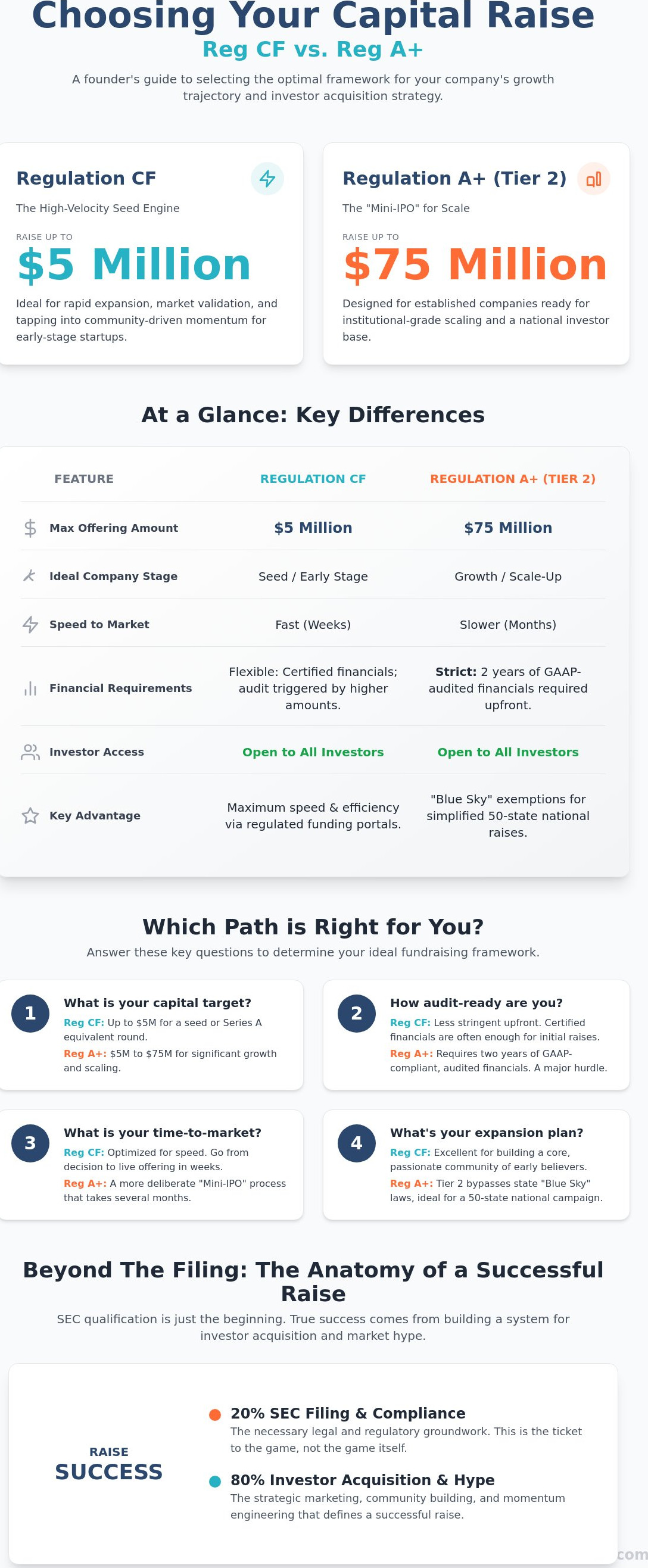
Reg CF vs Reg A+ at a Glance
Here is the short version, based on current SEC rules. Reg CF is built for smaller, faster community raises; Reg A+ is built for larger offerings that can absorb more disclosure and review.
| Factor | Reg CF | Reg A+ Tier 1 | Reg A+ Tier 2 |
|---|---|---|---|
| Max raise (12 months) | $5 million | $20 million | $75 million |
| Intermediary | Required: one SEC-registered funding portal or broker-dealer | Not required | Not required |
| SEC filing | Form C (no SEC qualification step) | Form 1-A plus SEC qualification | Form 1-A plus SEC qualification |
| Financial statements | Scale with raise size: officer-certified, CPA-reviewed, or audited | Audit not required federally (states may require one) | Two years of audited financials |
| State (Blue Sky) review | Preempted | Required in each state where you offer | Preempted |
| Non-accredited investor limits | Annual limits based on income or net worth | None | Up to 10% of the greater of annual income or net worth (unless the securities are listed) |
| Ongoing reporting | Annual report (Form C-AR) | Exit report only | Annual (1-K), semiannual (1-SA), and current (1-U) reports |
| Typical time to launch | Weeks (often 4 to 8) | Months (SEC plus state review) | Months (SEC review commonly 4 to 6) |
For a portal-level view of how Reg CF raises actually run, see our Reg CF fundraising platform guide.
The New Era of Equity Crowdfunding: Reg CF and Reg A+ in 2026
The era of the gated capital market is over. For decades, elite venture capital firms acted as the sole gatekeepers to high-growth opportunities, leaving founders to trade massive equity for early-stage survival. That dynamic has flipped. Founders are realizing that the "smart money" isn't always found in a Sand Hill Road boardroom. In 2026, the strategic question isn't just how to raise capital, but how to weaponize your cap table for market dominance.
Regulation Crowdfunding (Reg CF) has matured into the premier democratized seed round. It allows startups to bypass the traditional pitch deck circuit and go straight to the people who believe in their mission. On the other side of the spectrum, Regulation A+ acts as a "Mini-IPO" for companies that have moved past the proof-of-concept stage and are ready for institutional-grade scaling. Deciding Reg CF vs Reg A+ requires an honest assessment of your current trajectory.
Elite founders are increasingly choosing public raises because they offer something VC cannot: community-driven momentum. Instead of answering to a single board member with a conflicting exit timeline, you answer to a legion of brand ambassadors. This shift in sentiment is fueled by the realization that retail investors are often more patient and more aligned with long-term brand vision. By the time you reach a $75 million raise, you haven't just funded your company; you've built a protective moat of thousands of stakeholders.
The JOBS Act Legacy and 2026 Regulatory Updates
The evolution from the 2012 JOBS Act to the current 2026 SEC environment has been a financial revolution. Updates in February 2026 solidified these frameworks as legitimate alternatives to traditional financing. Reg CF now allows raises up to $5 million, competing directly with Series A rounds. Meanwhile, Reg A+ Tier 2 offers a $75 million ceiling. Retail capital is no longer a last resort; it's a strategic asset that builds brand loyalty while you scale. These 2026 updates provide the clarity needed for founders to move fast without the fear of compliance bottlenecks.
Accredited vs. Non-Accredited: Accessing the Full Spectrum
The true power lies in inclusivity. By tapping into both accredited and non-accredited investors, you're building a movement. Previously, 90% of the population was locked out of early-stage equity. Now, you can turn customers into shareholders. This creates a psychological advantage VCs can't replicate. A thousand retail investors become vocal advocates who drive sales and awareness. Your answer to Reg CF vs Reg A+ starts with deciding how large of a community you want to lead. It's about capturing the "Investor Hype" that turns a standard raise into a market-defining event.
Regulation Crowdfunding (Reg CF): The High-Velocity Seed Engine
Speed is the ultimate currency for an early-stage founder. If you're looking to capitalize on a sudden market trend or fuel a rapid expansion, Reg CF is your high-velocity vehicle. It's designed for efficiency, allowing you to move from a pitch deck to a live, capital-collecting offering page in a fraction of the time required for more complex filings. When evaluating Reg CF vs Reg A+, you must first look at your clock. Reg CF is the sprint that sets the pace for your entire capital strategy.
The technical backbone of this raise is the Form C filing. Unlike the exhaustive registration statements required for traditional public offerings, the Form C is a streamlined disclosure document filed with the SEC. A critical component of this process is the mandatory use of a registered funding portal. These platforms act as the digital town square where your offering lives, providing the infrastructure for Regulation Crowdfunding (Reg CF) compliance and investor management. Under the 2026 SEC guidance, these portals have more operational clarity than ever, ensuring a smoother experience for both the issuer and the retail investor.
Audit triggers are where many founders get tripped up. For raises below certain thresholds, you may only need financial statements certified by your CEO or reviewed by a CPA. However, as you approach the $5 million limit, the SEC requirements tighten. It is vital to remember that if your offering extends more than 120 days beyond your fiscal year-end, you'll need to file updated financial statements. This regulation keeps the market transparent but requires a disciplined "sprint" mindset. You aren't just raising money; you're managing a 90-day high-intensity campaign that demands absolute focus.
Launch Speed and Cost Efficiency
Expect a typical timeline of 4 to 8 weeks from discovery to "live" status. This speed is unmatched in the world of equity finance. The legal and accounting costs are significantly lower than larger raises, making it the ideal profile for pre-seed to early Series A companies with an active, engaged community. It's about getting the capital you need now without the six-month drag of a traditional institutional round.
The Marketing Constraints of Reg CF
While you can "test the waters" to gauge interest, the SEC maintains strict rules about how you advertise the specific terms of your raise outside of the funding portal. You can talk about the vision, but the technical details of the investment must be handled with precision. This is why specialized Reg CF marketing services are essential. They help you bypass these friction points by engineering hype within the boundaries of compliance. If you're unsure how to balance these rules while maintaining momentum, let's discuss your specific timeline to see if a sprint is your best move.
Regulation A+: The Mini-IPO for Scalable Dominance
If Reg CF is the high-velocity sprint, Regulation A+ is the endurance race designed for market dominance. For companies that have moved past the initial proof-of-concept and are eyeing a $10M+ valuation, Tier 2 of Regulation A (Reg A+) has become the definitive vehicle for institutional-grade scaling. The 2026 limit of $75 million in a 12-month period has completely redefined what a "mini-IPO" can achieve. It offers a level of capital depth that was previously reserved for traditional public markets, allowing you to fund massive expansion without the immediate pressure of a NASDAQ listing.
One of the most significant advantages of a Tier 2 offering is the Blue Sky exemption. SEC qualification at the federal level preempts the need for state-by-state filings, removing a massive layer of regulatory friction and legal expense. However, this freedom comes with a higher entry price. You must prepare for a rigorous two-year financial lookback featuring GAAP-compliant audits. This isn't just a paperwork exercise; it's a signal to the market that your company possesses the operational maturity to handle significant public interest. When weighing Reg CF vs Reg A+, you have to decide if you're ready for that level of transparency and scrutiny.
This regulation demands a "marathon" mindset. Unlike the 90-day window often seen in crowdfunding, a Reg A+ offering can act as a perpetual fundraising machine, staying open for up to a year and being renewed annually. It allows you to build a steady pulse of capital that grows alongside your milestones.
SEC Qualification: The Marathon to "Qualified" Status
The path to a live Reg A+ offering starts with the Form 1-A filing. Expect a 4 to 6 month SEC review period as regulators scrutinize your business model and financials. Once qualified, you'll face ongoing reporting requirements, including annual (1-K) and semi-annual (1-SA) filings. While this sounds daunting, the prestige of being "SEC Qualified" signals institutional readiness to every investor who sees your page. It separates the serious contenders from the noise.
Unrestricted Marketing and Scaling Potential
The marketing freedom in Reg A+ is a game changer. Unlike Reg CF, you have much broader latitude to "Test the Waters" and promote your offering across diverse channels. You can leverage sophisticated digital marketing and advertising strategies to drive both retail and institutional interest simultaneously. This is the preferred vehicle for companies that need to reach a national audience to justify a high valuation. When asking Reg CF vs Reg A+, consider if your growth requires the unrestricted reach that only a mini-IPO provides.
Decision Matrix: 5 Questions to Determine Your Path
Choosing your regulatory framework isn't just about the dollar amount; it's about the infrastructure of your future. To answer Reg CF vs Reg A+, you must look past the immediate check and analyze your operational capacity. Capital is a commodity, but timing and compliance are strategic weapons. Use these five questions to pressure-test your readiness before committing to a filing.
- What is your immediate capital requirement? Is this a $2 million bridge to reach a specific milestone, or a $20 million expansion aimed at market dominance?
- Are your financials ready for the spotlight? Do you have two years of GAAP-compliant audits prepared, or are you still operating on cash-basis accounting?
- What does your investor profile look like? Does your brand have the viral consumer appeal to activate a massive retail base, or is this a niche B2B play requiring targeted institutional outreach?
- What is your setup budget? Can you comfortably absorb the $100,000+ legal and accounting costs associated with a "Mini-IPO," or do you need a leaner entry point?
- What is your horizon? Do you need liquidity in 60 days to survive, or can you wait 6 months to qualify a larger, more prestigious round?
The Accounting Trigger: Audit vs. Review
The "Accounting Trigger" is the primary cost-driver in choosing between Reg CF and Reg A+. For Regulation A+ Tier 2, a full two-year audit is a non-negotiable entry requirement regardless of your raise size. In contrast, Reg CF allows for CPA-reviewed financials for many mid-tier raises, significantly lowering the barrier to entry for early-stage teams. Strategically timing your raise to coincide with your fiscal year-end can minimize these expenses, but you must be prepared for the transparency that institutional-grade capital demands.
Investor Management and the "Shadow Cap Table"
Many founders fear that thousand-person cap tables will scare off future venture capital. This "Shadow Cap Table" concern is easily solved through the use of Special Purpose Vehicles (SPVs) in Reg CF, which aggregate small investors into a single line item. To maintain control and drive future realization events, you need high-fidelity data. Implementing a custom investor CRM allows you to score leads and track attribution with precision, turning a management headache into a powerful marketing engine. If you're ready to build this infrastructure, book a strategy session to map out your technical stack and investor acquisition plan.
When to Graduate from Reg CF to Reg A+
Many companies don't treat Reg CF vs Reg A+ as a one-time choice. A common sequence is to run a Reg CF round first, prove demand with a real investor community, and then step up to Reg A+ when the business outgrows the $5 million rolling cap. Signals that it may be time to graduate:
- You're bumping into the cap. Your next 12-month capital plan clearly exceeds $5 million.
- Your financials are audit-ready. You can produce two years of audited statements, or budget for them, as Tier 2 requires.
- Your Reg CF investors are engaged. A responsive shareholder base from your first round becomes the warm audience for a larger offering.
- You can carry ongoing reporting. Your team can handle 1-K, 1-SA, and 1-U filings after qualification.
- You need national reach. Tier 2's state preemption and broader marketing latitude fit a nationwide campaign.
Sequencing matters. Offerings that run close together can raise SEC integration questions, so work with securities counsel on timing before you file a Form 1-A. If you're still choosing a portal for round one, compare options in our guide to the best Reg CF portals in 2026. And if you're weighing crowd capital against a traditional round altogether, read equity crowdfunding vs VC: how to raise without venture capital.
Beyond the Filing: Engineering Your Raise with Pre-IPO Hype
The SEC qualification is just your ticket to the stadium. It isn't the game itself. Many founders spend months obsessed with legal compliance only to launch to the sound of digital crickets. In the 2026 capital markets, regulation represents only 20% of your success. The other 80% is pure engineering. Deciding Reg CF vs Reg A+ is a technical necessity, but building the hype cycle is what actually puts capital in the bank.
Success requires a bridge between institutional authority and retail energy. You need to present the stability of a "Mini-IPO" while capturing the infectious momentum of a ground-floor opportunity. This is where Foundation Infrastructure becomes your most valuable asset. It transforms passive curiosity into committed capital by creating a seamless, high-trust environment for every potential stakeholder. Without this layer, you're just another company with an open round and no audience. You need to move investors from "curious" to "capital" using a relentless omnichannel outreach strategy.
The Fundraising Tech Stack
Data-driven raises live or die by their attribution. You cannot afford to guess which ad channel is driving your high-net-worth leads. Utilizing Foundation Infrastructure allows you to implement 60-day attribution tracking, preventing the wasted spend that plagues unoptimized campaigns. By scoring leads within your retail pool, you can identify the "institutional whales" who are watching your progress before they write a significant check. This level of precision is what separates a $5 million Reg CF sprint from a failed attempt. It's about owning the data so you can own the market.
Strategic Advisory for Elite Founders
We act as the informed insider for founders who refuse to leave their funding to chance. The 2026 market is faster and more competitive than ever. If you want a direct assessment of your current raise potential or need to architect a strategy that spans from $5 million to $75 million, you can Ask the CEO for a calculated perspective. Don't let your regulatory choice be the bottleneck of your ambition. Whether you are leaning toward a seed-stage sprint or a dominant market expansion, the right system makes the difference. Book a strategy session today to architect your investor acquisition system and secure the capital your growth demands.
Dominate the Capital Markets of 2026
The decision between a high-velocity seed engine and a scalable mini-IPO isn't just about the dollar amount; it's about the long-term architecture of your cap table. Whether you choose the $5 million limit of Reg CF or the $75 million powerhouse of Reg A+ Tier 2, your success depends on the infrastructure you build today. The 2026 SEC updates have leveled the playing field, making retail capital a strategic asset for those who move with precision and authority.
Deciding Reg CF vs Reg A+ is the first step toward institutional-grade momentum. We combine omnichannel outreach with a Custom Investor CRM that features high-fidelity 60-day attribution tracking. We don't just help you file; we help you win by engineering the hype cycle that converts passive curiosity into committed capital. The gated world of elite finance is officially open.
Ready to engineer your capital raise? Book a 30-minute strategy session with our team to architect your growth trajectory. It's time to claim your place in the market and build the future your company deserves.
Frequently Asked Questions
Can I switch from Reg CF to Reg A+ mid-raise?
You can't simply "flip a switch" to change regulations while your round is live. They are distinct legal frameworks with different filing requirements. To move from one to the other, you'd typically close your Reg CF and begin the 4 to 6 month qualification process for a Reg A+ offering. Many elite founders use a successful Reg CF as a "proof of concept" to build the momentum needed for a larger $75 million Tier 2 raise later.
How much does it cost to launch a Reg CF campaign in 2026?
Budgeting for a Reg CF involves legal fees for the Form C filing and CPA reviews of your financial statements. While the setup is leaner than a full mini-IPO, you shouldn't underfund your marketing efforts. It's often the most cost-effective way to answer Reg CF vs Reg A+ while testing market demand with a $5 million ceiling. Prioritizing your investor acquisition budget is what prevents a "failed" public raise.
What is the "Testing the Waters" rule for Reg A+?
This rule is a strategic gift that allows you to gauge market interest before your offering is officially qualified by the SEC. You can solicit non-binding indications of interest to see if your audience is ready to write checks. It's a powerful way to build "Investor Hype" and ensure your $75 million target is realistic before you commit to the heavy costs of a two-year GAAP audit.
Do I need a broker-dealer for a Reg A+ offering?
You aren't strictly mandated to use a broker-dealer for a Tier 2 direct offering, but they add a layer of institutional credibility. They can help navigate state-level complexities and provide access to specialized investor networks. Most dominant raises use a blend of direct-to-consumer digital marketing and broker-dealer support to maximize their reach and ensure a successful realization event.
How long does an SEC qualification for Reg A+ typically take?
Expect the qualification process to take 4 to 6 months from your initial Form 1-A filing. This window includes the back-and-forth of the SEC comment period where regulators scrutinize your business model and financial disclosures. It’s a marathon that requires a steady pulse of content and community engagement to keep your "curious" investors from losing interest before the round officially opens.
Are Reg CF investors considered "accredited" by default?
No, the primary advantage of Reg CF is that it opens the door to non-accredited retail investors. While accredited individuals can certainly participate, the framework was designed to democratize access to the 90% of the population previously locked out of early-stage equity. This allows you to turn your most loyal customers into shareholders, creating a moat of brand ambassadors that traditional VC cannot replicate.
What happens if I don’t reach my minimum funding goal in a Reg CF?
If you fail to hit your target, all committed funds are returned to the investors, and you walk away with zero capital. This all-or-nothing model is why engineering your raise is so critical. It’s also why choosing Reg CF vs Reg A+ requires a deep look at your existing community and your ability to drive high-velocity interest from day one.
How does a Custom Investor CRM help with SEC compliance and reporting?
A Custom Investor CRM centralizes your data for mandatory annual filings like the Form C-AR or the 1-K. It tracks every investor touchpoint and provides the 60-day attribution needed to prove your marketing is compliant and effective. By organizing thousands of retail leads into a single high-fidelity system, you turn a reporting headache into a scalable asset for future raises.
Disclaimer
Educational only. Not investment, tax, or legal advice. Pre-IPO Hype is investor relations infrastructure for Regulation CF and Regulation A+ raises. We are not a broker-dealer, funding portal, or investment adviser, and we do not offer or sell securities or make investment recommendations. Any securities offering is made only by the issuer, through its own offering documents and, where required, a registered intermediary.


